
A marker weighs your sources before your argument, and synonyms for evidence set that weight. Overclaim here and the whole point falls with it.
Evidence flattens the scale. A dataset and a single quoted anecdote both arrive under the same word, and only one survives a challenge.
Hard sources can be produced and checked by somebody else, and a dataset is the plain case. Softer sources point one way and stop there, and naming which you have is half the honesty of a paper.
Evidence Synonyms for Documented Proof and for Indications
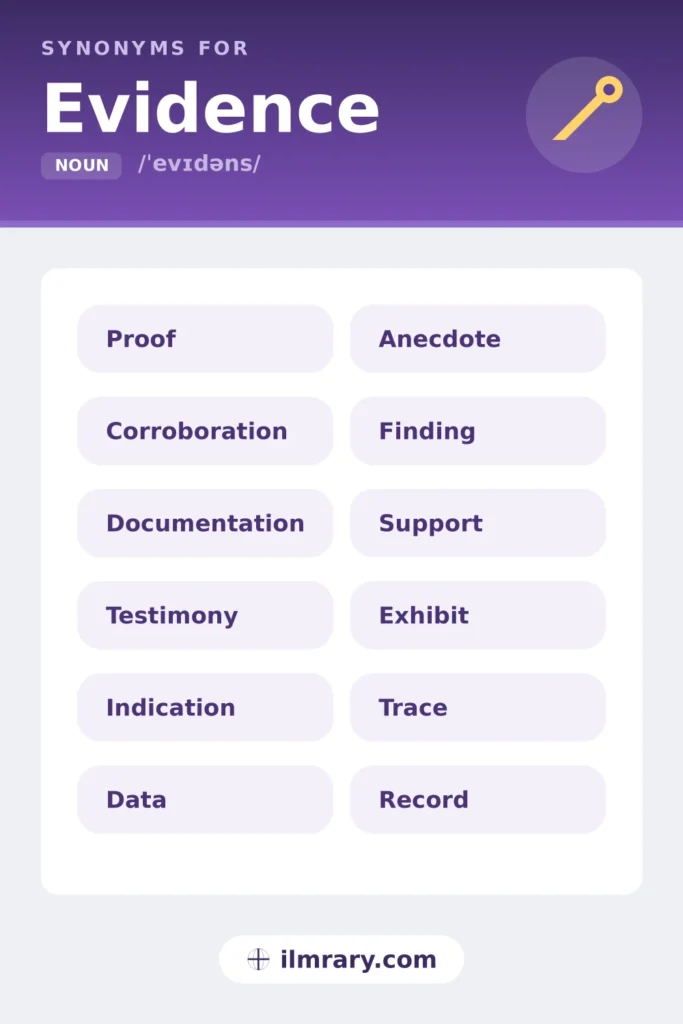
Words for Evidence That Reaches a Long Way
Strong evidence closes off alternatives. Its strength usually comes from independence, since two sources that share an origin add far less than they appear to.
Proof
Academic writing
Meaning
Something that settles a claim beyond reasonable doubt.
When to use it
It belongs to logic and mathematics, and empirical disciplines avoid it deliberately. Claiming proof for a statistical result is the clearest overreach available.
- The parish records amount to proof of residence and to nothing about occupation.
- Proof was never the standard and the coverage reported it as though it were.
Corroboration
Academic writing
Meaning
Independent support for an account.
When to use it
Shared with the demonstrate family, where independence is the essential condition. Two sources from one origin corroborate nothing at all.
- The shipping records corroborate a departure date the diary gives only vaguely.
- Corroboration came from a source neither party had known existed.
Documentation
Academic writing
Meaning
Written records made at the time.
When to use it
Contemporaneity and purpose both matter, since a record kept for one reason answers a different question badly. Its weakness is what was never written down.
- Documentation survives from 1911 and stops abruptly in 1938.
- The documentation was complete and recorded only what the form asked for.
Data
Academic writing
Meaning
Systematically collected information.
When to use it
Collection method is where its authority comes from, which is why the phrase the data shows conceals more than it reveals. It is plural in formal usage and singular almost everywhere.
- The data cover four years and the definition changed in the third.
- Data were collected for a purpose that has nothing to do with the question being asked.
Finding
Academic writing
Meaning
Something an investigation established.
When to use it
Shared with the insight family, where a method stands behind it. A finding is evidence that has already been processed rather than raw material.
- The finding held across every subgroup except the smallest.
- Findings were accepted in full and the recommendations were not.
Exhibit
Everyday
Meaning
An item formally produced as evidence.
When to use it
Legal usage fixes it, where an exhibit is numbered and admitted. It names the status of a thing in a process rather than its persuasive force.
- The exhibit was a single page and it decided the whole hearing.
- Every exhibit was disclosed and two of them contradicted the statement.
Record
Academic writing
Meaning
Something set down so it can be referred to.
When to use it
Shared with the note family, where permanence is the claim. Administrative records are the largest underused evidential source in most fields.
- The records survive from 1911 and nobody had read them as data.
- Records were complete and the coding practice changed twice within them.
Words for Evidence That Only Points
Weaker evidence raises or lowers likelihood without settling anything. Naming it honestly is what stops a reader discounting the stronger material alongside it.
Indication
Academic writing
Meaning
A sign pointing toward a conclusion.
When to use it
It claims direction and nothing more, which makes it the honest word when the mechanism is unknown. Its modesty protects the argument around it.
- There are indications of a change in practice and no measure of one.
- Every indication pointed the same way and none of them was decisive.
Testimony
Academic writing
Meaning
An account given by somebody who was there.
When to use it
Its reliability is a property of the person and the circumstances rather than the content, which is why courts examine both. Memory degrades and interest distorts.
- Testimony from four witnesses agreed on the sequence and differed on the timing.
- The testimony was honest and forty years old.
Circumstantial evidence
Academic writing
Meaning
Evidence requiring an inference to reach the conclusion.
When to use it
It is routinely dismissed in speech and routinely decisive in practice, since most convictions rest on it. The inference is where it can be attacked.
- The case was circumstantial and none of the alternatives survived examination.
- Circumstantial evidence accumulated until no other account remained.
Anecdote
General writing
Meaning
A single story offered as illustration.
When to use it
Shared with the observation family, where selection after the fact is admitted. Its power is memory rather than proof, which cuts both ways.
- The anecdote circulated for years and the figures never supported it.
- An anecdote that opened the report was the only part anybody quoted.
Support
Academic writing
Meaning
Information making a claim more likely without settling it.
When to use it
Shared with the demonstrate family, where its modesty is why journals prefer it to proof. It leaves room for a later study to complicate the finding.
- The results support the hypothesis for urban districts and not for rural ones.
- Three lines of evidence support the reading and none is decisive alone.
Trace
Academic writing
Meaning
A physical remnant left by something that happened.
When to use it
Archaeology and forensics fix the sense, where a trace was left without anybody intending to record anything. That absence of intent is exactly what makes it valuable.
- Traces of the earlier boundary survive in the field pattern.
- The trace was unintentional, which is why nobody had thought to remove it.
How to Choose the Right Synonym for Evidence
Name the kind and its reach. Strong evidence closes alternatives, and independence is usually where the strength comes from, so corroboration requires sources with separate origins and two documents from one office corroborate nothing. Documentation carries contemporaneity and a purpose, which means a record kept for one reason answers a different question badly. Proof belongs to logic and empirical work avoids it deliberately. Weaker evidence points without settling, and naming it honestly protects the stronger material beside it, so an indication claims direction alone, testimony depends on the person rather than the content, and circumstantial evidence is dismissed in speech and decisive in practice. A trace is valuable precisely because nobody intended to leave it.
What kind and how far are the two questions: corroboration or documentation where alternatives close, indication or testimony where the reach is honestly shorter.
Opposite Words for Evidence
- Speculation
- Assertion
- Rumour
- Assumption
- Absence of proof
Test Your Word Choice
Question 1: Two documents from the same office agree. What does that provide?
Corroboration requires independent origins, so shared provenance adds no separate support. Proof belongs to logic rather than to records at all.
Question 2: Which is dismissed in speech and decisive in practice?
Most convictions rest on evidence requiring an inference, despite the phrase being used dismissively. Anecdote is selected after the fact and testimony depends on a person's reliability.
Question 3: Why is an unintentional trace valuable?
A trace was left without anybody intending to record anything, so it escapes the selection that shapes deliberate records. Age and physicality matter less than the absence of intent.
Evidence Synonyms: Questions Examiners Ask
What can I write instead of the evidence shows?
Naming the kind does what the evidence shows cannot: the records show, testimony agrees, corroboration comes from an independent source, or the data indicate. Each version tells a reader where the support originated, which decides how far the claim reaches.
Why do empirical fields avoid the word proof?
Empirical fields avoid proof because evidence makes a conclusion more or less likely rather than settling it. Proof belongs to logic and mathematics, where a result follows from the premises with nothing left over. Claiming it for a statistical finding is the most visible form of overreach.
What weakens documentation as evidence?
Documentation is weakened by what nobody wrote down. A complete record kept for one purpose answers that purpose well and any other question badly, which is the standard archival problem. Say what the record was for before you ask it to support a claim it never anticipated.
How should I treat old testimony as evidence?
Treat old testimony as evidence about a person's memory as well as about the event. Recollection reorders and fills gaps without the speaker noticing, so an account can be entirely honest and forty years old at once. Saying both things is what lets a reader weigh it.