
Every essay has to name what an author took for granted, and another word for assumption is how you do it.
Assumption is too blunt for the job. It covers a starting point somebody declared and a belief they never noticed holding.
A premise set out in the open is one kind. A belief nobody declared is quite another, and the second kind is where the sharpest criticism in a paper starts.
Assumption Synonyms for Premises and for Beliefs Nobody Declared
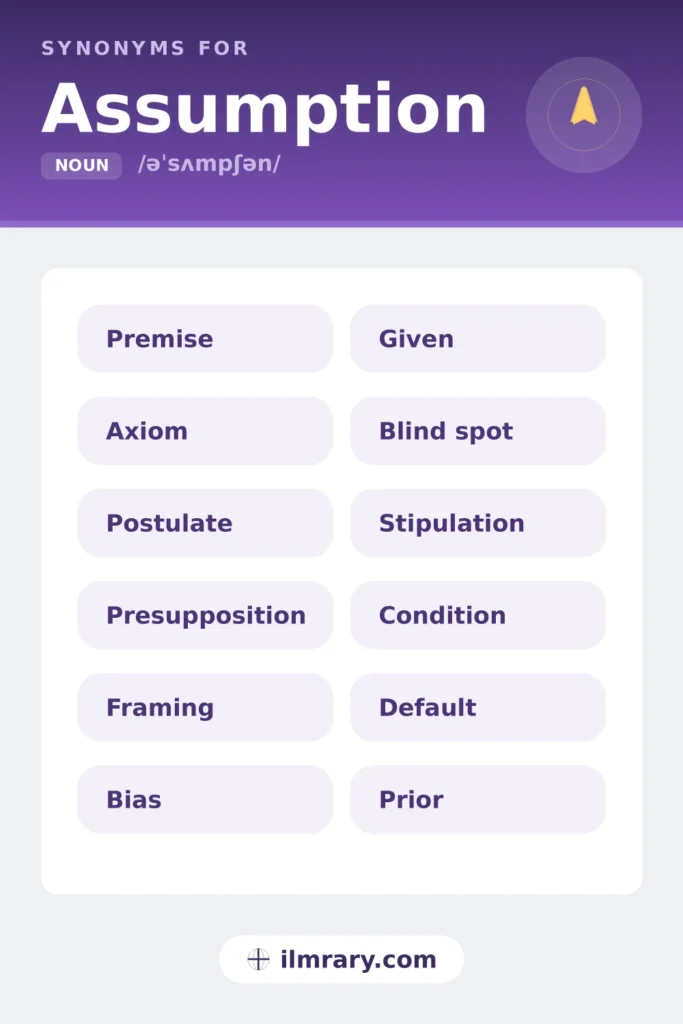
Words for Assumptions Stated Openly
Declared starting points are visible and therefore arguable. Naming them is normal scholarly practice rather than a criticism of the author.
Premise
Academic writing
Meaning
A stated proposition an argument is built on.
When to use it
Logic fixes the sense, where premises are the sentences a conclusion follows from. Attacking a premise is a legitimate and clean move that attacking a conclusion rarely is.
- The argument is valid and the second premise is false.
- Both papers share a premise that the field abandoned in the nineties.
Axiom
Academic writing
Meaning
A starting point accepted without proof.
When to use it
Mathematics uses it precisely and other fields borrow it loosely for anything treated as beyond question. Its strict sense means proof was never expected.
- Change one axiom and a different geometry follows.
- Treating growth as an axiom is what the whole critique attacks.
Postulate
Academic writing
Meaning
Something proposed as true for the purposes of the argument.
When to use it
Weaker than an axiom and stronger than a guess, and it invites the reader to grant it provisionally. Physics and formal reasoning use it most.
- The postulate holds at low velocities and breaks down above them.
- Two postulates carry the entire derivation.
Given
Academic writing
Meaning
Something the argument treats as already settled.
When to use it
It is the plainest word available and it names what a reader is being asked to accept before anything else happens. Taking something as given is a choice worth flagging.
- Taken as given, the funding formula makes the conclusion inevitable.
- The givens do more work in this model than any of its findings.
Stipulation
Academic writing
Meaning
A definition or condition laid down for the argument.
When to use it
The author sets it rather than discovering it, which is why stipulating a definition is legitimate and stipulating a fact is not. Philosophy holds the distinction firmly.
- By stipulation, skilled means anything above the second tier.
- The stipulation is reasonable and quietly settles half the question.
Condition
Academic writing
Meaning
A requirement that must hold for a claim to apply.
When to use it
It bounds the claim rather than founding it, which is a different job from a premise. Boundary conditions are where most disputes about generalisation live.
- The result holds under conditions the study never observed.
- Every condition was stated and two of them were never met in practice.
Prior
Academic writing
Meaning
A belief held before the evidence is considered.
When to use it
Bayesian statistics gave it a technical sense that has spread into ordinary academic speech. It names the starting belief that the evidence then updates.
- The conclusion depends almost entirely on the prior rather than the data.
- Two analysts with different priors read the same evidence in opposite directions.
Words for Assumptions Nobody Declared
Buried assumptions are where the interesting criticism lives, because the author usually did not know they were making one. Identifying them is the analytical move words reward most.
Presupposition
Academic writing
Meaning
Something a statement takes for granted in order to make sense.
When to use it
It survives negation, which is the technical test, since asking whether somebody stopped doing something presupposes they were doing it either way. Linguistics holds the strict sense.
- The question presupposes a decline that the data do not show.
- Presuppositions in the survey wording shaped every answer that followed.
Implicit assumption
Academic writing
Meaning
Something relied on without ever being stated.
When to use it
The plainest phrase for the buried kind, and naming it is the whole contribution. It accuses nobody of dishonesty, only of not noticing.
- An implicit assumption of geographic stability runs through the whole model.
- The implicit assumption was that everybody had a bank account.
Bias
Academic writing
Meaning
A systematic tendency that pushes results in one direction.
When to use it
Statistics uses it for a measurable property of a method and everyday speech uses it for prejudice, and the two get confused constantly. Naming the mechanism keeps it technical.
- Selection bias explains the whole difference between the two cohorts.
- The bias was in the sampling frame rather than in anybody's intentions.
Blind spot
General writing
Meaning
A whole area a person or a field fails to see.
When to use it
It claims something larger than an assumption, since a blind spot covers a category rather than a proposition. Slightly informal and forceful as criticism.
- The literature has a blind spot about unpaid work that the study inherits.
- A blind spot rather than a mistake, which makes it harder to correct.
Framing
Academic writing
Meaning
The way a question is set up, which shapes the answers available.
When to use it
It operates before the argument starts, which is why framing criticism cannot be answered inside the original terms. Policy and media analysis rely on it.
- The framing made cost the only variable anybody discussed.
- Reframing the question as access rather than eligibility changed the whole debate.
Default
General writing
Meaning
What is assumed when nobody decides otherwise.
When to use it
It names an assumption built into a system rather than an argument, which is why design and policy work care about it so much. Nobody chooses a default and everybody lives with it.
- The default was full-time and every form after it followed.
- Changing the default did more than three years of encouragement.
How to Choose the Right Synonym for Assumption
Say whether the author knew. Declared starting points are legitimate and arguable, so a premise can be attacked cleanly, an axiom claims proof was never expected, a stipulation sets a definition rather than a fact, and a condition bounds a claim rather than founding it. Prior names the belief the evidence is meant to update. Undeclared assumptions are where criticism has force, since a presupposition survives negation and is built into how a question is asked, an implicit assumption accuses nobody of dishonesty, framing operates before the argument starts and cannot be answered in its own terms, and a default is an assumption built into a system nobody chose. Assumption covers both kinds and identifies neither.
The sentence that works names the assumption and its owner: premise or stipulation where it was declared, presupposition or framing where it shaped the question before anybody argued.
Opposite Words for Assumption
- Evidence
- Finding
- Demonstration
- Observation
- Conclusion
Test Your Word Choice
Question 1: Which kind of assumption survives negation?
Asking whether somebody stopped doing something presupposes they were doing it whether the answer is yes or no. Premises and postulates are stated propositions the argument can drop.
Question 2: Which criticism cannot be answered inside the original terms?
Framing sets up which answers are available before any argument begins. Bias is a measurable tendency in a method and a condition bounds a claim within the existing terms.
Question 3: Which is legitimate to set and illegitimate to invent?
Stipulating a definition for the purposes of an argument is normal practice. Stipulating a fact is not, and a prior is a starting belief the evidence then updates.
Assumption Synonyms: Questions Examiners Ask
How do I criticise an assumption in an essay?
To criticise an assumption in an essay, name it and say who owns it. An implicit assumption of geographic stability, or a presupposition built into the survey wording, gives the author something to answer. Accusing a text of making assumptions gives them nothing to answer at all.
What is the difference between a premise and a presupposition?
A premise is stated and can be withdrawn, while a presupposition is built into how something is expressed and survives even when the statement is negated. Asking when a policy failed presupposes the failure whichever answer arrives, and attacking that buried layer is the sharper critical move.
Is bias a technical word or an everyday one?
Bias works as both a technical word and an everyday one, and the overlap causes real trouble in essays. In statistics it names a measurable property of a method with no reference to anyone's intent, so writing that the sampling frame biases the estimate stops a reader hearing an accusation.
Why do defaults deserve a word of their own?
Defaults deserve a word of their own because nobody chooses them and everybody works inside them. A form that assumes full-time working shapes years of data without anyone once arguing for the assumption, which is exactly the sort of thing an essay is well placed to expose.