
Setting a question up decides what an answer can be, and other ways to say frame do that work. The setup carries as much weight as the answer.
Framed says a choice was made and hides the choice. Every framing rules something out, and a marker reads for what got left outside.
The first frame sets the terms a paper works with. Later reframing moves them once an argument has run, and naming which you mean keeps the reading honest.
Frame Synonyms for Setting a Question Up and for Recasting It
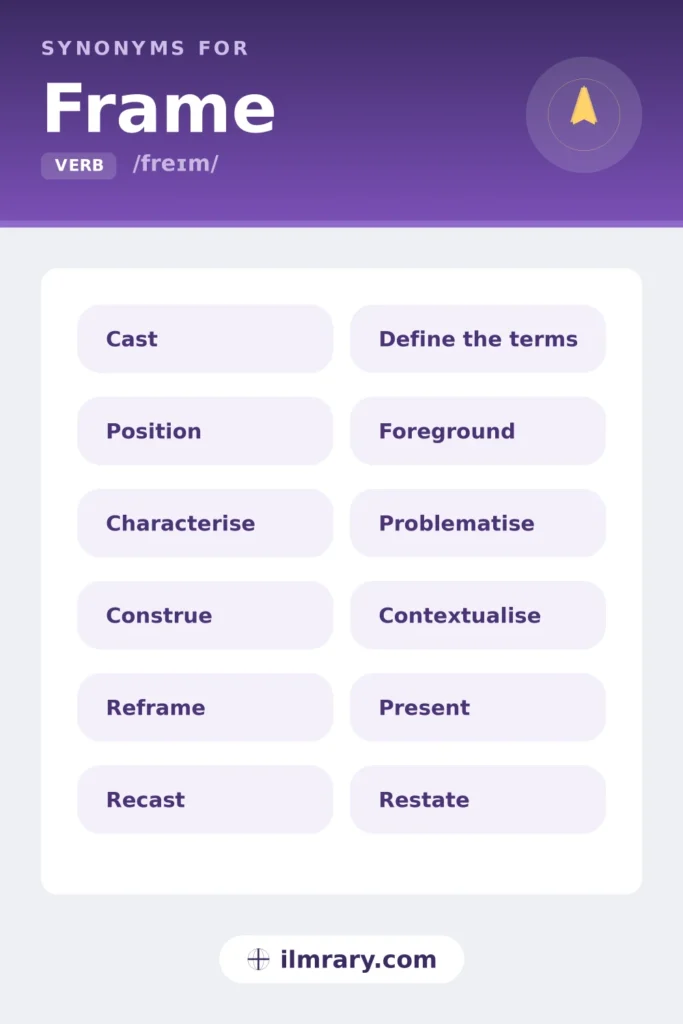
Where Frame Means Setting Up the Question
Setup words operate before the argument. Naming one is often the sharpest criticism available, because it reaches the decision everybody else accepted without noticing.
Cast
Academic writing
Meaning
To present something as being of a particular kind.
When to use it
It claims a category was chosen, which invites the question of what other category was available. Historical and media analysis use it precisely.
- The dispute was cast as a technical matter and settled by lawyers.
- Casting the shortage as a recruitment problem ruled out every retention answer.
Position
Academic writing
Meaning
To place something relative to what else is available.
When to use it
Shared with the strategy family, where rivals are assumed. Applied to an argument it claims a place on a map somebody else drew.
- The paper positions itself against a literature it cites twice.
- Positioning the reform as modernisation made opposition sound nostalgic.
Define the terms
Academic writing
Meaning
To fix what the words in a question mean.
When to use it
This is where most framing actually happens, since whoever settles the definitions has usually settled the answer. Shared with the define family for the same reason.
- Defining skilled as anything above the second tier settled half the question.
- The terms were defined by the department that would be assessed against them.
Characterise
Academic writing
Meaning
To describe something as having a particular nature.
When to use it
Shared with the represent family, where the description belongs to the describer. Reporting how a source characterised something keeps the attribution visible.
- The report characterises the delay as administrative rather than political.
- Characterising the period as stable ignores two currency crises.
Construe
Academic writing
Meaning
To interpret how a term or a text should be read.
When to use it
Shared with the define family, where legal usage decides cases. It claims a reading among possible readings rather than a fixed meaning.
- The clause was construed narrowly and the appeal turned on that alone.
- Construing the phrase as directory rather than mandatory changed the outcome.
Present
General writing
Meaning
To set something before an audience in a particular way.
When to use it
Shared with the present family, where it claims delivery rather than persuasion. In framing terms it is the neutral word for how something was put.
- The chapter presents three explanations and endorses none of them.
- Presented as a choice between two options that were never the only two.
Pose
Academic writing
Meaning
To put a question in a particular form.
When to use it
The form is the whole content, since a question posed one way makes certain answers unsayable. Posing a different question is often the entire contribution of a paper.
- Posing it as a question about access rather than eligibility changed the whole debate.
- The question was posed in terms that made the obvious answer impossible to state.
Words for Changing How Something Is Seen
Reframing words move an argument onto different ground. They are the strongest available response to a framing that cannot be answered in its own terms.
Reframe
Academic writing
Meaning
To set a question up differently so other answers become available.
When to use it
It is the only real response to a framing you cannot argue inside, which is why policy and negotiation reach for it. Naming both framings is what makes it visible.
- Reframing the question as capacity rather than demand made the funding case obvious.
- Reframing took one paragraph and changed what the committee thought it was deciding.
Recast
Academic writing
Meaning
To present something as a different kind of thing.
When to use it
It claims a category change rather than a new reading, which is a larger move. Historiography uses it for revisions that reclassify rather than reinterpret.
- The book recasts a religious dispute as a quarrel about property.
- Recasting the failure as a design problem stopped the search for somebody to blame.
Foreground
Academic writing
Meaning
To move something into the reader's immediate view.
When to use it
Shared with the emphasize family, where rearrangement rather than volume is the claim. It changes what a text appears to be about without changing a word of it.
- The revised edition foregrounds labour where the original foregrounded land.
- Foregrounding the narrator's silence changes the whole reading.
Problematise
Academic writing
Meaning
To treat as questionable something taken for granted.
When to use it
Critical theory made it standard and general readers find it jargon, so the audience decides whether to use it. The operation it names is genuinely worth having.
- The chapter problematises the category rather than applying it.
- Problematising the measure was more productive than improving it.
Contextualise
Academic writing
Meaning
To place something among the conditions that shaped it.
When to use it
Shared with the context family, where the risk is explaining nothing at length. Naming which conditions mattered is what separates it from decoration.
- Contextualising the figure against the funding change explained the whole jump.
- Contextualised at length and never compared with anything.
Restate
Academic writing
Meaning
To say something again in sharper or different words.
When to use it
Shared with the summarise family, where no compression or combination is claimed. Restating an objection in the author's own terms is what makes it answerable.
- Restating the objection in the author's own terms made it answerable.
- The restatement reads sharper than the original and changes nothing.
Which Frame Synonym Fits Your Evidence
Locate where the question was decided. Setup verbs operate before any argument, and defining the terms is where most framing actually happens, since whoever settles the definitions has usually settled the answer. Cast claims a category was chosen and invites the question of which others were available, and pose treats the form of the question as its content, which is why posing a different one is often a paper's entire contribution. Reframing verbs move the argument onto other ground, which is the only real response to a framing you cannot argue inside. Recast claims a category change rather than a new reading, and foreground changes what a text appears to be about without altering a word of it. Frame names the operation and locates none of it.
Where the question was settled is the part to name: define the terms or cast for the setup, reframe or recast where the whole ground needed moving.
Opposite Words for Frame
- Accept the terms
- Take as given
- Answer within
- Concede the premise
- Leave unquestioned
Test Your Word Choice
Question 1: Where does most framing actually happen?
Whoever settles what the words mean has usually settled the answer available. Conclusions and evidence both operate after the terms have been fixed.
Question 2: What is the only real response to a framing you cannot argue inside?
Setting the question up differently makes other answers available, which arguing on the original terms cannot. Rebutting works inside the frame and contextualising adds conditions to it.
Question 3: Which claims a category change rather than a new reading?
Recasting presents something as a different kind of thing, such as a religious dispute becoming a quarrel about property. Restating changes the wording and foregrounding changes what comes first.
Common Questions About Frame Synonyms
What can I write instead of frames the question?
Instead of frames the question, write poses it as, casts it as, or defines the terms so that. Each names the operation the author performed, and naming the operation is what turns a vague complaint about framing into a criticism a reader can check.
Why can a framing not be answered on its own terms?
A framing cannot be answered on its own terms because accepting the question concedes the ground it was built on. A shortage cast as a recruitment problem admits only recruitment answers, so anybody who wants to argue about retention has to move the question first.
Should I use problematise in an essay?
Problematise belongs in critical theory and the fields next to it, where the word is standard and precise. For a general or policy essay it reads as jargon, and treating as questionable says the same thing without making the reader stop.
What makes contextualising more than decoration?
Contextualising becomes more than decoration when it names which conditions mattered. Placing a figure against the funding change that produced it explains the figure, while paragraphs of background with no comparison in them explain nothing and delay the argument.