
How deep a paper went is what a marker grades, and synonyms for explore report it. Claiming more than you did is the common fault.
Explores promises depth and delivers none. A two-page skim and a full interrogation of the data both get the word.
Wide reading across many sources is one claim, and a reference list backs it. Deep work on one source is another, and a method section backs that against the data.
Explore Synonyms for Wide Reading and for Deep Work
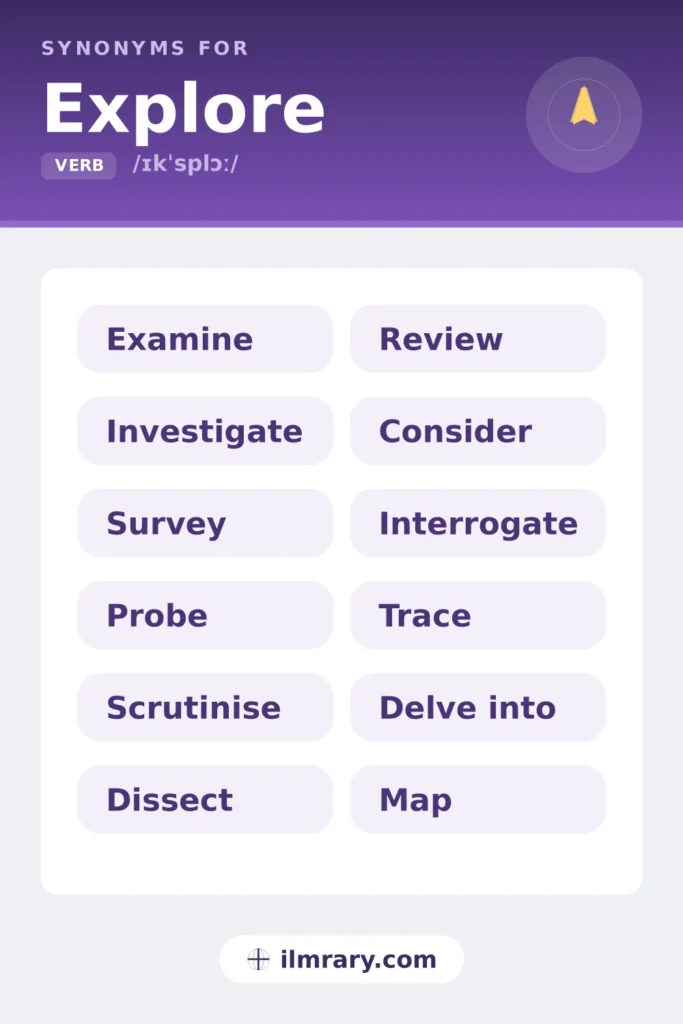
Where Explore Means Covering Ground
Breadth words describe looking across a field rather than into one part of it. Literature reviews and scoping work depend on them, and none of them promises depth.
Survey
Academic writing
Meaning
To look across a whole field to see what it contains.
When to use it
Coverage is the claim and depth is explicitly not, which is why a survey chapter precedes the analysis rather than replacing it. It has a second sense in data collection that context separates.
- The opening chapter surveys four decades of writing on the subject.
- Surveying the field showed how little of it rests on primary material.
Examine
Academic writing
Meaning
To look at something closely and in order.
When to use it
The neutral middle of this family, claiming attention without claiming suspicion. It is the safest verb in an essay plan and the least memorable.
- The chapter examines three explanations and rejects the first.
- Examining the ledgers alongside the letters resolves the discrepancy.
Review
Academic writing
Meaning
To go over existing material and assess it.
When to use it
It assumes the material already exists and belongs to somebody else, so reviewing is never original inquiry. Its precision comes from that limitation.
- The article reviews the evidence for a link nobody has yet tested directly.
- Reviewing the earlier trials showed the same flaw repeated four times.
Consider
Academic writing
Meaning
To give a matter deliberate thought.
When to use it
Thought rather than evidence is the claim, which makes it right for theoretical work and weak for empirical. Essays overuse it because it commits to nothing.
- The section considers whether intention matters to the definition at all.
- Considering the counter-case first strengthens the argument that follows.
Trace
Academic writing
Meaning
To follow something through time or across a sequence.
When to use it
A path is implied, so the verb needs a chronology or a chain to follow. History and etymology use it precisely and static analysis cannot.
- The book traces the idea from the pamphlets to the statute.
- Tracing the funding through three departments took most of a year.
Map
Academic writing
Meaning
To set out the shape and boundaries of a field.
When to use it
Structure rather than content is the claim, so mapping shows how parts relate. Social science adopted it thoroughly and it has become slightly overused.
- The review maps the debate onto two axes that had not been distinguished before.
- Mapping the referral routes exposed four that led nowhere.
Canvass
General writing
Meaning
To go through a range of views or options.
When to use it
It implies asking rather than reading, so opinions and possibilities are its natural objects. British usage keeps it current in legal and policy writing.
- The chapter canvasses every reading the text will bear.
- Canvassing the alternatives took longer than testing the one that worked.
Words for Digging Into One Thing
Depth words concentrate on a single point and apply pressure to it. Several assume something is wrong, so using them casually accuses a source the writer meant only to read.
Investigate
Academic writing
Meaning
To look into something systematically to find out the truth.
When to use it
Method is implied and often suspicion as well, since investigations usually begin because something looked wrong. Research writing uses it neutrally and journalism does not.
- The study investigates why two identical schemes produced opposite outcomes.
- Investigating the discrepancy took three months and one phone call.
Probe
Academic writing
Meaning
To press into something to find what lies underneath.
When to use it
Pressure and resistance are both implied, so a probe expects to meet something. Shorter and more forceful than investigate, and it fits interviews and close reading.
- The interviewer probed the inconsistency until the account changed.
- Probing the assumption exposes a circularity the argument depends on.
Scrutinise
Academic writing
Meaning
To inspect something closely for faults or detail.
When to use it
Fault-finding is the expectation, which makes it accusatory when applied to a colleague's work. American spelling drops to scrutinize with no change of force.
- The accounts were scrutinised line by line and two payments could not be matched.
- Scrutinising the sampling frame explained the anomaly the authors had attributed to season.
Interrogate
Academic writing
Meaning
To question a source or an idea hard enough to expose its assumptions.
When to use it
Critical theory made it standard for texts and concepts, where interrogating means refusing to take terms as given. Outside that tradition the police sense still dominates.
- The chapter interrogates the category of skilled labour rather than applying it.
- Interrogating the survey questions matters more here than analysing the answers.
Delve into
General writing
Meaning
To go deeply into a subject or a body of material.
When to use it
Digging is the whole metaphor and it suits archives and detail rather than concepts. Slightly informal, and it has become a favourite of writing that promises depth without reaching it.
- The biography delves into a decade the earlier accounts had skipped.
- Delving into the appendices produced the only genuinely new figure.
Dissect
Academic writing
Meaning
To take something apart to see how its parts work.
When to use it
It claims the thing can be separated into components, which is a real analytic assumption rather than a flourish. Argument and prose take it and continuous processes do not.
- The article dissects the ruling clause by clause.
- Dissecting the argument shows two premises doing all the work.
Matching an Explore Synonym to the Strength of Your Claim
Say how wide and how deep. Breadth verbs make no promise about depth, and among them survey covers a field, review assesses material somebody else produced, trace follows a chain through time and map sets out how parts relate. Depth verbs concentrate, and several bring an attitude with them, since scrutinise expects faults, probe expects resistance and interrogate refuses to take the terms as given. Investigate falls between neutrality and suspicion depending on the field. Explore stays honest only where the outcome was genuinely open, and in every other case a verb that names the depth describes the work better.
The reach comes before the verb: survey or map for the whole field, probe or dissect when one point took all the pressure.
Opposite Words for Explore
- Ignore
- Overlook
- Assume
- Skim
- Take for granted
Test Your Word Choice
Question 1: The chapter follows an idea from pamphlets to statute. Which verb names that?
Trace follows something through time or across a sequence. Map sets out how parts relate and survey covers a field without following any chain.
Question 2: Which verb refuses to take a source's terms as given?
Interrogate questions a concept hard enough to expose its assumptions. Review assesses existing material and examine looks closely without challenging the terms.
Question 3: Which verb accuses a colleague's work when used casually?
Scrutinise implies inspection for faults, so applying it to a colleague reads as suspicion. Consider claims deliberate thought and canvass goes through a range of views.
Explore Synonyms: What Tutors Ask Next
What can I write instead of explores in an essay?
Instead of explores, write examines where you looked closely at one thing, surveys where you covered a field, traces where you followed a chain through time, and interrogates where you refused the terms as given. Each names the depth of the search rather than gesturing at it.
When is explore the right verb in an essay?
Explore is the right verb where the outcome was genuinely open and you did not know what you would find. Exploratory analysis is a recognised stage of research, and naming it as such reads better than dressing it up as a test of a hypothesis you formed afterwards.
What is the difference between examine and investigate?
Examine claims close, ordered attention; investigate claims a systematic search for the truth and usually implies something looked wrong. The difference shows up in what each verb can take as an object, since investigating a discrepancy sounds natural and investigating a poem sounds like an accusation.
Is delve into too informal for academic writing?
Delve into appears in published academic prose often enough to pass, though it reads slightly casual. The larger risk is the promise it makes, since a paragraph that delves has to produce material the reader has not already seen, and most do not.