
How far your doubt goes is what a marker grades, and another word for question sets it. Overstating it costs more than understating it.
Questioned covers a raised eyebrow and a demolition. Both appear in the same sentence shape, and only one needs the evidence to back it.
Softer wording keeps a finding standing while you press on it. Harder wording says it fell, and that second claim needs the evidence directly before it.
Question Synonyms for Doubt Raised and for a Finding Refuted
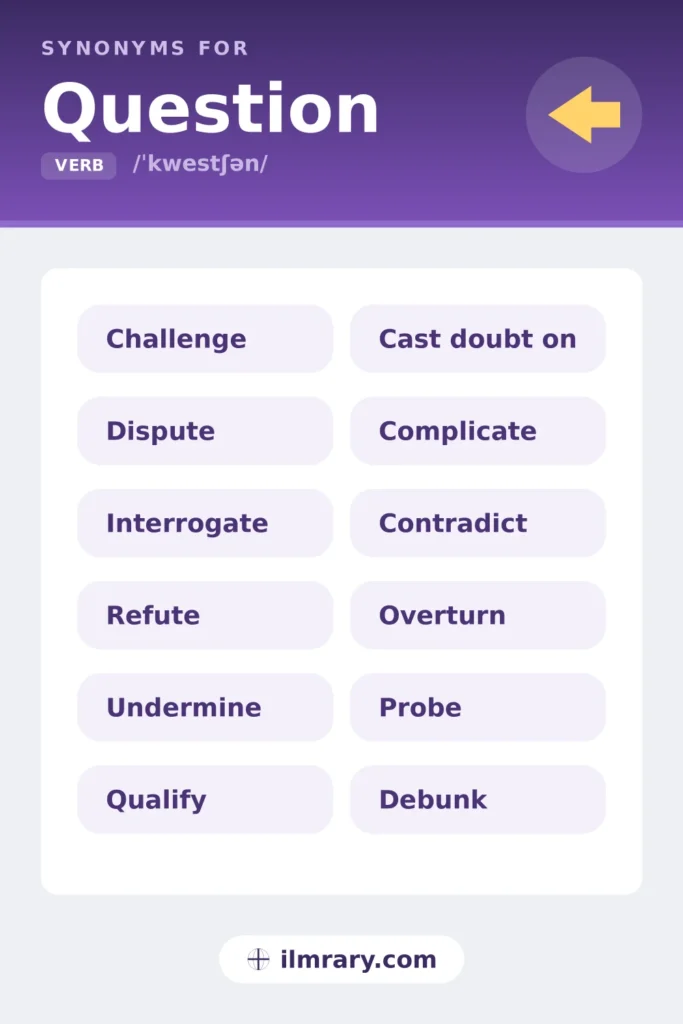
Where Question Raises Doubt Without Settling It
Partial doubt leaves the claim standing while weakening it. This is the honest report for most scholarly disagreement, since outright refutation is rarer than essays suggest.
Cast doubt on
Academic writing
Meaning
To give reasons for holding something less confidently.
When to use it
It reduces confidence without claiming the thing is false, which is what most evidence actually achieves. Its precision makes it the workhorse of literature reviews.
- The later dating casts doubt on a chronology two generations had accepted.
- Nothing in the study casts doubt on the mechanism, only on its size.
Challenge
Academic writing
Meaning
To formally contest whether something holds.
When to use it
Shared with the test family, where challenge is a named duty in governance. In argument it claims the position was contested rather than defeated.
- The article challenges an orthodoxy that had gone unexamined for a decade.
- Challenged the forecast at three consecutive boards until it was rebuilt.
Complicate
Academic writing
Meaning
To show something is messier than it was taken to be.
When to use it
It adds difficulty rather than removing a claim, which is what most good scholarship does. Literary and historical writing use it as high praise.
- The correspondence complicates the picture without overturning it.
- Complicating the account does more here than replacing it.
Qualify
Academic writing
Meaning
To narrow a claim so it holds only within limits.
When to use it
It preserves the claim by shrinking it, which is a constructive move rather than an attack. Naming the limit is the whole contribution.
- The finding is qualified to urban districts and holds firmly there.
- Two qualifications survive and the headline claim does not.
Interrogate
Academic writing
Meaning
To question a source or an idea hard enough to expose its assumptions.
When to use it
Shared with the explore family, where critical theory made it standard for concepts. Outside that tradition the police sense still arrives first.
- The chapter interrogates the category of skilled labour rather than applying it.
- Interrogating the survey questions matters more here than analysing the answers.
Probe
Academic writing
Meaning
To press into something to find what lies underneath.
When to use it
Shared with the explore family, where pressure and resistance are both implied. It expects to meet something rather than to conclude anything.
- Probing the assumption exposed a circularity the argument depends on.
- The interviewer probed the inconsistency until the account changed.
Revisit
Academic writing
Meaning
To reopen a question that had been treated as settled.
When to use it
It claims the settlement was premature rather than wrong, which is the gentlest form of disagreement available. New evidence usually licenses it.
- The archive release makes it worth revisiting a case closed in 1974.
- Revisiting the question produced the same answer for entirely different reasons.
Words That Claim the Thing Is Wrong
Full disagreement claims something has been shown to fail. Words test these hardest, because the demonstration has to be visible on the page rather than promised.
Refute
Academic writing
Meaning
To show that a claim is false.
When to use it
It requires the demonstration to have happened, which is why using it for merely denying something is the most common misuse in student writing. Rebut is the weaker cousin.
- The parish records refute a chronology that had rested on a single memoir.
- She refutes the second claim and leaves the first untouched.
Dispute
Academic writing
Meaning
To deny that something is so.
When to use it
It claims disagreement rather than proof, which makes it honest where refute would overstate. Two parties can dispute something indefinitely without either refuting anything.
- Two authors dispute the dating and neither has settled it.
- The figures are disputed and the direction of travel is not.
Contradict
Academic writing
Meaning
To assert the opposite of what something claims.
When to use it
It names a logical relation rather than an act of persuasion, so evidence can contradict a claim without anybody arguing. Precise and slightly cold.
- The ledgers contradict the account the memoir gives of the same year.
- Two sections of the report contradict each other on the eligibility rule.
Undermine
Academic writing
Meaning
To weaken the support a claim rests on.
When to use it
It attacks the foundation rather than the conclusion, which often does more damage. The conclusion may survive with different support, and saying so is honest.
- The sampling problem undermines every comparison in the paper.
- Undermining the premise leaves the conclusion standing on nothing.
Overturn
Academic writing
Meaning
To replace an established position with a different one.
When to use it
It claims the field moved, which is a historical statement as much as an intellectual one. Legal usage keeps a precise sense about decisions being reversed.
- The excavation overturned a consensus that had held since the seventies.
- Overturning the ruling took four years and two appeals.
Debunk
General writing
Meaning
To expose something as false or exaggerated.
When to use it
Journalism and popular writing own it, and it carries a note of satisfaction that academic prose avoids. It implies the claim was not merely wrong but overblown.
- The paper debunks a statistic that had circulated unchecked for a decade.
- Debunking the myth took less space than explaining why it had spread.
Matching a Question Synonym to the Strength of Your Claim
Say how far the doubt went. Partial doubt is the honest report for most disagreement, so cast doubt on lowers confidence without claiming falsity, qualify preserves a claim by shrinking it, and complicate adds difficulty rather than removing anything, which is what most good scholarship achieves. Revisit is the gentlest form, claiming a settlement was premature rather than wrong. Full disagreement has to be demonstrated, so refute requires the demonstration to be on the page, dispute claims only denial, contradict names a logical relation without any persuasion, and undermine attacks the support rather than the conclusion, which often does more damage. Question covers every one of these and reports the weakest.
The verb should match the damage done: cast doubt or qualify where the claim survives, refute or undermine only where the page shows the work.
Opposite Words for Question
- Accept
- Endorse
- Confirm
- Corroborate
- Take on trust
Test Your Word Choice
Question 1: Which verb requires the demonstration to be visible on the page?
Refute claims a falsity was shown, so denying something is not refuting it. Dispute claims disagreement and challenge claims the position was contested.
Question 2: Which attack often does more damage than attacking the conclusion?
Undermining the foundation leaves the conclusion standing on nothing, even where the conclusion might survive with different support. Contradiction and debunking address the claim itself.
Question 3: Which verb is high praise in literary and historical writing?
Complicating a picture adds difficulty without removing the claim, which is what careful scholarship usually achieves. Overturn claims the field moved and qualify narrows a claim to hold within limits.
Question Synonyms: What Tutors Ask Next
What can I write instead of questions the assumption?
Instead of questions the assumption, pick the verb that matches how far the doubt went. Cast doubt on where confidence should fall, qualifies where the claim survives inside limits, undermines where the support fails, and refutes where the demonstration is on the page.
What is the difference between refute and rebut?
Refute claims a demonstration, and rebut claims an answer. Showing a claim false is refutation, replying to it is rebuttal, and the two are graded differently. Using refute for a plain denial is the most frequent misuse in student writing, and a marker reads it as a promise the essay never keeps.
Is complicate a criticism?
Complicate is nearer to praise than to criticism in literary and historical writing. Showing that a picture is messier than the field assumed is a contribution in its own right, and it makes no claim that anybody was wrong about anything.
When should I write dispute rather than refute?
Write dispute whenever the matter is still open. Two scholars can dispute a dating for decades without either of them settling it, and dispute reports that state accurately where refute would claim a demonstration neither side ever produced.