
Writing something down and pressing it on a reader are different acts, and another word for note decides which. The choice shows whose view is on the page.
Notes reads as neutral and often is not. It records a fact and quietly asks the reader to weigh it.
Keeping your own view out of the sentence is one job. Pushing the reader towards a point is another, and a marker reads the second as your claim.
Note Synonyms for Quiet Recording and for Pointing
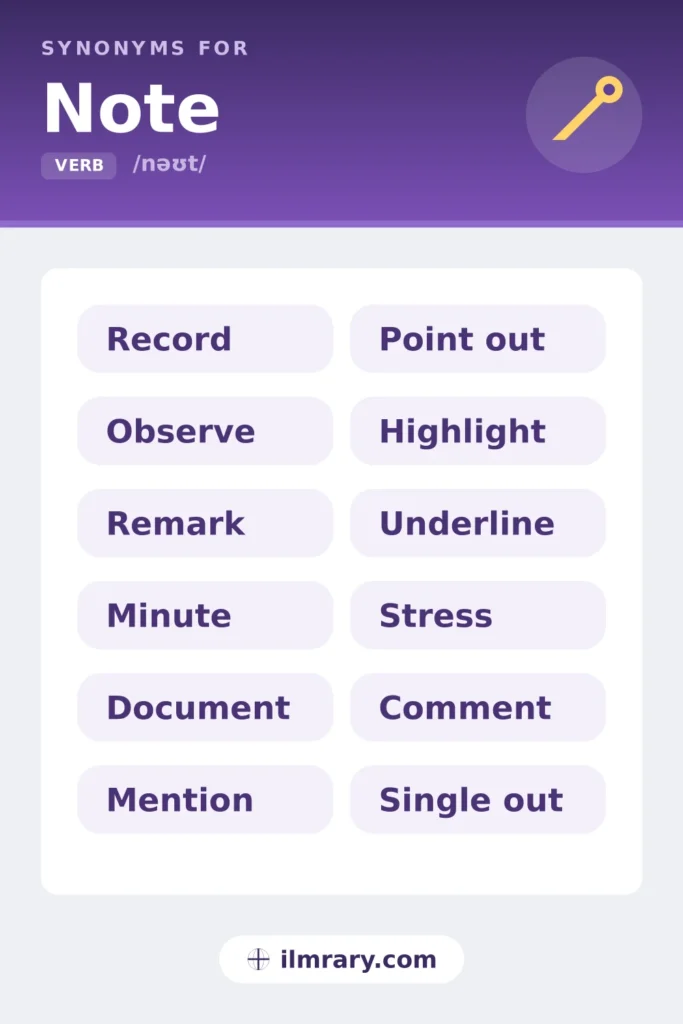
Where Note Means Quiet Recording
Recording words put something on the page without pressing it. Their restraint is deliberate, and they suit details that matter later rather than now.
Record
Academic writing
Meaning
To set something down so it can be referred to.
When to use it
Permanence rather than emphasis is the claim, which is why minutes and case notes use it. The point of recording is that somebody comes back to it.
- The minutes record an objection that nobody repeated aloud.
- Recorded the reasons at the time, which settled the dispute two years later.
Observe
Academic writing
Meaning
To notice and state something.
When to use it
It has a technical sense in research about systematic watching, and a plain sense about remarking. Both are common and the sentence usually settles which.
- The author observes that the two surveys never cite each other.
- Observed the process for four shifts before proposing a single change.
Remark
Academic writing
Meaning
To make a passing comment on something.
When to use it
Brevity and slightness are both implied, which makes it right for an aside. It signals that the point is not being developed.
- She remarks in a footnote that the figures were never audited.
- The remark is the most interesting sentence in the chapter.
Minute
Academic writing
Meaning
To record something formally in the record of a meeting.
When to use it
It claims a formal written record with a status, since minuted decisions bind in a way conversations do not. Anything not minuted is treated as never having happened.
- The objection was minuted and the decision stood.
- Minuted at the time, which settled the dispute two years later.
Comment
Academic writing
Meaning
To offer a view on something in passing.
When to use it
It claims a view rather than an argument, which is why review and commentary writing use it constantly. Its lightness is what limits it.
- Two reviewers commented on the sampling and neither pursued it.
- The chapter comments on the funding and analyses none of it.
Mention
General writing
Meaning
To refer to something briefly.
When to use it
The lightest verb available, and it claims nothing beyond that the thing appeared. Saying a source mentions something is often a criticism.
- The report mentions the delay once and never returns to it.
- Mentioned in passing and cited by everybody afterwards.
Document
Academic writing
Meaning
To record something in a form that can be produced later.
When to use it
Evidence is the purpose, so documenting implies somebody may need to prove it. Clinical, legal and audit settings treat it as a duty rather than a choice.
- Documented every deviation and the reasons for it as it happened.
- The practice was documented for years and reviewed by nobody.
Words for Drawing the Reader's Eye
Directing words assume a reader might otherwise pass over something. They claim selection, which invites the question of why this and not that.
Point out
General writing
Meaning
To direct attention to something the reader might miss.
When to use it
It implies the point was overlooked, which carries a faint edge when applied to another author. Neutral about size and firm about direction.
- The reviewer points out that the control group changed halfway through.
- Pointing out the omission did more than cataloguing what the report included.
Highlight
Academic writing
Meaning
To draw attention to one part of something larger.
When to use it
Shared with the highlight family, where selection is the whole action. It claims you chose what mattered rather than that the point is true.
- The comparison highlights how differently the two regions funded the same duty.
- Reviewers highlighted the omission and the second edition addressed it.
Underline
Academic writing
Meaning
To emphasise something already visible.
When to use it
Like underscore, the typographic metaphor implies the point was already there. It reinforces rather than introduces.
- The later figures underline what the first survey had only suggested.
- Underlining the distinction cost a sentence and prevented a chapter of confusion.
Stress
Academic writing
Meaning
To mark something as deserving particular attention.
When to use it
Shared with the emphasize family, where it is the neutral workhorse. Shorter than emphasise and identical in force.
- Keynes stresses expectation rather than the interest rate itself.
- The guidance stresses consent at every stage of the process.
Draw attention to
General writing
Meaning
To point the reader toward something they might pass over.
When to use it
Shared with the emphasize family, where its neutrality recommends it. It claims no force at all, which suits describing a source you disagree with.
- The report draws attention to a funding gap it declines to explain.
- Drawing attention to the exception weakens the rule the chapter defends.
Single out
Academic writing
Meaning
To pick one item from a set for particular notice.
When to use it
Shared with the highlight family, where it is the most explicit about choosing. It invites the question of why that one, which is often the interesting part.
- The inspectors singled out one authority in an otherwise unremarkable region.
- Reviewers singled out the third chapter and ignored the rest.
Choosing a Note Synonym an Examiner Will Accept
Decide whether the point should be findable or unmissable. Quiet recording puts something on the page for later, so record claims permanence, document implies somebody may need to prove it, and minute claims a formal record that binds. Remark and mention are the lightest, and describing a source as mentioning something is frequently a criticism. Directing verbs assume a reader would otherwise pass over, so point out implies the thing was overlooked and carries an edge when applied to another author, single out is the most explicit about choosing, and underline reinforces something already visible. Note is the neutral middle, and four of them in a paragraph is the sign that nothing is being argued.
Volume should match the point: record or document where it needs to be findable later, point out or single out where the reader would otherwise miss it.
Opposite Words for Note
- Overlook
- Omit
- Ignore
- Pass over
- Leave unrecorded
Test Your Word Choice
Question 1: Which verb implies somebody may need to prove it later?
Documenting exists so the thing can be produced as evidence, which is why clinical and legal settings treat it as a duty. Remark and comment are both passing views.
Question 2: Which claims receipt without agreement?
Registering an objection means it entered the record while the decision stood. Observe states something noticed and underline emphasises something already visible.
Question 3: Saying a source mentions something is usually what?
Mention claims nothing beyond that the thing appeared, so describing a treatment that way implies it was inadequate. Neutral reporting would use notes or discusses.
Note Synonyms: Questions Students Ask
What can I use instead of notes in an essay?
Swap notes for the verb that matches the claim: observes where something was seen, records where permanence is the point, points out where a reader might have passed over it, and remarks where the aside is meant to stay brief.
Why is noting four things in one paragraph a problem?
Noting four things in one paragraph is a problem because each note is a decision to mention rather than to argue. A paragraph built from notices reads as a list of things the writer saw and could not place, and the reader waits for the point that never arrives.
Does point out carry an edge in academic writing?
Point out carries a slight edge, since it implies the thing was overlooked. Applied to a reviewer who caught a design flaw the verb reads as fair. Applied to a colleague stating something obvious, it reads as pointed, and observes or notes would have cost the sentence nothing.
What is the difference between record and document as verbs?
Record sets something down, and document sets it down in a form that can be produced later to somebody else. Audit and clinical work treat documenting as the standard, and recording as what people mean when they say they did it. The gap between the two is where disputes start.