
Acting for people and drawing a picture are two jobs, and another word for represent tells them apart. Essays slide between them without a signal.
Represents carries both. A union that speaks for members and a graph that shows rainfall use the same word for unlike work.
Standing in for people needs a mandate they granted. Standing in for an idea needs a case, and a marker checks which word you meant.
Represent Synonyms for Standing in Place and for Portraying
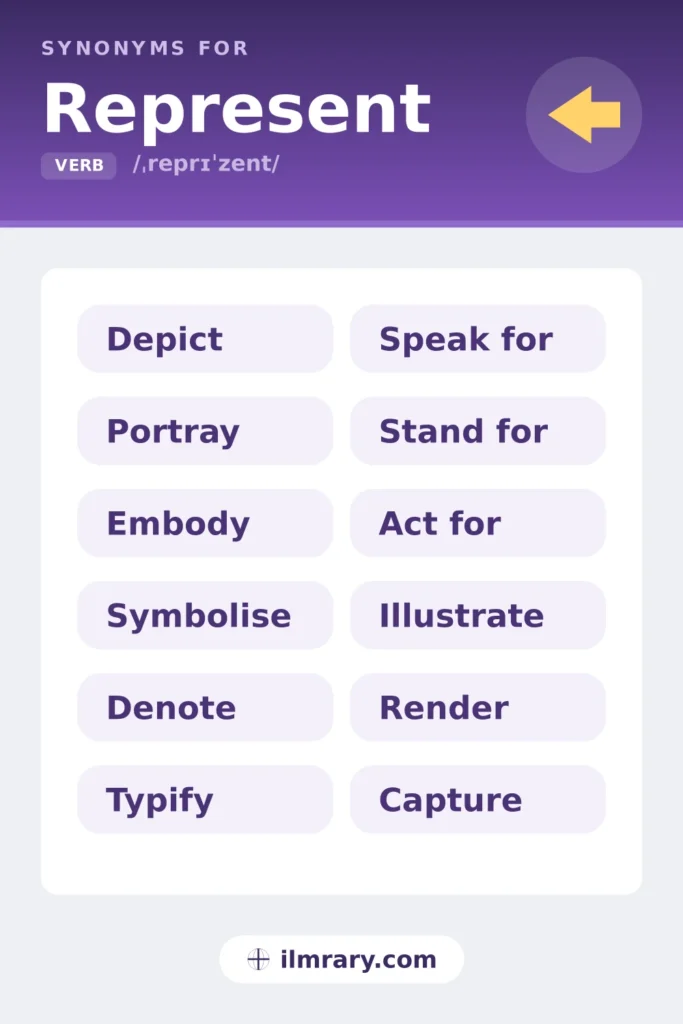
Where Represent Means Standing in Place of Something
Substitution senses cover acting for others or serving as a token of them. Political, legal and statistical writing rely on the distinction between speaking for a group and being counted as one of it.
Speak for
General writing
Meaning
To express the views of others with their authority.
When to use it
Authority is the whole question, and the phrase invites it immediately. Whether the speaker was mandated or merely assumed the role is what arguments about representation usually turn on.
- No delegate could plausibly speak for a membership that had never met.
- She spoke for the tenants at every hearing and never claimed to be one.
Stand for
General writing
Meaning
To serve as a sign or token of something else.
When to use it
Substitution without authority, so an object can stand for an idea while nobody appointed it. Its plainness makes it the natural gloss for symbolic readings.
- The empty chair stands for the members who were never invited.
- Both letters stand for the same sound in the older spelling.
Act for
Academic writing
Meaning
To take action on somebody's behalf under authority.
When to use it
Legal usage fixes it, where acting for a client means holding an instruction. It claims delegation rather than resemblance, and confusing the two misstates a relationship.
- The firm acted for both parties and disclosed the fact late.
- Trustees act for beneficiaries who have no say in the decision.
Denote
Academic writing
Meaning
To refer to something directly and by convention.
When to use it
Linguistics and logic fix the sense, where denotation is the plain reference before any association attaches. Its opposite number, connote, is what casual writing usually means.
- In this notation the second column denotes the year of entry.
- The word denotes a legal status and connotes a great deal more.
Typify
Academic writing
Meaning
To be a recognisable and characteristic example of something.
When to use it
It claims the case is representative in the ordinary sense, which is a real empirical assertion. Choosing a typifying example without saying how it was chosen weakens the whole argument.
- The Bolton scheme typifies a model that spread across the north within a decade.
- Nothing about the sample typifies the wider population.
Symbolise
Academic writing
Meaning
To stand for something by association rather than resemblance.
When to use it
Convention does the work, so a symbol means what a culture agreed it means. American spelling drops to symbolize and the sense is unchanged.
- The bridge symbolises a reconciliation that never quite arrived.
- White symbolises mourning in traditions the novel never mentions.
Embody
Academic writing
Meaning
To give concrete form to an idea or quality.
When to use it
The abstraction becomes visible in a body or an institution rather than merely being pointed at. Stronger than symbolise, since embodiment claims the thing is present rather than referred to.
- The charter embodies a principle the founders had argued about for years.
- She embodied the contradiction the movement never resolved.
Words for Portraying Something
Portrayal senses cover showing a subject in another medium. Choosing among them signals how faithful, how selective and how interested the portrayal was.
Depict
Academic writing
Meaning
To show something in a picture or a description.
When to use it
The neutral verb for portrayal in any medium, and it claims nothing about accuracy. Art history and literary criticism both treat it as the default.
- The panel depicts a harvest that the estate records show never happened.
- Both novels depict the strike and neither mentions the settlement.
Portray
Academic writing
Meaning
To present a subject in a particular light.
When to use it
Interpretation is implied, so a portrayal has an angle that a depiction need not. It suits arguments about how a group or a figure was treated.
- The memoir portrays him as a reluctant administrator and the minutes disagree.
- Early accounts portray the settlement as empty land.
Illustrate
Academic writing
Meaning
To make something easier to grasp by giving an instance.
When to use it
Shared with the show family, where an illustration clarifies rather than proves. One example illustrates and never demonstrates.
- The Dublin case illustrates how quickly the policy broke down.
- Hogarth illustrates the argument better than the pamphlets did.
Render
Academic writing
Meaning
To reproduce something in another form or medium.
When to use it
Craft and technique are implied, so rendering is about how the transfer was done. Translation, drawing and music all use it precisely.
- The translator renders the pun as a rhyme and loses the reference.
- The engraver rendered the whole facade from a single sketch.
Capture
General writing
Meaning
To convey something elusive accurately.
When to use it
Success is built into the word, so calling a portrayal a capture endorses it. That endorsement makes it unsuitable for neutral description.
- The photographs capture a street that was demolished within the year.
- No summary captures the tone of the exchange.
Characterise
Academic writing
Meaning
To describe something as having a particular nature.
When to use it
It attributes a quality rather than showing it, so the description belongs to the describer. Reporting how a source characterised something keeps the attribution visible.
- The report characterises the delay as administrative rather than political.
- Characterising the period as stable ignores two currency crises.
Matching a Represent Synonym to the Strength of Your Claim
Split standing in for from showing. Substitution runs from act for and speak for, which claim authority somebody granted, through stand for and denote, which are matters of convention, to typify, which makes an empirical claim about how ordinary the case was. Embody is the strongest of them because it says the abstraction is present rather than pointed at. Portrayal runs from depict, which claims nothing about angle, through portray and characterise, which both carry an interpretation, to capture, which endorses the result as accurate. Represent itself is precise only where a modifier or the surrounding sentence has already settled which of the two families is meant.
Whether the thing stands in or shows is the question: act for and typify on one side, depict and portray on the other.
Opposite Words for Represent
- Misrepresent
- Distort
- Obscure
- Caricature
- Exclude
Test Your Word Choice
Question 1: A firm holds an instruction from a client. Which verb is exact?
Act for claims delegated authority to take action on somebody's behalf. Stand for is substitution by convention and typify claims the case is characteristic.
Question 2: Which verb endorses the portrayal as accurate?
Capture has success built into it, so using it approves the result. Depict claims nothing about accuracy and characterise attributes a quality to the describer.
Question 3: Which verb makes an empirical claim that could be checked against a population?
Typify asserts the case is characteristic of a wider group, which data can test. Symbolise and embody both work through convention and form rather than frequency.
Represent Synonyms: What Tutors Ask Next
What is another word for represents in an essay?
Another word for represents depends on which job the verb is doing. Depicts works where a text or image shows something, portrays where an angle is involved, stands for where the relation is a matter of convention, and speaks for where authority over a group is the point.
What is the difference between depict and portray?
Depict shows a subject without claiming an angle, and portray presents it in a particular light. Arguments about bias almost always need portray, since the angle is the thing under discussion, and depict quietly concedes the point by pretending no choice was made.
When should I use denote rather than connote?
Denote belongs to the plain conventional reference of a word, and connote to everything the word drags along with it. Casual writing that reaches for denote usually means connote, and the swap quietly reverses the sentence, since a term can denote one thing while connoting its opposite.
Is typify a safe word to use in an essay?
Typify is safe only where you can say how the case was chosen. The word asserts that your example is characteristic of a wider group, so a convenient or self-selected case makes the claim indefensible the moment a marker asks what the example was drawn from.