
Owning a fault reads differently from describing a boundary, and another word for limitation decides which. The distinction is graded as much as the finding.
Limitation carries both. A sample you chose to keep small and a bias you failed to control both go in the same section, and a marker separates them anyway.
A boundary you set on purpose is a design decision, and you defend it. A weakness you did not catch is a fault, and admitting the bias plainly costs less than hiding it.
Limitation Synonyms for Design Choices and for Weaknesses
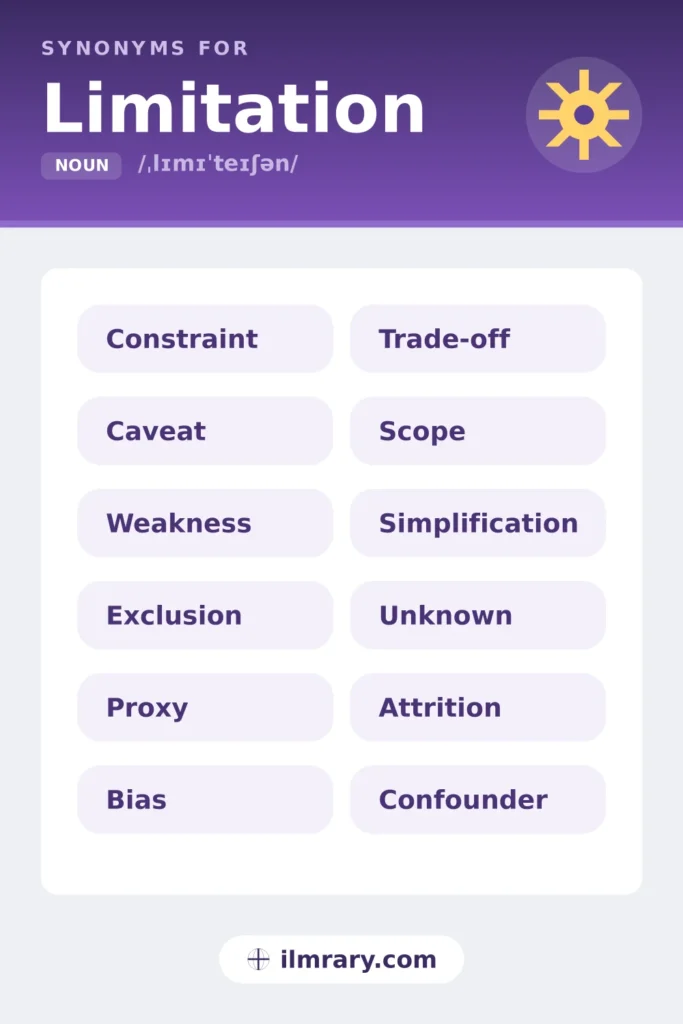
Limitation Words for Restrictions Nobody Chose
Imposed restrictions came from outside the study. Reporting them is honest and costs nothing, which is why limitations sections are full of them.
Constraint
Academic writing
Meaning
Something that stops the work going further.
When to use it
Shared with the capacity family, where naming the kind is what makes it actionable. It claims the restriction was external rather than accepted.
- The binding constraint was access to the records rather than the sample size.
- Constraints were listed in every paper and ranked in none of them.
Boundary condition
Academic writing
Meaning
The range within which a result holds.
When to use it
It bounds the claim rather than weakening it, which is why stating one strengthens a finding. Generalisation disputes are almost always about these.
- The result holds under boundary conditions the study never observed.
- Every boundary condition was stated and two of them were never met in practice.
Scope
Academic writing
Meaning
What is inside a piece of work and what is not.
When to use it
Shared with the design family, where the exclusions are the valuable half. Saying something was out of scope is a defence only if the scope was stated in advance.
- The scope excluded rural districts and the conclusions were drawn about all of them.
- Scope was set before the data arrived, which the appendix records.
Caveat
Academic writing
Meaning
A warning attached to how a result should be read.
When to use it
It qualifies the reading rather than the work, and a caveat nobody carries forward has done nothing. Its usual fate is to be stated once and ignored.
- The caveat appeared on page four and in none of the coverage.
- Caveats were attached to every figure and stripped in the summary.
Unknown
Academic writing
Meaning
Something the work could not determine.
When to use it
It admits absence rather than error, which is different and often more productive. Naming what remains unknown is what shapes the next study.
- The mechanism remains unknown and every proposed one fits the data equally well.
- Two unknowns were named and funded work followed on one of them.
Attrition
Academic writing
Meaning
Loss of participants over the course of a study.
When to use it
Whether the losses were random decides whether it matters, since differential attrition breaks comparisons entirely. The rate alone tells you nothing.
- Attrition reached a third and fell disproportionately on the group that had least to gain.
- Attrition was reported and never analysed by characteristic.
Confounder
Academic writing
Meaning
A third factor explaining an apparent relationship.
When to use it
It names the specific alternative explanation, which is far stronger than a general warning about causation. Controlling for one is a claim that can be checked.
- Deprivation was the confounder and the association disappeared once it was controlled for.
- Every plausible confounder was listed and two were unmeasurable.
Words for Restrictions the Design Accepted
Chosen restrictions could have gone another way. Naming them is what distinguishes a real limitations section from a ritual one.
Weakness
Academic writing
Meaning
A defect in how the work was done.
When to use it
It concedes fault rather than circumstance, which is why authors avoid it. Naming your own weakness before a reviewer does costs less than the reverse.
- The central weakness is that engagement was operationalised as attendance.
- Two weaknesses were named by the authors and a third by every reviewer.
Trade-off
Academic writing
Meaning
What was given up in order to get something else.
When to use it
Shared with the strategy family, where naming it proves a choice was made. In method it explains a weakness rather than merely admitting one.
- The trade-off was depth for coverage and the paper says so in the design section.
- Naming the trade-off turned a criticism into an explained decision.
Simplification
Academic writing
Meaning
Deliberately leaving out detail to make something tractable.
When to use it
All models do it and only some say so, which is the difference between a stated assumption and a hidden one. Saying what was left out is the whole discipline.
- The simplification assumes no migration between districts, which the appendix defends.
- A simplification that held for the first decade and quietly stopped holding.
Proxy
Academic writing
Meaning
A stand-in measure used because the real one is unavailable.
When to use it
Shared with the measure family, where admitting the substitution is the honest move. The distance between the proxy and the concept is where criticism lands.
- Attendance was a proxy for engagement and a poor one.
- Used spend per head as a proxy until the outcome data arrived.
Exclusion
Academic writing
Meaning
A group or case deliberately left out.
When to use it
It is a decision with consequences for who the findings apply to, which is why exclusion criteria are published. Unstated exclusions are the more serious problem.
- The exclusion of non-English speakers removed a fifth of the population.
- Exclusions were stated and their effect on the conclusions was not.
Bias
Academic writing
Meaning
A systematic tendency pushing results in one direction.
When to use it
Shared with the assumption family, where the technical and everyday senses collide. Naming the mechanism keeps it about method rather than about anybody's intentions.
- Selection bias explains the whole difference between the two cohorts.
- The bias was in the sampling frame rather than in anybody's intentions.
Telling the Limitation Synonyms Apart
Say whether it could have gone another way. Imposed restrictions cost nothing to admit, so a constraint came from outside, a boundary condition bounds the claim and strengthens it by doing so, and an unknown admits absence rather than error. Attrition and confounding are the two that decide whether comparisons survive, and both need analysis rather than a rate. Chosen restrictions are the ones a ritual limitations section omits, since a weakness concedes fault, a simplification admits what was deliberately left out, a proxy admits a substitution, and an exclusion decides who the findings apply to. Naming a trade-off turns a criticism into an explained decision, which is the strongest move available in the whole section.
Imposed and chosen are separate admissions: constraint or boundary condition where the world decided, weakness or trade-off where the design did.
Opposite Words for Limitation
- Strength
- Generalisability
- Robustness
- Completeness
- Scope covered
Test Your Word Choice
Question 1: Which strengthens a finding by being stated?
Stating the range within which a result holds bounds the claim rather than weakening it. A weakness concedes a defect and bias names a systematic tendency.
Question 2: Which turns a criticism into an explained decision?
Naming what was given up to gain something else shows the design was chosen rather than defaulted into. A caveat qualifies the reading and an exclusion leaves a group out.
Question 3: What decides whether attrition matters?
Differential attrition breaks comparisons regardless of the rate, since the groups stop being alike. A high random loss can leave the comparison intact.
Questions That Follow a Limitation Claim
What makes a limitations section worth reading?
Naming the restrictions the design accepted is what makes a limitations section worth reading. Constraints nobody could avoid cost the author nothing to admit, so they persuade nobody. Saying engagement was operationalised as attendance tells a reader precisely what the study could not see.
What is the difference between a constraint and a weakness?
A constraint came from outside the study, and a weakness was accepted inside the design. Reporting the first is honest and costs the author nothing. Conceding the second is what separates a real limitations section from a ritual one, which is why ritual sections list only constraints.
Why do caveats get dropped from research coverage?
Caveats get dropped because nobody carries them forward. A caveat on page four that never appears in the abstract or the press release has done no work at all, and stating it once satisfies the author rather than the reader who repeats the finding.
How should confounders be handled in a limitations section?
Confounders should be named specifically rather than warned about in general. Saying deprivation was the confounder and the association vanished once it was controlled for gives a reader a claim they can check. A sentence conceding that unmeasured confounding may exist concedes nothing.