
Overstating what a study showed is a common fault, and demonstrate synonyms are where it starts. The wording promises more than the data holds.
Demonstrated claims proof. A correlation in one sample and a replicated finding both demonstrate something, and a marker sees the difference.
Words that close a question claim proof, and only replicated work carries them. Words that point one way claim support, which is what a single sample demonstrates.
Another Word for Demonstrate and the Proof Each One Needs
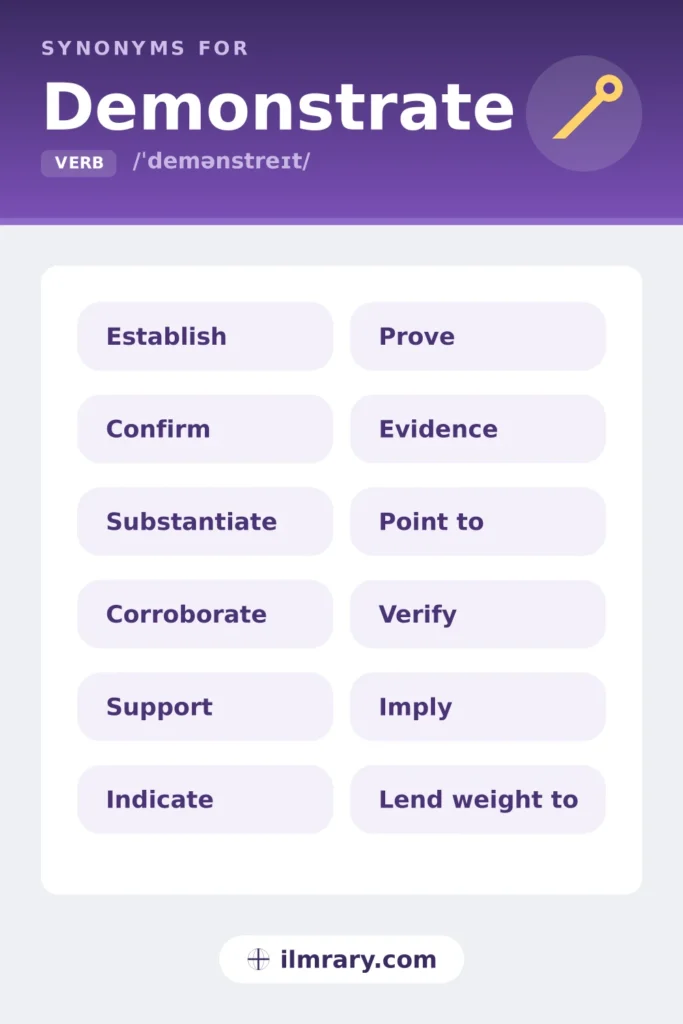
Where Demonstrate Claims the Argument Closes
Closure words assert that the question is settled. Words test them hardest, because a claim of proof invites the reader to look for the step that is missing.
Prove
Academic writing
Meaning
To establish beyond reasonable doubt.
When to use it
The strongest verb available and the one empirical disciplines avoid, since proof belongs to mathematics and logic rather than to evidence. Historians and scientists prefer weaker verbs for exactly that reason.
- The parish records prove the family was in Norfolk by 1690.
- Nothing in the correspondence proves intent, though a good deal suggests it.
Establish
Academic writing
Meaning
To settle a point firmly enough for later argument to rest on it.
When to use it
Shared with the establish family, where it names founding rather than proving. Here it claims a foundation, so what follows should build rather than defend.
- The second chapter establishes a chronology the rest of the book assumes.
- Once the baseline is established, the divergence after 1979 explains itself.
Confirm
Academic writing
Meaning
To show that something already proposed is correct.
When to use it
It requires a prior claim, so confirming something nobody had suggested is a contradiction in terms. Replication studies and follow-up analysis own it.
- The second excavation confirmed the dating the first had proposed tentatively.
- Two independent datasets confirm the seasonal effect.
Substantiate
Academic writing
Meaning
To supply the support a challenged claim was lacking.
When to use it
It implies the claim was doubted, which makes it sharper than confirm. Legal and investigative writing use it precisely, and its formality suits contested material.
- The tribunal found the allegation substantiated on two counts.
- Nothing in the archive substantiates the figure the memoir gives.
Verify
Academic writing
Meaning
To check something against a source and find it accurate.
When to use it
Checking rather than arguing is the claim, so verification tests a fact and never an interpretation. Data and archival work use it constantly.
- Every quoted figure was verified against the original returns.
- The attribution could not be verified and appears in the notes as disputed.
Corroborate
Academic writing
Meaning
To support an account with independent evidence.
When to use it
Independence is the essential part, so a second source from the same origin corroborates nothing. Legal and historical writing hold the strict sense.
- The shipping records corroborate a departure date the diary gives only vaguely.
- Two witnesses corroborate the account and both were employed by the company.
Attest to
Academic writing
Meaning
To provide evidence that something was so.
When to use it
It usually takes an inanimate subject, where surviving material testifies without arguing. Slightly formal and common in archaeological and archival writing.
- The foundations attest to a building larger than any record describes.
- Surviving ledgers attest to a trade the histories had assumed was marginal.
Words That Claim Support Without Closure
Support words stop short of settling the question, and stopping short is what makes them credible. Careful writing uses them far more often than the closure words.
Evidence
Academic writing
Meaning
To serve as evidence for something.
When to use it
The verb use spread from policy and education writing and still irritates some readers, though it is now standard in both. It claims support without asserting how much.
- The uptake figures evidence a demand the consultation had denied existed.
- Improvement is evidenced across all four measures and explained by none of them.
Support
Academic writing
Meaning
To make a claim more likely without settling it.
When to use it
The neutral workhorse of empirical writing, and its modesty is why journals prefer it to prove. It leaves room for a later study to complicate the finding.
- The results support the hypothesis for urban districts and not for rural ones.
- Three lines of evidence support the reading and none of them is decisive alone.
Indicate
Academic writing
Meaning
To point toward a conclusion without settling it.
When to use it
Shared with the show family, where its caution dominates scientific abstracts. It protects the writer when a later finding complicates the picture.
- The survey results indicate a shift the interviews do not confirm.
- Early returns indicate turnout was highest where spending was lowest.
Point to
General writing
Meaning
To identify something as relevant to a conclusion.
When to use it
Shared with the highlight family, and here it stays deliberately loose about strength. It suits describing a body of evidence whose weight is still being assessed.
- The pattern points to an administrative cause rather than a demographic one.
- Several details point to a rewrite that the manuscript itself does not record.
Imply
Academic writing
Meaning
To carry a conclusion without stating it.
When to use it
The conclusion belongs to the evidence rather than the author, which is what separates it from suggest. Logic gives it a strict sense that ordinary usage loosens.
- A charge at that rate implies a contract nobody has found.
- The silence after 1848 implies a rupture the biography never addresses.
Lend weight to
General writing
Meaning
To add strength to an argument already under way.
When to use it
It admits the argument existed before the evidence arrived, which is honest in a literature review. Slightly informal and sharper than the alternatives about doing only part of the work.
- The new dating lends weight to a reading proposed forty years earlier.
- Two minor findings lend weight to a case that still rests on one document.
Which Demonstrate Synonym Fits Your Evidence
Match the verb to what the evidence can bear. Closure verbs commit you completely, and each has a precondition, since confirm needs a prior claim, substantiate needs a challenged one, corroborate needs independent sources and verify needs a fact rather than a reading. Prove is the strongest and the least used in empirical work, precisely because evidence rarely reaches that far. Support verbs stop short deliberately, and support, indicate and point to are the ordinary vocabulary of careful writing, while imply hands the conclusion to the evidence rather than the author. Demonstrate falls between the two groups, which is why it needs the reasoning visible in the same paragraph.
The claim can only go as far as the evidence: corroborate and substantiate where the conditions are met, and support or indicate wherever the question stays open.
Opposite Words for Demonstrate
- Refute
- Disprove
- Undermine
- Contradict
- Cast doubt on
Test Your Word Choice
Question 1: A second source from an unrelated archive backs the account. Which verb is exact?
Corroborate requires independent evidence, which an unrelated archive supplies. Confirm needs a prior proposal and verify checks a fact against a source.
Question 2: The claim had been challenged and the evidence answers the challenge. Which verb fits?
Substantiate supplies the support a doubted claim was lacking. Indicate points without settling and attest to describes material testifying without any dispute in view.
Question 3: Which verb hands the conclusion to the evidence rather than the author?
Imply means the evidence carries the conclusion without anyone stating it. Suggest is the author offering a reading and support makes a claim more likely without drawing it.
Common Questions About Demonstrate Synonyms
What can I write instead of demonstrates in an essay?
Choose the verb that matches the proof, which is what demonstrates in an essay never does: establishes where the point founds later argument, confirms where something was already proposed, supports where the question stays open, and corroborates where a second independent source agrees with the first.
Why do scientists avoid the word prove?
Scientists avoid prove because proof belongs to mathematics and logic, where conclusions follow necessarily from premises. Empirical evidence makes a conclusion more or less likely instead, so support, indicate and point to describe what the data has actually done.
What is the difference between confirm and corroborate?
Confirm shows an earlier proposal was correct, and corroborate adds independent evidence to an existing account. Two documents produced by the same office confirm each other and corroborate nothing, which is the distinction a marker checks first.
Is evidence acceptable as a verb?
Evidence works as a verb in policy, education and social research writing, where it is standard. A minority of readers still dislike it, so where you expect that reader, support or the noun phrase is evidenced by avoids the argument entirely.