
How tightly a term is fixed decides what an essay can prove, and synonyms for define set that. The choice shows up in every later claim.
Defined hides the tightness. A measurable threshold and a loose working description both count as definitions, and a marker reads them very differently.
Pinning a term to something testable is one move. Setting a frame and leaving room is the other, and a thesis needs both in different places.
Define Synonyms for Pinning a Term Down and for Framing It
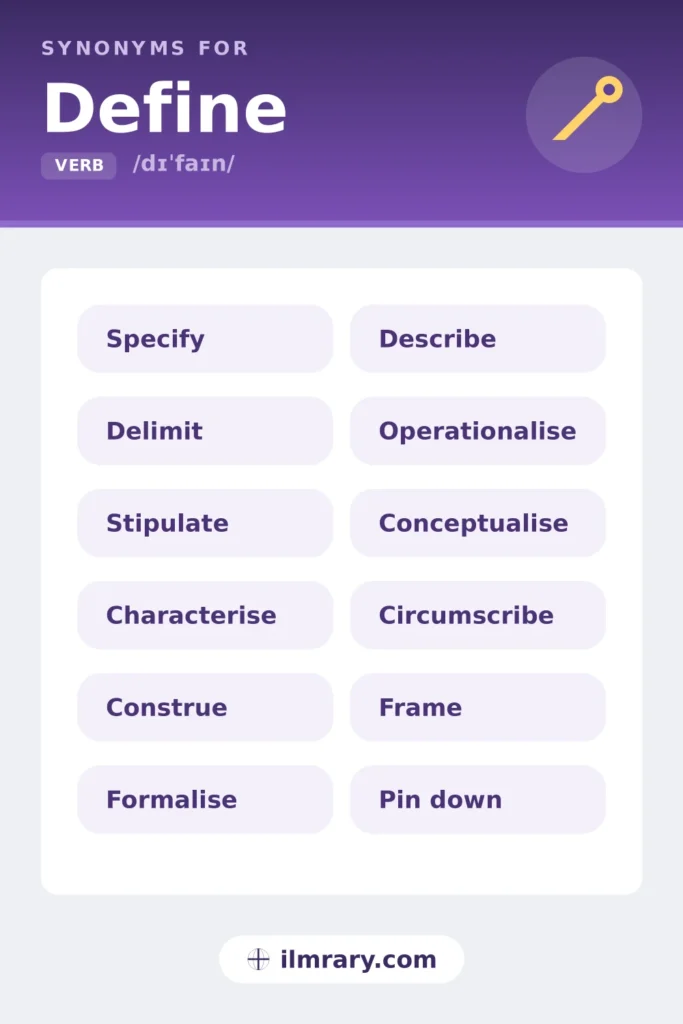
Where Define Means Fixing a Term Tightly
Tight fixing draws a boundary somebody could apply to a new case. Where the argument depends on which side of a line something falls, this is the work that has to be done.
Specify
Academic writing
Meaning
To state exactly what is meant, leaving no room to vary.
When to use it
Shared with the design family, where it closes decisions rather than describing them. In argument it removes the ambiguity a critic would otherwise use.
- The paper specifies skilled as anything above the second tier and the results follow from that.
- Specifying the population removed the objection two reviewers had raised.
Delimit
Academic writing
Meaning
To fix the boundaries of what is being discussed.
When to use it
It draws the edge rather than describing the centre, which is the harder half in contested terms. Scope disputes are almost always about delimitation.
- The study delimits the region by travel time rather than by administrative boundary.
- Delimiting the period at 1979 is defended in a footnote and drives the whole finding.
Operationalise
Academic writing
Meaning
To turn a concept into something that can be measured.
When to use it
Social science depends on it, and the gap between the concept and the measure is where most methodological criticism lands. Naming the measure invites that criticism deliberately.
- Poverty is operationalised as sixty per cent of median income, which the chapter defends.
- Operationalising engagement as attendance was the study's central weakness.
Stipulate
Academic writing
Meaning
To lay down a definition for the purposes of the argument.
When to use it
Shared with the assumption family, where setting a definition is legitimate and setting a fact is not. It admits the definition is chosen rather than discovered.
- By stipulation, skilled means anything above the second tier.
- The stipulation is reasonable and quietly settles half the question.
Circumscribe
Academic writing
Meaning
To limit something within stated bounds.
When to use it
Restriction is the emphasis, so it suits terms that would otherwise sprawl. Slightly formal and it carries a faint sense of deliberate narrowing.
- The judgment circumscribes the duty narrowly and later cases widened it again.
- Circumscribing the claim made it defensible and considerably less interesting.
Pin down
General writing
Meaning
To settle what something means when it keeps shifting.
When to use it
It admits the term has been slippery, which is honest and slightly informal. It suits reporting a literature that has used a word inconsistently.
- Nobody in the field had pinned down what integration was supposed to mean.
- Pinning the term down took a chapter and made the review possible.
Formalise
Academic writing
Meaning
To restate something in precise or symbolic terms.
When to use it
It moves from prose to a system where consequences can be derived, which is what economics and logic mean by it. Precision is bought at the cost of some of the original sense.
- Formalising the model exposed an inconsistency the verbal version had concealed.
- The formalisation is elegant and drops the part that made the idea interesting.
Words That Describe Rather Than Bound
Loose description tells a reader what something is usually like without fixing an edge. It is the honest choice for concepts that genuinely resist boundaries.
Characterise
Academic writing
Meaning
To describe the features something typically has.
When to use it
Shared with the represent family, where the description belongs to the describer. It claims typical features rather than necessary ones, which is a much weaker and often truer claim.
- The report characterises the delay as administrative rather than political.
- Characterising the period as stable ignores two currency crises.
Describe
General writing
Meaning
To give an account of what something is like.
When to use it
The plainest option and the one that claims no boundary at all. Its modesty is right where a term is contested and a stipulated definition would beg the question.
- The chapter describes four kinds of arrangement and defines none of them.
- Describing the practice honestly did more than any definition would have.
Construe
Academic writing
Meaning
To interpret how a term or a text should be read.
When to use it
Legal usage dominates, where construing a clause decides a case. It claims a reading among possible readings rather than a fixed meaning.
- The clause was construed narrowly and the appeal turned on that alone.
- Construing the phrase as directory rather than mandatory changed the outcome.
Conceptualise
Academic writing
Meaning
To set out how a phenomenon should be thought about.
When to use it
It works at the level above definition, deciding what kind of thing something is before deciding where its edges are. Theory writing uses it and it can sound like jargon elsewhere.
- Conceptualising care as labour rather than sentiment reorganised the whole field.
- The paper conceptualises the problem and leaves the measurement to others.
Frame
Academic writing
Meaning
To set up how a question should be understood.
When to use it
Shared with the assumption family, where framing operates before the argument and cannot be answered inside it. It shapes what counts as a relevant answer.
- Framing it as access rather than eligibility changed the whole debate.
- The framing made cost the only variable anybody discussed.
Typify
Academic writing
Meaning
To be a recognisable and characteristic example of something.
When to use it
Shared with the represent family, where it makes an empirical claim about how ordinary the case is. Choosing a typifying example without saying how it was chosen weakens the argument.
- The Bolton scheme typifies a model that spread across the north within a decade.
- Nothing about the sample typifies the wider population.
How to Choose the Right Synonym for Define
Fix a term only as tightly as the argument needs. Tight verbs draw a usable boundary, so specify removes ambiguity a critic would exploit, delimit fixes edges rather than centres, and operationalise converts a concept into a measure and invites the criticism that follows. Stipulate admits the definition was chosen and formalise buys precision at the cost of part of the original sense. Loose verbs describe rather than bound, and they are the honest choice for genuinely contested concepts, since characterise claims typical rather than necessary features, construe claims one reading among several, and conceptualise works a level above by deciding what kind of thing something is. Define covers the whole range, which is why an opening paragraph of definitions so often does no work.
The term should be fixed to the argument's need: specify or operationalise where a line decides the case, characterise or construe where the concept resists an edge.
Opposite Words for Define
- Blur
- Conflate
- Obscure
- Leave undefined
- Equivocate
Test Your Word Choice
Question 1: Which verb turns a concept into something countable and invites methodological criticism?
Operationalising converts a concept into a measure, and the gap between the two is where criticism lands. Characterise describes typical features and construe interprets a reading.
Question 2: Which verb draws the edge rather than describing the centre?
Delimit fixes the boundaries of what is being discussed, which is what scope disputes turn on. Describe gives an account and typify claims the case is characteristic.
Question 3: Which verb works a level above definition?
Conceptualising decides what kind of thing something is before its edges are drawn. Specify and stipulate both fix meaning within an existing conception.
Define Synonyms: Questions Examiners Ask
When does an essay need a definition?
An essay needs a definition when the argument would run differently under a rival one. A definition no part of the essay relies on is a ritual, and naming the line the argument turns on is what makes the paragraph earn its place.
What is the difference between defining and operationalising?
Defining says what a concept means, and operationalising says how it will be measured. The distance between the two is the most common target of methodological criticism in social science, because a measure can drift a long way from the concept it claims to capture.
Is stipulating a definition legitimate?
Stipulating a definition is legitimate for a term and never for a fact. Setting out that skilled will mean anything above the second tier is fair, as long as the choice is defended and the reader can see exactly what it excludes.
Why prefer characterise to define for contested concepts?
Characterise beats define for contested concepts because characterising claims typical features rather than necessary ones. Fixing an edge on a concept that genuinely resists one produces a definition every counter-example immediately breaks, and the essay then spends its length defending the edge.