
Background and cause are different claims in an essay, and context synonyms decide which one you made. The wrong word weakens a good point.
Context covers both. The year a study was written and the funding that shaped it are equally context, so the word leaves a marker guessing.
Description of the surroundings is one job. Naming the funding that shaped a study is another, and only the second belongs inside your argument.
Another Word for Context for the Setting and for the Forces Behind It
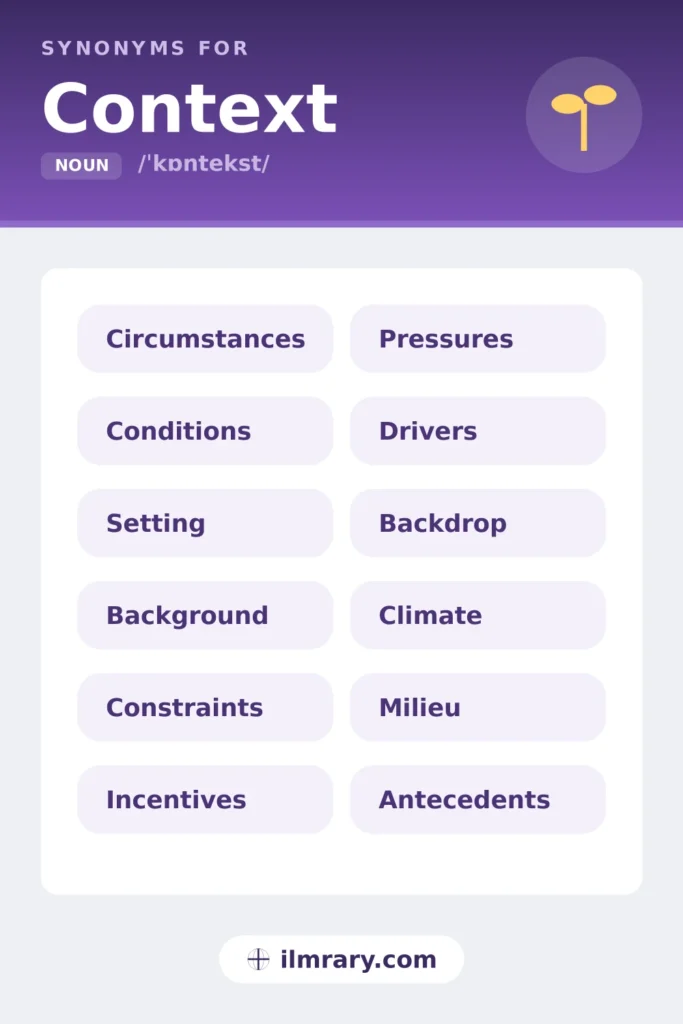
Context Words for the Situation at the Time
Situational words describe what was materially the case. They explain something the moment one of them is connected to an outcome rather than listed.
Circumstances
Academic writing
Meaning
The particular facts surrounding an event.
When to use it
It points at specifics rather than a general atmosphere, which is why legal and administrative writing prefer it. In the circumstances is a phrase that does real work.
- The circumstances included two vacancies and a system that had been live for a fortnight.
- In the circumstances the decision was defensible and in hindsight it was not.
Conditions
Academic writing
Meaning
The material state of things at the time.
When to use it
It suggests something measurable, such as staffing, funding or weather, which makes it the most concrete word in this family. Naming which condition is the whole contribution.
- Conditions in the second winter were worse and the outcome was better.
- Conditions were listed and none of them was linked to any result.
Setting
Academic writing
Meaning
Where and among whom something happened.
When to use it
Place and social arrangement rather than events, which is why qualitative research uses it for the site. It explains variation between places better than it explains change over time.
- The same intervention produced opposite results in two settings.
- Setting was described in detail and never used to explain the difference.
Background
Academic writing
Meaning
What came before and bears on the present.
When to use it
It claims relevance to what follows, which is why background sections that go unused read as padding. Everything in one should be needed later.
- The background section explains a funding change that the analysis then relies on.
- Background ran to eleven pages and two of them were used.
Backdrop
General writing
Meaning
The larger situation something took place against.
When to use it
Theatrical in origin and it implies the surroundings did not participate, which is often the point. It suits large conditions nobody could influence.
- The reform passed against a backdrop of falling revenue in every region.
- A backdrop of two elections shaped what was sayable and nothing else.
Milieu
Academic writing
Meaning
The social and cultural surroundings somebody moved in.
When to use it
It names a world rather than a place, and biography and intellectual history use it precisely. Slightly formal, and it claims the surroundings shaped the person.
- The milieu explains the vocabulary and none of the conclusions.
- A milieu in which the question could be asked and the answer could not be published.
Precedent
Academic writing
Meaning
What was done before in comparable circumstances.
When to use it
It explains by analogy, which is why legal reasoning is built on it. Its force depends entirely on whether the circumstances really were comparable.
- The precedent was thirty years old and had been distinguished twice.
- Precedent existed and nobody had looked for it before deciding.
Words for the Forces Acting on It
Force words explain rather than describe. They are what a reader wants when context is invoked, and they are the half most essays never reach.
Constraints
Academic writing
Meaning
What stopped the actors doing otherwise.
When to use it
Shared with the limitation family, where naming the kind makes it actionable. It explains a decision by showing the alternatives were unavailable.
- The binding constraint was the licence rather than the building.
- Constraints explained the choice that hindsight has been calling a failure.
Pressures
Academic writing
Meaning
Forces pushing actors toward a particular course.
When to use it
Shared with the capacity family, where naming what is under pressure is the minimum. It explains behaviour by showing what people were responding to.
- Financial pressures and inspection pressures pulled in opposite directions.
- Pressure was reported monthly for two years without a single figure attached.
Drivers
Academic writing
Meaning
Forces pushing an outcome in one direction over time.
When to use it
Shared with the cause family, where sustained influence rather than an event is implied. Policy writing uses it heavily and loosely.
- The main driver was demographic and every policy response addressed something else.
- Two drivers pulled in opposite directions and the net figure hid both.
Incentives
Academic writing
Meaning
What actors were rewarded for doing.
When to use it
Shared with the culture family, where they predict behaviour better than any stated value. They are the most explanatory contextual fact available and the least often stated.
- The incentives rewarded volume and the quality figures fell for two years.
- Incentives explained a behaviour that three reports had attributed to attitude.
Climate
Academic writing
Meaning
The prevailing mood or conditions of a period.
When to use it
Shared with the culture family, where it changes faster than culture. Political climate explains what was sayable rather than what was possible.
- The political climate made the option unsayable rather than unaffordable.
- Climate improved sharply and the same behaviours returned by autumn.
Antecedents
Academic writing
Meaning
The earlier events a situation grew out of.
When to use it
It claims a causal chain backward rather than mere chronology, which is stronger than background. Naming the link is what separates them.
- The antecedents run back to a boundary change nobody remembered.
- Antecedents were described and the connection to the outcome was assumed.
Which Context Synonym Fits Your Evidence
Connect one surrounding fact to one outcome. Situational words describe what was the case, so circumstances point at specifics, conditions suggest something measurable and are the most concrete of the family, and setting explains variation between places better than change over time. Background claims relevance, which is why anything in it that goes unused reads as padding. Force words explain rather than describe, and they are the half most essays never reach, since constraints show the alternatives were unavailable, pressures show what people were responding to, and incentives predict behaviour better than any stated value while being stated least often. Context names the whole surrounding and explains nothing until one part of it is connected to a result.
The condition and the link both need naming: circumstances or conditions for what was the case, constraints or incentives for what actually produced the outcome.
Opposite Words for Context
- Isolation
- Abstraction
- Vacuum
- Decontextualised
- In itself
Test Your Word Choice
Question 1: Which is the most explanatory contextual fact and the least often stated?
What people were rewarded for predicts their behaviour better than any stated value or mood. Climate describes prevailing conditions and a backdrop implies the surroundings did not participate.
Question 2: Which claims a causal chain backward rather than mere chronology?
Antecedents claim the earlier events a situation grew out of, which requires a link. Background claims relevance and precedent explains by analogy.
Question 3: What makes a background section padding?
Background claims relevance to what follows, so anything the analysis never relies on has broken that promise. Length and position are symptoms rather than the fault.
Common Questions About Context Synonyms
What can I write instead of in this context?
Under those staffing conditions, against a backdrop of falling revenue, or given incentives that rewarded volume: each of these replaces in this context with the condition that actually mattered. All three connect one surrounding fact to an outcome the reader can check.
Why does context in an essay often explain nothing?
Context explains nothing when it is listed rather than linked to a result. Describing a setting across half a page and never using it to account for the difference between two outcomes leaves the reader doing the work the paragraph promised. One connected fact does more than six described ones.
What is the difference between background and antecedents?
Background is what came before and bears on the present, while antecedents claim the present grew out of them. Antecedents assert a chain of causation, so the link has to be named rather than implied, and a marker who cannot find it discounts the paragraph.
When should I use milieu instead of setting?
Milieu belongs in biography and intellectual history, where the social world somebody moved in shaped what they could think and say. Setting names a place, while milieu names a whole world of company, conversation and assumption, which is the distinction to lean on when you choose it.