
How a paper got its material decides what it proves, and other ways to say observation report that. Markers grade the source first, then the point.
Observation covers a logged reading and a memory of a chat. A marker cannot tell which you had from the word alone.
A logged reading carries a method somebody can repeat. A story carries colour instead, and a paper needs both of them, kept well apart.
Observation Synonyms for Logged Readings and for Single Cases
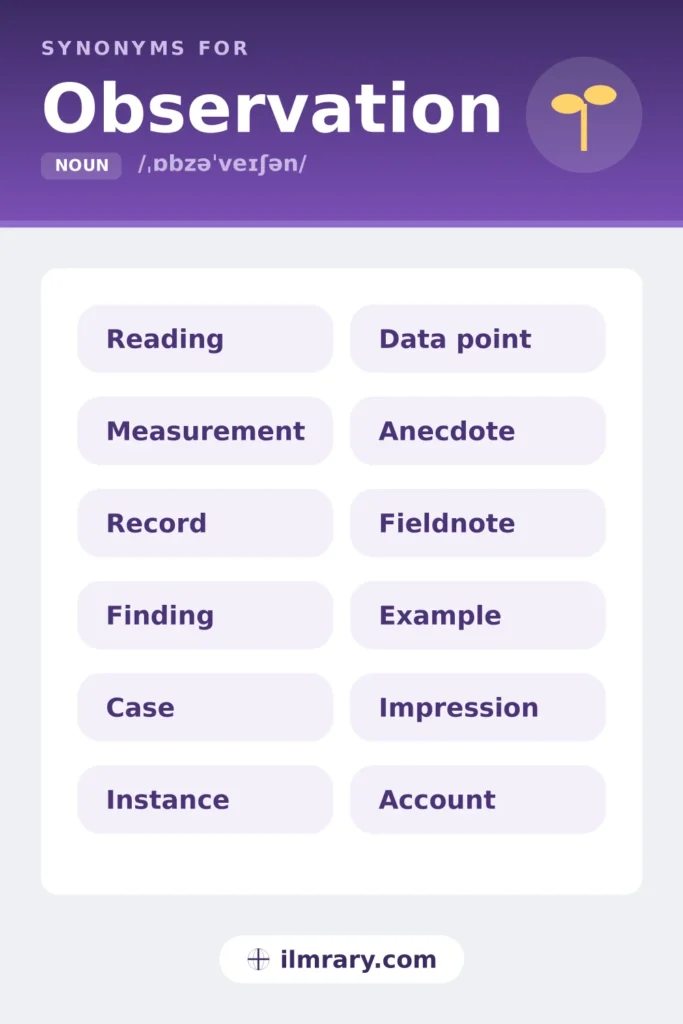
Observation Words for Structured Recording
Systematic noticing follows a method somebody could repeat. That repeatability is what turns noticing into evidence rather than impression.
Data point
Academic writing
Meaning
One value in a structured set.
When to use it
It claims membership of a series, which is where its weight comes from. A single data point is a phrase people use to dismiss something, and correctly.
- The data point sits three standard deviations out and was never investigated.
- Two thousand data points and the interesting one was excluded as an outlier.
Reading
Academic writing
Meaning
A measurement taken from an instrument.
When to use it
Shared with the claim family in a wholly different sense. Here it implies calibration and a device, so the accuracy question is about the instrument rather than the observer.
- Readings were taken hourly across the whole heating season.
- The reading drifted by two degrees and the calibration record explained why.
Fieldnote
Academic writing
Meaning
A record made at the time of observing.
When to use it
Contemporaneity is the whole claim, since a fieldnote written afterwards is a reconstruction. Ethnography treats the distinction as fundamental.
- Fieldnotes ran to four hundred pages across eleven months.
- Fieldnotes written the same evening captured detail the interviews had missed.
Measurement
Academic writing
Meaning
A quantity determined against a standard.
When to use it
It claims a unit and a method, which is what separates it from an impression. Uncertainty belongs beside it and usually goes missing.
- Measurements were repeated by a second observer on a tenth of the sample.
- The measurement was precise and the definition it measured was contested.
Record
Academic writing
Meaning
Something set down so it can be referred to.
When to use it
Shared with the note family, where permanence is the claim. Administrative records are the largest and most underused observational source in most fields.
- The records survive from 1911 and nobody had read them as data.
- Records were complete and the coding practice changed twice within them.
Finding
Academic writing
Meaning
Something an investigation established.
When to use it
Shared with the insight family, where discovery rather than compilation is claimed. It ranks above observation because a method stands behind it.
- The finding held across every subgroup except the smallest.
- Findings were accepted in full and the recommendations were not.
Sample
Academic writing
Meaning
The set of cases actually examined.
When to use it
How it was drawn decides what it supports, which is why the frame matters more than the size. Convenience sampling is the commonest unstated weakness.
- The sample was drawn from the housing list and excluded everybody not on it.
- A sample of four hundred, self-selected, described as representative.
Words for Single or Unstructured Instances
Individual instances count for something only when they are honest about being individual. Their value is often in raising a question rather than answering one.
Case
Academic writing
Meaning
One instance examined in its own right.
When to use it
Depth rather than number is the claim, and case study methodology defends that deliberately. Selection is where the argument lives, so say how the case was chosen.
- The case was chosen because it was atypical rather than despite it.
- Two cases in the same region reached opposite outcomes on identical facts.
Anecdote
General writing
Meaning
A single story offered as illustration.
When to use it
It admits it is one instance chosen after the fact, which is honest and is why anecdote is treated as the opposite of data. Its power is memory rather than proof.
- The anecdote circulated for years and the figures never supported it.
- An anecdote that opened the report was the only part anybody quoted.
Example
Academic writing
Meaning
One instance given to make something concrete.
When to use it
It illustrates rather than proves, which is the distinction undergraduate writing loses most often. One example illustrates and never demonstrates.
- The example makes the mechanism visible without establishing that it is common.
- Three examples were given and all three came from one authority.
Instance
Academic writing
Meaning
One occurrence of something.
When to use it
It is the plainest countable unit here, and it claims occurrence without claiming typicality. Counting instances is how a pattern gets established.
- Eleven instances were identified across four years of records.
- A single instance became a policy that outlived everybody involved.
Impression
General writing
Meaning
An unstructured sense of how something is.
When to use it
It admits no method at all, which makes it honest and weak. Naming something as an impression protects everything around it from being read as evidence.
- The impression was of a service under strain and the figures did not show it.
- Impressions from the visit prompted the audit that followed.
Account
Academic writing
Meaning
Somebody's narrative of what happened.
When to use it
Shared with the report family, where it claims a telling rather than an analysis. Whose account it is matters more than what it says.
- Her account of the incident matched the log to the minute.
- Two accounts of the same meeting disagreed on what had been agreed.
Which Observation Synonym Fits Your Evidence
Say how the noticing happened. Structured recording claims a method somebody could repeat, so a data point claims membership of a series, a fieldnote claims contemporaneity that a reconstruction cannot, and a measurement claims a unit and a standard with uncertainty that usually goes missing. A sample is defined by how it was drawn rather than how large it is. Single instances count only when honest about being single, so a case claims depth and lives or dies on how it was chosen, an anecdote admits it was picked after the fact, and an impression admits no method at all, which protects everything around it. Observation covers both kinds, and a reader assumes the stronger one unless told otherwise.
The method belongs beside the noticing: data point or fieldnote where a system existed, case or anecdote where one instance is honestly what you have.
Opposite Words for Observation
- Speculation
- Assumption
- Inference
- Conjecture
- Hearsay
Test Your Word Choice
Question 1: What decides what a sample supports?
The sampling frame decides which population the results apply to, so a large convenience sample supports less than a small random one. Size and response rate matter within that limit.
Question 2: Which admits it was chosen after the fact?
An anecdote is a single story offered as illustration and selected retrospectively, which is why it is treated as the opposite of data. A case is chosen by method and an instance is merely an occurrence.
Question 3: Which loses its value entirely if written later?
A fieldnote's claim is that it was made at the time, so one written afterwards is a reconstruction. Measurements and records can be transcribed without losing their standing.
Common Questions About Observation Synonyms
What can I write instead of observation in research writing?
Observation covers too much ground on its own, so name how the noticing happened: data point where it belongs to a series, fieldnote where it was written down at the time, case where one instance was examined in depth, and impression where no method stood behind it.
Why is a single data point not enough evidence?
Single data points take their meaning from the series they belong to, and alone one has none. A value three standard deviations out is a question worth asking rather than a finding worth reporting, and presenting it as evidence is what the phrase about one data point warns against.
Is an anecdote worth including in a research paper?
An anecdote earns its place in a research paper as illustration and never as evidence. Calling it an anecdote is what stops a reader mistaking one for the other. A report whose only quoted passage is the anecdote has told you what its evidence base looks like.
What makes a case study defensible?
Saying how the case was chosen makes a case study defensible. A case picked because it was atypical can be defended in a way one picked because it was available cannot, and stating that reason is most of the methodology a reader needs to judge the work.