
Pointing at something and praising it are different acts, and another word for highlight decides which you reported. A slip here credits an author with a view they never took.
Highlighted stays neutral on the surface and rarely is. It marks a passage as worth attention and hints at an approval you never wrote.
Neutral pointing names a passage and stops. Evaluative wording adds a verdict, and a marker will ask where the verdict came from.
Highlight Synonyms for Neutral Pointing and for a Verdict
Where Highlight Means Neutral Selection
Selection words pick one part without evaluating it. Reports and literature reviews depend on them because they let the evidence keep the argument rather than the vocabulary.
Single out
Academic writing
Meaning
To pick one item from a set for particular notice.
When to use it
The most explicit about the act of choosing, which is why it invites the question of why that one. It works equally for praise and blame, so context decides the flavour.
- The inspectors singled out one authority in an otherwise unremarkable region.
- Reviewers singled out the third chapter and ignored the rest.
Foreground
Academic writing
Meaning
To move something into the reader's immediate view.
When to use it
Shared with the emphasize family, where it names rearrangement rather than volume. Critical and cultural analysis treat it as the standard verb for changing what a text seems to be about.
- The introduction foregrounds gender where the earlier study foregrounded class.
- Foregrounding the footnotes turns a dry survey into an argument.
Spotlight
General writing
Meaning
To direct concentrated attention onto one thing.
When to use it
Journalism keeps it current and academic prose borrows it sparingly, since the theatrical metaphor is still audible. It implies the surrounding material went dark.
- The documentary spotlighted a single ward and the funding followed within months.
- Spotlighting one failure obscured the twenty that had been prevented.
Point to
General writing
Meaning
To indicate something as relevant to the argument.
When to use it
The plainest option and the most modest, since pointing claims nothing about weight. It suits describing a source whose emphasis you do not share.
- Critics point to the missing correspondence rather than the published work.
- The figures point to a decline that began well before the closure.
Flag
General writing
Meaning
To mark something for later attention.
When to use it
Bureaucratic in origin and now standard in reporting and review, where flagging is an action with a record behind it. It implies the matter is unresolved.
- The audit flagged three transactions and cleared two of them within a week.
- She flagged the inconsistency in draft and the final version kept it.
Note
Academic writing
Meaning
To record something as worth the reader's awareness.
When to use it
The quietest verb here, and its restraint is what recommends it when the point is small. Overusing it produces prose that observes everything and argues nothing.
- The editors note a discrepancy in the dating and leave it unexplained.
- It is worth noting that both surveys used the same flawed sampling frame.
Identify
Academic writing
Meaning
To name something previously unspecified.
When to use it
It claims discovery rather than emphasis, so the thing should not have been named already. Research writing uses it precisely and student writing often stretches it.
- The review identifies four mechanisms, only two of which had been described before.
- Identifying the source of the error took longer than correcting it.
Words That Carry a Verdict
Evaluative words make the selection and pass judgement in the same word. Words read them as argument, so the surrounding sentences have to support what the word already assumed.
Expose
General writing
Meaning
To make visible something that was concealed.
When to use it
Shared with the show family, where it implies somebody preferred the thing hidden. Investigative and critical writing carry it and neutral summary cannot.
- The audit exposed a gap between the published figures and the returns.
- Her reading exposes an assumption the whole tradition had left unexamined.
Showcase
General writing
Meaning
To display something to its best advantage.
When to use it
Approval is built in and so is the suggestion of arrangement, which makes it wrong for anything critical. Marketing and exhibition writing own it.
- The anthology showcases writers the mainstream presses had passed over.
- Showcasing the successes tells you nothing about the base rate.
Celebrate
General writing
Meaning
To draw attention to something with open approval.
When to use it
Endorsement is explicit, so it describes a source's attitude rather than your own findings. Cultural and historiographical writing use it about how a subject was treated.
- Victorian accounts celebrate an engineer whose safety record was among the worst.
- The exhibition celebrates the movement and never examines its funding.
Lay bare
General writing
Meaning
To strip something back so its workings are visible.
When to use it
More forceful than expose and more literary, and it suggests thoroughness rather than scandal. Critical and historical writing carry it well.
- The correspondence lays bare a negotiation the minutes had smoothed over.
- Two chapters lay bare the accounting that made the scheme look solvent.
Stress
Academic writing
Meaning
To mark something as deserving particular attention.
When to use it
Shared with the emphasize family, where it is the neutral workhorse. Set beside the evaluative verbs here it reads as deliberately withheld judgement.
- Keynes stresses expectation rather than the interest rate itself.
- The guidance stresses consent at every stage.
Dwell on
General writing
Meaning
To give something more attention than its weight deserves.
When to use it
Mild criticism is built in, since dwelling implies the writer should have moved on. It describes a source's proportions rather than its claims.
- The biography dwells on the quarrel and skips the decade of work after it.
- Rather than dwell on the failure, the report turns to what replaced it.
Choosing a Highlight Synonym an Examiner Will Accept
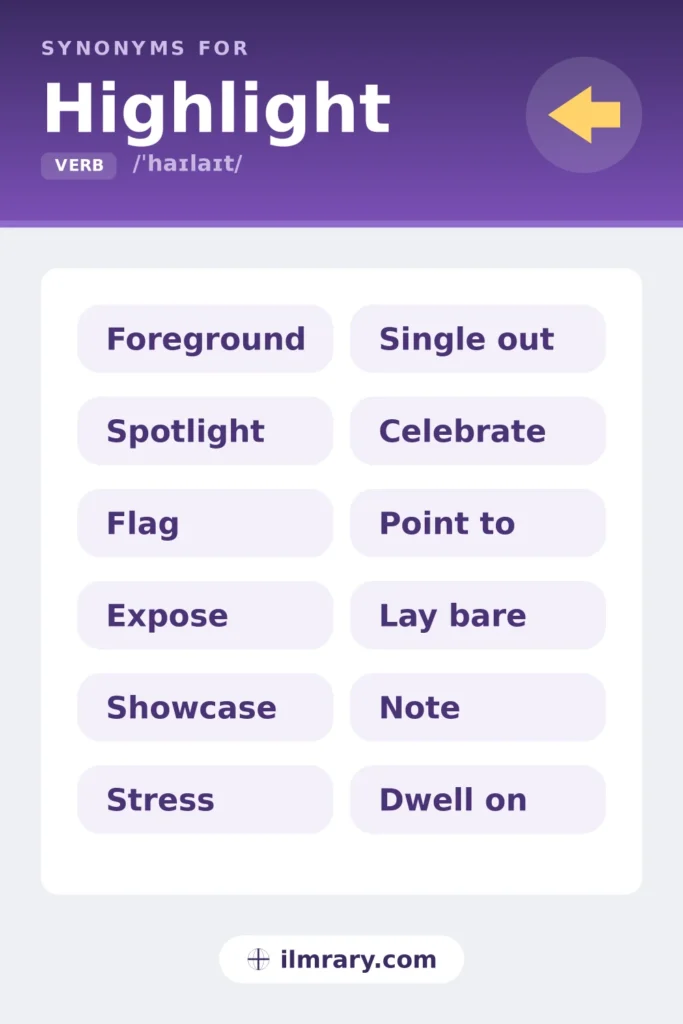
Separate the pointing from the judging. Neutral selection runs from note, which barely raises its voice, through point to and flag, which mark without weighing, to single out and foreground, which admit the choosing and change what a reader meets first. Evaluative selection carries the verdict inside the verb, so expose and lay bare assume something was hidden, showcase and celebrate assume approval, and dwell on assumes the attention was disproportionate. Identify belongs to neither, since it claims the thing had not been named before. Highlight itself is neutral and overused, which makes it safe and forgettable in equal measure.
Pointing and judging are different jobs. Note, flag and single out for the first, expose, showcase and dwell on for the second, once the argument has done the work.
Opposite Words for Highlight
- Overlook
- Downplay
- Obscure
- Omit
- Bury
Test Your Word Choice
Question 1: Which verb assumes somebody preferred the thing to stay hidden?
Expose makes visible what was concealed, and concealment implies intent. Flag marks something for attention and single out picks one item from a set.
Question 2: The biography spends forty pages on a quarrel and a paragraph on the work. Which verb reports that?
Dwell on carries the criticism that the attention outran the weight. Foreground describes rearrangement without judgement and note barely raises its voice.
Question 3: Which verb claims the thing had not been named before?
Identify names something previously unspecified, so it claims discovery. Spotlight concentrates attention and stress marks importance, and both assume the thing was already there.
Highlight Synonyms: Questions Students Ask
What can I use instead of highlight in an essay?
Instead of highlight, use note where the point is small, point to where you are reporting without agreeing, single out where the choosing is the interesting part, and foreground where the source changed what a reader meets first. All four say which of those you did, and highlight says none of them.
Is highlight too informal for academic writing?
Highlight is not too informal for academic writing, and it appears in published papers constantly. What markers object to is repetition rather than tone, since the same verb introduces every source in a weak draft. Variety fixes that, and nothing about the word needs replacing on grounds of formality.
When should I avoid the verb expose in an essay?
Avoid expose whenever nothing was actually hidden. A published table exposes nothing, because it was printed to be read, and the verb claims a concealment the evidence will not support. Where the source merely reports a finding, note or point to describes what happened.
What is the difference between flag and note?
Flag implies the matter is unresolved and somebody will return to it, while note implies the point is recorded and closed. Audit and review writing keep that distinction sharp, and general prose blurs it. In an essay, flag a gap you intend to address later and note one you do not.