
Where a reading stands in a debate is half its weight, and synonyms for interpretation place it. Two words for the same view can rank it very differently.
Interpretation stays neutral about that. A settled scholarly view and a single contested reading both count, and a marker separates them.
A reading can be described on its own terms. It can also be placed against what the field already accepts, and a marker credits the second more.
Interpretation Synonyms for a Reading and for a Contested Position
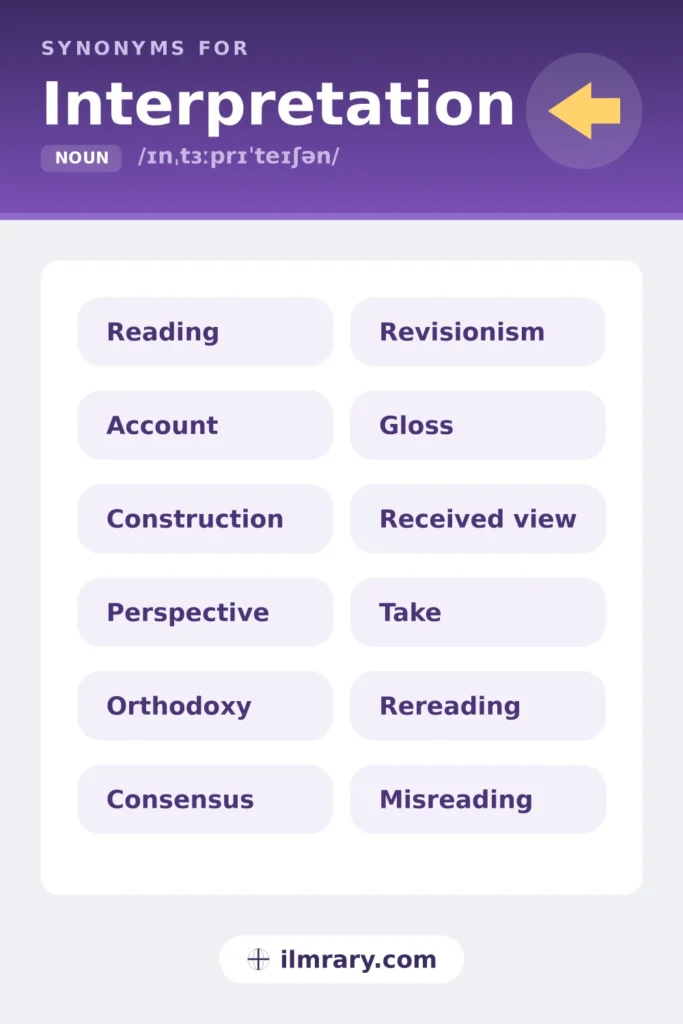
Interpretation Words for a Reading Among Others
Reading words concede that alternatives exist. Their strength is that they invite argument rather than pretending the question was settled.
Reading
Academic writing
Meaning
One interpretation among several a text will bear.
When to use it
Shared with the claim family, where rivals are admitted by the word itself. Defending one means showing it fits more of the material than its competitors.
- The reading is persuasive and rests on a passage never quoted in full.
- Two readings fit the poem and the chapter argues for the harder one.
Account
Academic writing
Meaning
An explanation of how something came about.
When to use it
Shared with the report family, where a telling rather than an analysis is claimed. In historiography it names a rival explanation rather than a narrative.
- The standard account puts the cause in the legislation and the archive disagrees.
- Two accounts of the same decade share no causal claims at all.
Construction
Academic writing
Meaning
The way a text or a rule is taken to mean something.
When to use it
Legal usage fixes it, where the construction of a clause decides cases. It implies deliberate interpretive work rather than an impression.
- The narrow construction of the duty survived until the appeal.
- A construction that nobody had proposed decided the whole matter.
Gloss
Academic writing
Meaning
A brief explanation of what something means.
When to use it
Shared with the summarise family, where it clarifies without stopping the argument. As a criticism, calling something a gloss says it explained too easily.
- The editor glosses two terms the modern reader would otherwise miss.
- The chapter offers a gloss where an argument was needed.
Take
General writing
Meaning
Somebody's particular view of something.
When to use it
Informal and personal, and it claims a view without claiming a defence. Journalism and commentary use it and formal prose does not.
- Her take on the reforms was the only one that predicted the outcome.
- A take rather than an argument, which the piece never pretends otherwise.
Perspective
Academic writing
Meaning
A position from which something is viewed.
When to use it
It names where somebody stands rather than what they concluded, which is why it explains disagreement without resolving it. Overuse has thinned it considerably.
- From a clinical perspective the delay is the whole problem and from a financial one it is not.
- Perspective was invoked in every paragraph and specified in none.
Lens
Academic writing
Meaning
A framework brought deliberately to a subject.
When to use it
It admits the framework shapes what is visible, which is honest and can excuse a great deal. Naming the lens is what makes the reading arguable.
- Reading the accounts through a gender lens surfaced the unpaid work entirely.
- A lens that makes one thing visible makes something else disappear.
Words for Readings That Contest a Settled View
Contesting readings position themselves against something. Naming what they are arguing with is what a word looks for, and most essays leave it out.
Orthodoxy
Academic writing
Meaning
The reading a field currently accepts.
When to use it
It names the position everybody argues against without needing to defend, which is what makes it powerful. Identifying it correctly is half of any historiographical essay.
- The orthodoxy held for thirty years on a single misread table.
- Nothing in the article challenges the orthodoxy it claims to overturn.
Revisionism
Academic writing
Meaning
A reading that deliberately reverses the accepted one.
When to use it
It announces the contest in its own name, and in political usage it carries an accusation that scholarship does not. Naming which orthodoxy is being revised is essential.
- The revisionist account moved the cause forward by a decade and survived.
- Revisionism became the orthodoxy within fifteen years and attracted its own revisionists.
Consensus
Academic writing
Meaning
Broad agreement among those qualified to judge.
When to use it
It claims agreement rather than truth, which is why consensus can be wrong and still be the consensus. Saying how wide and how recent it is matters.
- The consensus formed quickly and rested on two studies that were never replicated.
- Consensus on the mechanism and disagreement on everything downstream of it.
Received view
Academic writing
Meaning
What is generally taken to be so.
When to use it
It carries a faint scepticism, since calling something the received view usually precedes attacking it. It names transmission rather than evidence.
- The received view came from a textbook rather than from any study.
- Two generations inherited the received view without anybody rechecking the source.
Rereading
Academic writing
Meaning
A fresh interpretation of familiar material.
When to use it
It claims nothing new was found and that the old material yields more, which is the commonest form of literary contribution. Its modesty is honest.
- The rereading uses no new sources and changes what all of them mean.
- A rereading of the correspondence rather than a discovery in it.
Misreading
Academic writing
Meaning
An interpretation the material does not support.
When to use it
It claims error rather than difference, which is a much stronger accusation than disagreement. Showing what the text actually says is the whole burden.
- The misreading rests on a translation nobody had checked.
- Calling it a misreading rather than a disagreement obliged the author to prove it.
Telling the Interpretation Synonyms Apart
Say how contested the reading is. Neutral words concede that rivals exist, so reading admits alternatives by its own name, construction implies deliberate interpretive work and decides cases in law, and lens names the framework openly, which is honest and can excuse a great deal. Take is a view without a defence and belongs to commentary. Contesting words position themselves, and naming what they argue with is what most essays omit, since an orthodoxy is the position nobody has to defend, revisionism announces the reversal in its own name, and received view carries a scepticism that usually precedes an attack. Misreading claims error rather than difference, which is a far larger burden. Interpretation covers all of it and locates nothing.
Position the reading, lens or construction where the framework is the point, orthodoxy or revisionism where the argument is with somebody in particular.
Opposite Words for Interpretation
- Fact
- Measurement
- Literal meaning
- Consensus
- Misreading
Test Your Word Choice
Question 1: Which names the position nobody has to defend?
An orthodoxy is what a field accepts and therefore argues from rather than for. Consensus claims agreement among the qualified and perspective names a vantage point.
Question 2: Which claims error rather than difference?
Calling something a misreading asserts the material does not support it, which is a heavier burden than disagreeing. Rereading finds more in familiar material and revisionism reverses an accepted account.
Question 3: Which uses no new sources and changes what the old ones mean?
A rereading claims the familiar material yields more, which is the commonest form of literary contribution. Construction is deliberate interpretive work and a gloss is a brief explanation.
Questions That Follow an Interpretation Claim
What can I write instead of my interpretation is?
Replace my interpretation is with this reading, which concedes that alternatives exist, or the account offered here, which proposes a rival explanation. Both position the interpretation against something instead of presenting it as the only one available to the reader.
Why does naming the orthodoxy matter in an essay?
Naming the orthodoxy matters because an argument needs somebody to be arguing with. An essay claiming to overturn a settled view without saying whose view it was gives a marker nothing to check the claim against, and the reversal reads as assertion.
Is admitting a lens a weakness in academic writing?
Admitting a lens is honesty that strengthens the reading rather than a weakness. Saying that a gender lens surfaced the unpaid work tells a reader what became visible and, by implication, what the same lens pushed out of view.
Can a consensus be wrong?
Consensus can be wrong routinely, because the word claims agreement rather than truth. Saying how wide the consensus is, how recent it is and whether it rests on replicated work turns the term into information a marker can weigh.