
Essay instructions use words that sound simpler than they are. Other ways to say compare belong to that group.
Compare is the widest of them. It can mean placing two things side by side, or measuring one against the other, and a marker cannot tell which you intended.
What each one asks you to do is the difference. Some words look for similarities. Some look for differences. Others set one thing against a fixed standard. Naming the task in your own words makes the paragraph easier to write and easier to follow.
Compare Synonyms for Finding Differences and Setting Sources Together
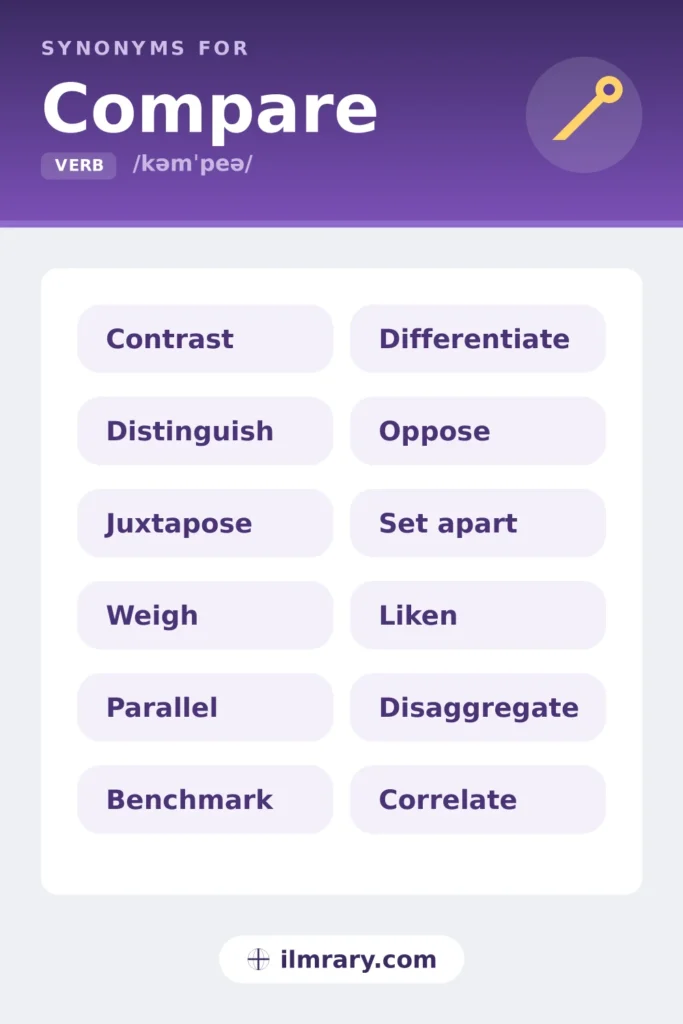
Where Compare Means Finding Differences
Difference words separate things that a reader might otherwise run together. Precision here is what stops an essay treating two cases as interchangeable when they are not.
Contrast
Academic writing
Meaning
To set out how two things differ.
When to use it
Difference rather than similarity is the whole job, so a contrast that finds agreement has misused the word. It expects the difference to be the point.
- The chapter contrasts the two funding regimes and never explains their common origin.
- In contrast, the Scottish scheme kept its original eligibility rules.
Distinguish
Academic writing
Meaning
To mark the line between two things that get confused.
When to use it
It claims the confusion was real and worth ending, which makes it the sharpest verb in conceptual writing. Naming the criterion is what completes it.
- The paper distinguishes influence from authority and the argument turns on that line.
- Distinguishing outputs from outcomes changed how the whole programme was judged.
Differentiate
Academic writing
Meaning
To identify what makes something different in kind.
When to use it
Slightly more technical than distinguish and common in biology, marketing and taxonomy. It suggests a property that separates rather than a line somebody drew.
- Two features differentiate the northern sites from every other group.
- Nothing in the data differentiates the two cohorts once age is controlled for.
Oppose
Academic writing
Meaning
To set two things against each other as alternatives.
When to use it
It claims the two exclude each other, which is a stronger assertion than difference. Many oppositions in essay writing turn out to be false ones.
- The literature opposes structure and agency more sharply than the evidence supports.
- Opposing the two accounts hides how much they share.
Set apart
General writing
Meaning
To identify what makes one case unusual.
When to use it
It singles out one item rather than comparing two evenly, which suits case selection. Plainer than differentiate and easier to read.
- What sets the 1961 survey apart is that it recorded refusals.
- One feature sets the case apart and the chapter builds on it.
Disaggregate
Academic writing
Meaning
To break a combined figure into its parts.
When to use it
It reveals differences hidden inside an average, which is why policy analysis relies on it. The word is technical and the operation is often the whole finding.
- Disaggregating by tenure showed two opposite trends inside one flat national figure.
- The headline held and disaggregation broke it apart entirely.
Discriminate
Academic writing
Meaning
To tell two things apart reliably.
When to use it
The technical sense about telling apart survives in measurement and psychology, while the everyday sense is about unfair treatment. That collision makes it risky outside specialist writing.
- The test discriminates between the two conditions at every severity level.
- No measure in the study discriminates between the groups.
Words for Placing Things Side by Side
Placement words bring two things into view without necessarily judging between them. Whether a judgement follows is the difference that matters most to a word.
Juxtapose
Academic writing
Meaning
To place two things together so the reader sees the relation.
When to use it
Judgement is deliberately withheld, which is why literary and visual analysis use it. The effect belongs to the reader rather than the writer.
- Juxtaposing the two prefaces makes the shift of tone obvious without comment.
- The exhibition juxtaposes the drawings and the account books.
Weigh
Academic writing
Meaning
To assess two things against each other before deciding.
When to use it
A judgement is coming, which is what separates it from juxtapose. Saying what tipped the balance is the part that earns the verb.
- The chapter weighs cost against access and comes down on access.
- Weighing the two accounts takes a paragraph and settles the rest of the argument.
Benchmark
Academic writing
Meaning
To measure something against a comparable standard.
When to use it
Shared with the target family, where the comparison group is the argument. It ranks rather than describes, so a like-for-like defence is expected.
- Benchmarked against four similar authorities and ranked second on cost.
- Benchmarking against the wrong peer group flattered the whole report.
Parallel
Academic writing
Meaning
To show two things running along the same lines.
When to use it
It claims structural resemblance rather than mere similarity, so the shape has to match. Historical writing uses it and readers test it immediately.
- The two reform periods parallel each other closely until the final year.
- A parallel that holds for a decade and then breaks is worth the whole chapter.
Liken
General writing
Meaning
To say one thing resembles another.
When to use it
It claims resemblance in one respect rather than across the board, which is what keeps a comparison honest. The respect is what belongs in the sentence.
- He likens the process to sedimentation and means only the slowness.
- Likening the two systems misled everybody who had not read the footnote.
Correlate
Academic writing
Meaning
To show two quantities moving together.
When to use it
Shared with the insight family, where association is claimed and cause denied. Naming the confounder you checked is what earns a reader's trust.
- The two measures correlate strongly and neither causes the other.
- Correlating the series exposed a reporting change rather than a real effect.
Matching a Compare Synonym to the Strength of Your Claim
Say why the two things are beside each other. Difference verbs separate, so contrast expects the difference to be the point, distinguish claims a real confusion is being ended and needs its criterion named, and disaggregate breaks an average apart to reveal opposite trends inside it. Oppose claims the two exclude each other, which is stronger than most essays can support. Placement verbs bring things into view, and whether judgement follows is the whole distinction, since juxtapose withholds it deliberately and weigh promises it is coming. Parallel claims structural resemblance that readers immediately test, and liken claims resemblance in one named respect. Compare covers all of it and states no purpose at all.
The purpose is what to name: contrast or distinguish where the difference counts, juxtapose where the reader should judge, weigh where you will.
Opposite Words for Compare
- Conflate
- Equate
- Confuse
- Lump together
- Overlook differences
Test Your Word Choice
Question 1: Which verb deliberately withholds the judgement?
Juxtapose places two things together and leaves the effect to the reader. Weigh promises a judgement is coming and benchmark ranks against a standard.
Question 2: A flat national figure hid two opposite trends. Which verb names the operation that found them?
Disaggregating breaks a combined figure into its parts and reveals what an average concealed. Contrast sets out differences and liken claims resemblance.
Question 3: Which verb claims the two things exclude each other?
Oppose sets two things against each other as alternatives, which is stronger than difference. Differentiate identifies what separates them and parallel claims they run along the same lines.
Compare Synonyms: What Tutors Ask Next
What can I write instead of compare and contrast?
Swap compare and contrast for distinguish where a real confusion needs ending, weigh where a judgement follows, juxtapose where the reader should draw the line, and disaggregate where an average is hiding the difference. Each states the purpose that compare leaves out.
What is the difference between contrast and distinguish?
Contrast sets out how two things differ, and distinguish draws a line between two things that were being run together. Distinguish claims the confusion mattered and needs its criterion named, which makes it the stronger analytical move and the riskier one.
Is oppose too strong for most essays?
Oppose is too strong for most essays, because it asserts that two alternatives exclude each other. A great many oppositions in the literature turn out to be false ones the evidence never supported, and a marker who spots that reads the rest of the paragraph sceptically.
Should I use discriminate in an essay?
Discriminate belongs in measurement and psychology, where telling apart reliably is the standard technical sense. Anywhere else the everyday meaning about unfair treatment arrives first and derails the sentence, so differentiate or distinguish is the safer verb in an essay.