
Essays have to report how much thought an author gave, and consider synonyms do that work. Markers read that line closely in every essay.
Considered says nothing about how much. A page of argument and one line in passing both count, and a marker sees the gap.
Weighing one source against another is one report. A line in passing is a second, and the gap between them shows how far the author went.
Another Word for Consider for Real Weighing and for a Passing Mention
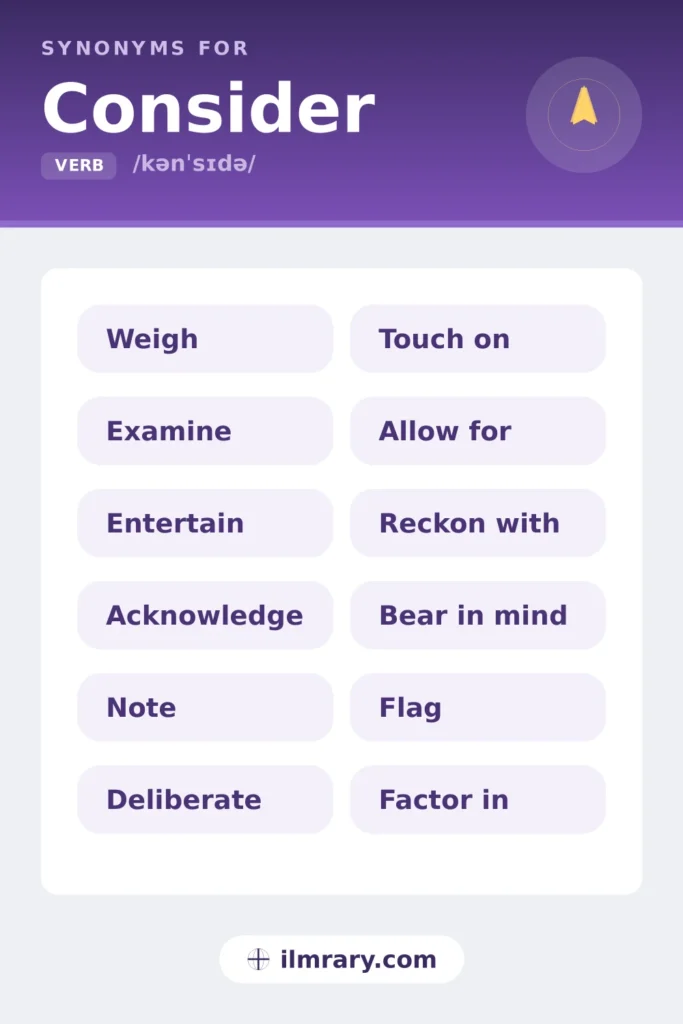
Where Consider Means Giving Real Attention
Serious attention changes something downstream. Their evidence is that the argument reads differently afterwards, which a word will check.
Weigh
Academic writing
Meaning
To assess two or more things against each other before deciding.
When to use it
Shared with the compare family, where a judgement is coming. Saying what tipped the balance is the part that earns the verb.
- The chapter weighs cost against access and comes down on access.
- Weighing the two accounts takes a paragraph and settles the rest of the argument.
Take into account
Academic writing
Meaning
To let something affect the conclusion reached.
When to use it
It claims the thing changed the outcome, which is a testable statement rather than a courtesy. Administrative and legal writing use it because decisions can be challenged on it.
- Took into account the two objections and the recommendation changed as a result.
- Every relevant factor was taken into account and the reasons were recorded.
Examine
Academic writing
Meaning
To look at something closely and in order.
When to use it
Shared with the explore family, where it is the safe neutral middle. It claims attention without claiming any conclusion.
- Examined every case file from the two years before the policy changed.
- The chapter examines three explanations and rejects the first.
Entertain
Academic writing
Meaning
To consider a position seriously without adopting it.
When to use it
Shared with the argue family, where taking an objection properly is a real intellectual virtue. It costs a page and buys the whole argument.
- The author entertains the materialist reading for a chapter and rejects it carefully.
- Entertaining the objection properly costs a page and buys the whole argument.
Reckon with
General writing
Meaning
To face something that cannot be argued away.
When to use it
It implies the thing is inconvenient and unavoidable, which is why it appears when a field has been ignoring something. Slightly informal and forceful.
- The literature has yet to reckon with the missing decade of data.
- Reckoning with the cost changed the whole recommendation.
Deliberate
Academic writing
Meaning
To think carefully over a period before deciding.
When to use it
Time and formality are both implied, so committees and juries deliberate and individuals mostly do not. It names a process rather than a mental act.
- The panel deliberated for two days and gave written reasons.
- Deliberation was scheduled for an hour and took three.
Factor in
General writing
Meaning
To include something in a calculation or judgement.
When to use it
It implies quantification even where none exists, which makes it precise in modelling and loose everywhere else. Naming how much it counted is what saves it.
- Factored in the seasonal effect and the difference disappeared.
- Factored in without any weighting, which is another way of saying mentioned.
Words for Acknowledging in Passing
Light attention notices something without letting it change anything. Naming it honestly is better than dressing it up, since a word can see the argument was unaffected.
Note
Academic writing
Meaning
To record something as worth the reader's awareness.
When to use it
Shared with the highlight family, where restraint is what recommends it. Overusing it produces prose that observes everything and argues nothing.
- The editors note a discrepancy in the dating and leave it unexplained.
- It is worth noting that both surveys used the same flawed sampling frame.
Acknowledge
Academic writing
Meaning
To admit something that counts against your position.
When to use it
It concedes rather than merely mentions, which is why acknowledging a limitation reads as candour. What follows decides whether the concession was real.
- The paper acknowledges the sampling problem and proceeds as though it did not exist.
- Acknowledging the counter-evidence early made the conclusion harder to dismiss.
Touch on
General writing
Meaning
To mention something briefly without developing it.
When to use it
It admits the treatment was slight, which is honest in a literature review and damning in a conclusion. Its modesty is the point.
- The chapter touches on funding and never returns to it.
- Touching on the objection is not the same as answering it.
Allow for
Academic writing
Meaning
To make room for something that might affect the result.
When to use it
It claims provision rather than analysis, so allowing for something and measuring it are different acts. Statistical and planning writing keep the distinction.
- The model allows for seasonal variation and does not estimate it.
- Allowed for a delay that arrived a year later than the contingency assumed.
Bear in mind
General writing
Meaning
To keep something present while reading or deciding.
When to use it
It asks the reader to do the work rather than doing it yourself, which is why it appears where an author has run out of room. Conversational in tone.
- Bear in mind that the two surveys used different definitions.
- Bearing it in mind is not the same as adjusting for it.
Flag
General writing
Meaning
To mark something so somebody looks at it.
When to use it
Shared with the highlight family, where the matter stays unresolved by implication. It passes the problem forward rather than addressing it.
- Flagged the inconsistency in draft and the final version kept it.
- Flagged three risks and one of them arrived exactly as described.
Choosing a Consider Synonym an Examiner Will Accept
Say whether the argument changed. Real attention leaves a mark downstream, so weigh promises a judgement and needs the tipping factor named, take into account claims the outcome altered and can be challenged on that, and entertain claims an objection was taken properly rather than knocked down. Reckon with implies the thing is unavoidable and the field has been avoiding it. Light attention notices without changing anything, and honesty here reads better than inflation, since acknowledge concedes something that counts against you, touch on admits the treatment was slight, and bear in mind hands the work to the reader. Consider spans the whole range, which is why markers treat it as a signal that a paragraph is about to do nothing.
How far the thought went is the reportable part: weigh or take into account where the conclusion moved, acknowledge or note where it honestly did not.
Opposite Words for Consider
- Ignore
- Dismiss
- Overlook
- Disregard
- Brush aside
Test Your Word Choice
Question 1: Which verb makes a claim that could be challenged on review?
Taking something into account asserts the conclusion was affected, which decisions can be contested on. Note records awareness and touch on admits brief treatment.
Question 2: Which admits the treatment was slight?
Touch on concedes something was mentioned without development. Examine claims close ordered attention and deliberate names a formal process over time.
Question 3: Which hands the work to the reader?
Bear in mind asks the reader to hold something while reading rather than adjusting for it yourself. Allow for makes provision and weigh promises a judgement.
Consider Synonyms: Questions Students Ask
What can I write instead of the chapter considers?
Instead of the chapter considers, write weighs where a judgement follows, takes into account where the conclusion changed, examines where the attention was close, and acknowledges where the point counts against the argument. Each tells a marker what the paragraph did.
Why do markers distrust the word consider?
Markers distrust consider because it so often introduces a paragraph that changes nothing downstream. Where the argument reads identically with that paragraph deleted, the verb was doing the work of pretending otherwise, and a marker will test exactly that.
Is acknowledging a limitation a weakness in an essay?
Acknowledging a limitation becomes a weakness only when nothing follows it. Conceding a sampling problem and then proceeding as though it did not exist reads worse than never raising it, and adjusting the claim afterwards is what makes the concession count.
What is the difference between allowing for and adjusting for?
Allowing for makes room for something, and adjusting for measures its effect and removes it. A model that allows for seasonal variation without estimating it has adjusted for nothing, and a marker reading the methods section will say so.