
How bad it got is what a panel asks first, and another word for conflict settles it. The scale you name is the claim you make.
Conflict covers the mild and the serious alike. A tense meeting and a formal grievance both count, so the word gives a reader no scale.
Early friction reads as a working problem. A formal stage reads as a process on record, and a recruiter treats the second as something that reached HR.
Conflict Synonyms From Everyday Friction to a Formal Grievance
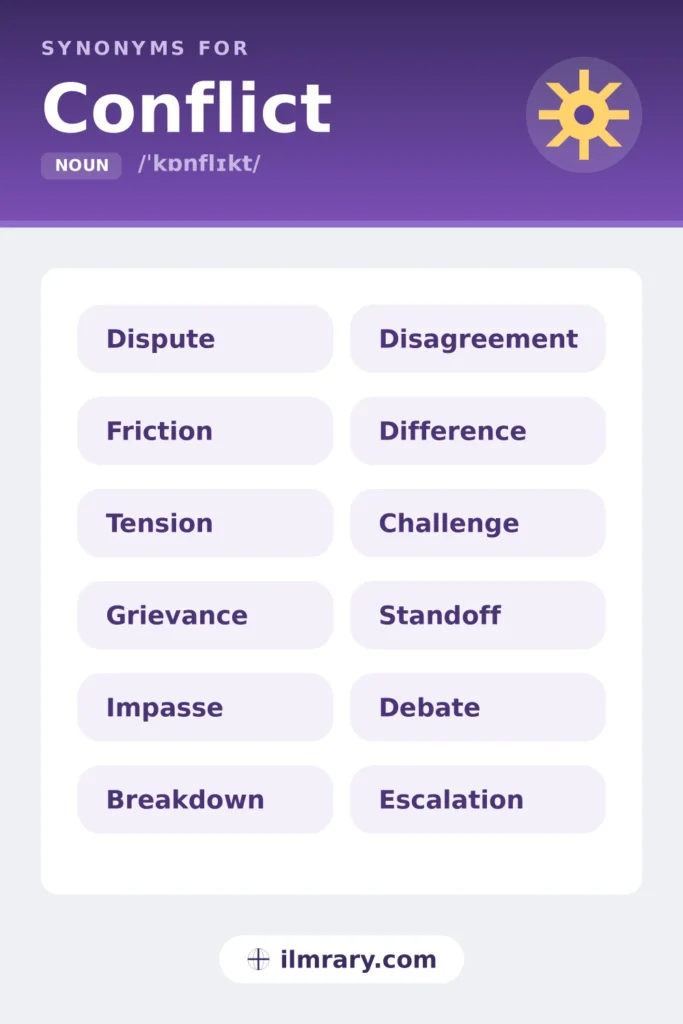
Conflict Words for Disagreement That Still Works
Early-stage disagreement is normal and productive. Treating it as a crisis is a mistake, and naming it honestly avoids inflating an ordinary working difficulty.
Friction
Cover letter
Meaning
Ordinary difficulty between people or teams working together.
When to use it
It is expected rather than exceptional, which is why removing all of it is neither possible nor desirable. Naming it acknowledges a cost without claiming a crisis.
- Friction between the two teams was constant and never once stopped the work.
- Friction over the handover disappeared when the form changed.
Disagreement
Resume bullet
Meaning
Two parties holding different views.
When to use it
The plainest and least dramatic word available, and it claims nothing about conduct. Most professional disagreement is exactly this and gets described as something worse.
- Disagreement on the method ran for a year and produced a better protocol.
- A disagreement about evidence rather than about people.
Tension
Cover letter
Meaning
Strain between competing demands or parties.
When to use it
It can describe structural pressure rather than personal difficulty, which is why tension between objectives is an accurate phrase. It names a state rather than an event.
- Tension between speed and accuracy was designed into the targets.
- Tension in the team traced back to a rota rule nobody had explained.
Difference
Cover letter
Meaning
A divergence of view or approach.
When to use it
The most neutral term available and the most diplomatic, which is why formal writing uses it about senior people. It refuses to characterise the conduct.
- Differences over strategy were recorded and did not affect the vote.
- A difference of professional judgement rather than a dispute.
Challenge
Resume bullet
Meaning
Formally questioning whether something holds.
When to use it
Shared with the test family, where governance treats challenge as a named duty. Framing disagreement as challenge legitimises it rather than pathologising it.
- Challenged the forecast at three consecutive boards until it was rebuilt.
- Challenge was expected and the absence of it was the finding.
Debate
Cover letter
Meaning
Structured argument between parties who both accept the process.
When to use it
It assumes rules and good faith, which is why calling something a debate is a claim about conduct as well as content. It implies the disagreement is productive.
- The debate ran through two committees and improved the proposal both times.
- Debate stopped being debate the week the emails started being copied upward.
Competing priorities
Resume bullet
Meaning
Legitimate aims that cannot all be served at once.
When to use it
It locates the problem in the situation rather than in anybody, which is often accurate and always diplomatic. Naming the trade-off is what resolves it.
- Competing priorities between safety and throughput were resolved by changing the target.
- Competing priorities described honestly stopped two teams blaming each other.
Words for Disagreement That Has Stopped Working
Later stages require intervention rather than management. Naming the stage accurately is what tells a reader the size of what you were dealing with.
Dispute
Resume bullet
Meaning
A disagreement formal enough to have a process attached.
When to use it
Shared with the question family, where denial rather than proof is claimed. In employment and contract settings a dispute has stages and a record.
- Resolved a billing dispute that had run through two escalation stages.
- The dispute went to adjudication and settled the day before the hearing.
Grievance
Cover letter
Meaning
A formal complaint raised by an employee.
When to use it
Shared with the escalation family, where employment procedure fixes the stages. Describing an informal disagreement as a grievance misstates what happened.
- The grievance was upheld in part and the procedure was rewritten afterwards.
- Two grievances in a year prompted the review that found the rota fault.
Impasse
Cover letter
Meaning
A position from which neither side can move.
When to use it
It claims genuine deadlock rather than reluctance, so somebody outside is usually needed. Negotiation writing uses it precisely and business speech inflates it.
- The impasse broke when a third party proposed something neither side could have.
- An impasse on price and agreement on everything else.
Breakdown
Cover letter
Meaning
The point at which a working relationship stops functioning.
When to use it
It names the relationship rather than the issue, which is why breakdown survives the issue being settled. Repairing one is a distinct and undervalued piece of work.
- Breakdown between the two departments predated every person then in post.
- The breakdown was repaired by a shared piece of work rather than a conversation.
Standoff
Everyday
Meaning
A position where both sides have stopped and neither will move first.
When to use it
Informal and it implies waiting rather than deadlock, since either side could move and neither wants to go first. Face rather than substance usually maintains it.
- The standoff lasted a term and ended when somebody offered a room.
- A standoff about who would apologise rather than about what had happened.
Escalation
Resume bullet
Meaning
A disagreement passed upward for resolution.
When to use it
Shared with the escalation family, where the destination is the whole claim. It names movement rather than a state, which is why escalation counts are worth tracking.
- Escalations halved once the two leads met weekly rather than by exception.
- Escalation reached the chief executive twice in a year on the same issue.
How to Choose the Right Synonym for Conflict
Name the stage. Working disagreement is normal, so friction is expected and removing all of it is neither possible nor desirable, disagreement is the plainest word and describes most professional difficulty accurately, and competing priorities locates the problem in the situation rather than in anybody. Challenge legitimises the same behaviour that conflict pathologises. Stopped disagreement needs intervention, and the stages differ, since a dispute has a process attached, an impasse claims genuine deadlock that needs somebody outside, a standoff is maintained by face rather than substance, and a breakdown names the relationship rather than the issue and survives the issue being settled. Conflict covers all of it, which is why managed conflict tells a reader nothing about the size of the job.
Where it had got to is the part a reader wants. Friction or competing priorities where the work continued, impasse or breakdown where it had stopped and outside help was needed.
Opposite Words for Conflict
- Agreement
- Alignment
- Cooperation
- Consensus
- Harmony
Test Your Word Choice
Question 1: Which survives even after the original issue is settled?
A breakdown names the relationship rather than the issue, so resolving the substance leaves it intact. An impasse ends when the deadlock breaks and a dispute ends when it is settled.
Question 2: Which is maintained by face rather than substance?
In a standoff either side could move and neither wants to go first. A grievance follows a formal procedure and tension describes strain between demands.
Question 3: Which legitimises the behaviour that conflict pathologises?
Governance treats challenge as a named duty, so framing disagreement that way makes it expected rather than a problem. Friction describes ordinary difficulty and escalation describes movement upward.
Conflict Synonyms: Questions Recruiters Ask
What can I write instead of managed conflict?
Managed conflict tells a reader nothing until you name the stage the disagreement had reached: resolved a billing dispute through two escalation stages, or repaired a breakdown between departments that predated everybody in post. Both say what the job actually required of you.
Is friction between teams a problem?
Friction between teams is normal rather than a problem, since two teams with different objectives will always pull against each other somewhere. An organisation reporting none has either aligned every incentive perfectly or stopped people from raising anything, and the second is far more common.
What is the difference between an impasse and a standoff?
An impasse means neither side can move, and a standoff means neither side will go first. A standoff usually breaks when somebody offers a face-saving route out, while an impasse needs a new option nobody had on the table before.
Why should I track escalation counts?
Track escalation counts because they measure whether the ordinary route works. Escalations halving once two team leads met weekly shows the exception process had been carrying work the routine one should have handled, which is a result a hiring manager recognises.