
Freedom at work is easy to claim and hard to prove, and another word for autonomy is where the proof comes from.
Autonomy claims a lot and proves nothing. Worked autonomously turns up on almost every remote application, and no employer can check it.
Deciding freely inside a stated limit is one claim. Working with nobody watching is a different one, and a panel will want to know which you mean.
Autonomy Synonyms and the Limits That Came With Them
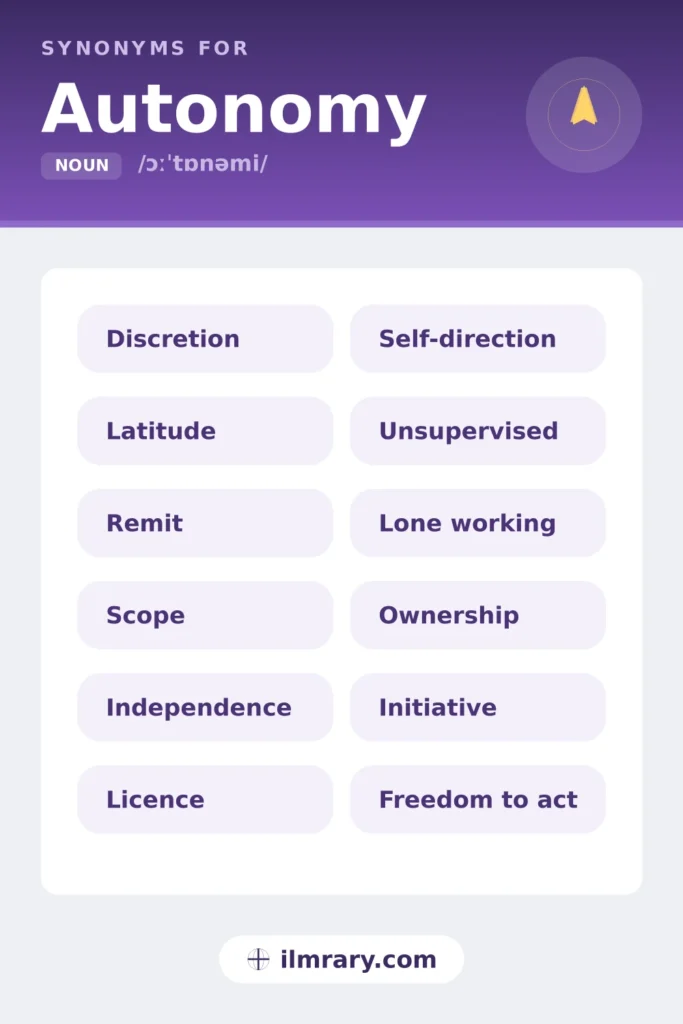
Autonomy Words for Deciding Within Limits
Bounded freedom operates inside rules somebody else set. Naming the boundary is what turns an unverifiable claim into a checkable one.
Discretion
Resume bullet
Meaning
Room to use judgement where rules do not settle the case.
When to use it
It exists precisely where procedure stops, which is why professional and legal work value it. Its exercise is usually recorded, which makes the claim evidenced.
- Exercised discretion on threshold cases and recorded reasons on every one.
- Discretion was removed after the review and the appeal rate doubled.
Latitude
Cover letter
Meaning
Room to vary how something is done.
When to use it
It describes width of room rather than a specific power, so it is vaguer than discretion and warmer. Granting latitude is something a manager does deliberately.
- The role came with latitude on method and none on timing.
- Given latitude, she rebuilt the process rather than patching it.
Delegated authority
Resume bullet
Meaning
Power to decide up to a stated limit.
When to use it
Shared with the budget family, where the limit is the whole value. It is the most concrete freedom claim available and the one applications most often leave out.
- Delegated authority to fifty thousand and to hire within the establishment.
- Delegated authority stopped at the point where every real decision began.
Remit
Resume bullet
Meaning
The range of matters somebody may decide or be asked about.
When to use it
Shared with the accountability family, where it bounds rather than creates. A wide remit with no authority behind it is the least comfortable position on any chart.
- The remit covered three services and the pressure came from a fourth.
- Widening the remit without widening the budget produced predictable results.
Scope
Resume bullet
Meaning
What is inside a piece of work and what is not.
When to use it
Shared with the design family, where the exclusions are the valuable half. It bounds the work rather than the decisions, which is a related and separate thing.
- Scoped the programme so the statutory work finished before the optional started.
- Scope grew by a third and the timescale did not.
Licence
Cover letter
Meaning
Permission to depart from the usual way of doing things.
When to use it
It implies somebody granted an exception, which makes it a stronger and rarer claim than latitude. Creative licence is the fixed phrase and it carries an expectation of results.
- Given licence to rebuild the whole intake rather than improve it.
- Licence came with a deadline and nothing else.
Freedom to act
Cover letter
Meaning
Being able to proceed without seeking approval.
When to use it
Job evaluation schemes use it as a formal factor with defined levels, which makes it precise in public sector applications. Elsewhere it reads as a phrase rather than a term.
- Freedom to act extended to redesigning the pathway without further approval.
- Freedom to act was high and the accountability was higher.
Words for Working Without Supervision
Independence words describe an absence of oversight rather than a grant of power. References confirm them easily, which is what makes them worth claiming precisely.
Independence
Cover letter
Meaning
Working without direction from anybody else.
When to use it
It has a second and stronger sense in audit and regulation, where independence means no conflicting interest. The two get confused and the second is a formal status.
- Independence from the department being audited was the whole point of the arrangement.
- Two years of independence with a manager three hundred miles away.
Self-direction
Cover letter
Meaning
Setting and following your own course of work.
When to use it
Shared with the initiative family, where remote work turned it into a hiring criterion. It claims you needed no manager for momentum, which a reference confirms or destroys.
- Self-directed across eighteen months with no line manager on site.
- A self-directed review produced the recommendation the board adopted.
Unsupervised
Resume bullet
Meaning
Working without anybody overseeing the work.
When to use it
Plain and factual rather than flattering, and its bluntness is what makes it checkable. Clinical and technical settings treat unsupervised practice as a formal milestone.
- Practised unsupervised from the eleventh month rather than the eighteenth.
- Unsupervised on nights within a year of qualifying.
Lone working
Everyday
Meaning
Working alone, usually with a safety policy attached.
When to use it
Health and safety fixed the sense, so it names a risk category rather than a freedom. Applying it as a boast misreads what the phrase is for.
- Lone working policy was rewritten after the second incident.
- Lone working across a rural caseload for four years.
Ownership
Resume bullet
Meaning
Holding the outcome as yours to deliver.
When to use it
Shared with the accountability family, where it has been thinned by management usage. Autonomy without ownership is freedom, and with it is responsibility.
- Took ownership of a target three previous holders had missed.
- Ownership sat with the programme board and delivery sat with nobody.
Initiative
Resume bullet
Meaning
The readiness to act without being told.
When to use it
Shared with the initiative family, where it names both a trait and a self-started effort. It describes what you did with the freedom rather than the freedom itself.
- Took the initiative on a backlog nobody had been asked to touch.
- Initiative was the trait claimed and the effort was the evidence.
Choosing an Autonomy Synonym That Holds Up
Say what you could settle alone. Bounded freedom names the edge, so discretion operates where rules stop and is usually recorded, delegated authority states a value you could commit, and a remit or scope bounds the matters rather than the decisions. Licence is the rarest, claiming somebody granted an exception with results expected. Independence describes the absence of oversight, and it splits in two, since working unsupervised is a factual milestone while independence in audit is a formal status about conflicting interests. Self-direction claims you needed no manager for momentum, which a reference either confirms or destroys. Autonomy claims all of it and states no limit, which is why the phrase about working autonomously persuades nobody.
The boundary is what a reader needs: delegated authority with a figure or discretion with the case type, self-direction where the claim is that nobody was watching.
Opposite Words for Autonomy
- Supervision
- Dependence
- Micromanagement
- Constraint
- Oversight
Test Your Word Choice
Question 1: Which word operates precisely where the rules stop?
Discretion is judgement exercised where procedure does not settle the case. Scope bounds what work is included and independence describes absence of direction.
Question 2: Which term has a formal second sense about conflicting interests?
In audit and regulation, independence means having no interest in what you are examining, which is a status rather than a working style. Latitude and licence both describe room granted.
Question 3: Which phrase names a risk category rather than a freedom?
Lone working is a health and safety classification with a policy attached. Unsupervised describes a practice milestone and freedom to act is a job evaluation factor.
Autonomy Synonyms: Questions Applicants Ask
What can I write instead of worked autonomously?
Worked autonomously earns its place only once the boundary is named: delegated authority to a stated figure, discretion over named case types, or eleven months running the site with no manager present. Each gives a reader an edge they can picture, which the phrase alone never does.
What is the difference between discretion and latitude?
Discretion is judgement exercised where the rules stop deciding, and latitude is room to vary the method. Discretion normally leaves a written record of the reasons behind it, which makes it far easier to evidence than latitude, since a referee can confirm what you were allowed to settle alone.
Is unsupervised a weak word on a resume?
Unsupervised is a factual word rather than a weak one, and in clinical and technical fields it names a formal milestone. Practising unsupervised from the eleventh month rather than the eighteenth is precise, dated and checkable, which puts it well ahead of any adjective about independence.
Should I claim lone working as autonomy?
Claiming lone working as autonomy misreads the term, since it classifies a safety risk rather than granting any freedom. Anyone hiring in that field reads the boast as unfamiliarity with the policy framework they work under every day, so keep it out of the autonomy claim entirely.