
Acting early and acting unasked are two claims, and other ways to say proactive split them. The word alone proves neither of them.
Proactive has been used so widely it reads as nothing. What a panel wants is the moment nobody asked you and you moved anyway.
Getting ahead of a problem needs a date on it. Moving before anybody asked needs a witness, and both are checkable against a record.
Proactive Synonyms for Acting Early and Acting Unasked
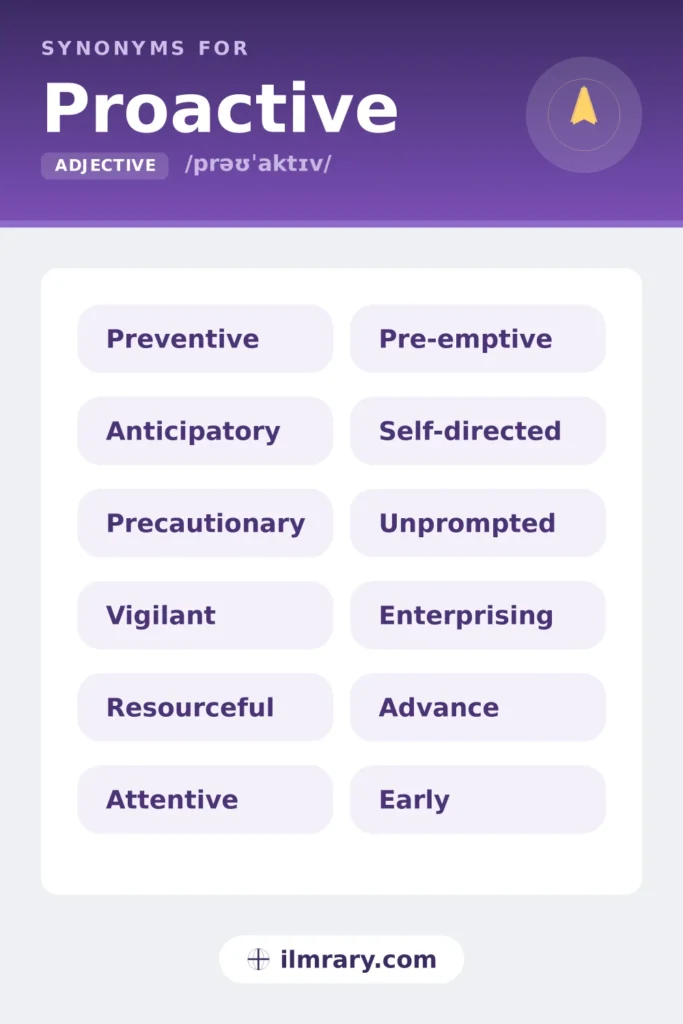
Where Proactive Means Acting Before a Problem Arrives
Timing words claim you moved first, which is a checkable assertion when a date sits beside it. Each assumes a different degree of certainty about what was coming.
Pre-emptive
Resume bullet
Meaning
Taken to stop something already in motion.
When to use it
It claims the threat was real and close, so a vague risk will not support it. Military and legal usage give it force and a faint edge of aggression.
- A pre-emptive rewrite of the guidance landed a fortnight before the ruling.
- Pre-emptive contact with the regulator turned an investigation into a conversation.
Preventive
Resume bullet
Meaning
Designed to stop a problem from arising at all.
When to use it
Health, safety and maintenance own it, and the evidence is always a rate that fell. Preventative is the longer variant and British writing accepts both.
- Preventive maintenance cut unplanned outages from nine a year to one.
- A preventive screening round found four cases the referral route had missed.
Anticipatory
Cover letter
Meaning
Prepared in expectation of something likely to happen.
When to use it
Formal and slightly clinical, and it concedes uncertainty in a way pre-emptive does not. Policy, planning and clinical writing use it without strain.
- Anticipatory staffing covered a surge the modelling had flagged in spring.
- An anticipatory budget line paid for the appeal nobody wanted to predict.
Forward-thinking
Cover letter
Meaning
Planning for conditions that have not arrived yet.
When to use it
Shared with the innovative family, where it claims foresight rather than invention. Anything dated ahead of the sector proves it without an adjective.
- Forward-thinking procurement locked prices before the shortage arrived.
- A forward-thinking board funded retraining a year before the closures.
Precautionary
Cover letter
Meaning
Taken as a safeguard against an outcome that might not occur.
When to use it
It admits the risk was uncertain, which is honesty rather than weakness in regulated settings. The precautionary principle gave it a technical life in environmental and public health writing.
- A precautionary suspension held for six days until the tests cleared.
- Precautionary stock covered the border delays that never materialised.
Advance
Resume bullet
Meaning
Done ahead of the point at which it would normally happen.
When to use it
The plainest of these, and it works as a modifier where the others would sound heavy. Advance notice and advance planning are fixed phrases that survive any setting.
- Advance briefing to all nine sites stopped the rumour before it started.
- Advance ordering saved eleven per cent against the spot price.
Early
Everyday
Meaning
Happening before the expected or usual time.
When to use it
Unglamorous and precise, and it beats every longer word here when a date follows it. Early intervention is a term of art in education and social care.
- Early intervention kept two families out of the statutory process.
- Flagged the discrepancy early enough that nobody had to restate.
Words for Acting Without Being Asked
Volition words shift the claim from timing to permission, saying nobody told you. Reference checks confirm them easily, which is why they outperform any word about attitude.
Self-directed
Cover letter
Meaning
Setting and following your own course of work.
When to use it
Shared with the initiative family, where remote work turned it into a hiring criterion. It claims you needed no manager for momentum, which a reference confirms or destroys.
- Self-directed across eighteen months with no line manager on site.
- A self-directed review produced the recommendation the board adopted.
Unprompted
Everyday
Meaning
Done without anyone requesting it.
When to use it
The most literal claim available and the least used, which makes it land freshly. It fits a single act better than a habit.
- An unprompted audit of the old files found the missing consents.
- She raised the conflict unprompted and the panel noted it.
Enterprising
Resume bullet
Meaning
Ready to start something and carry the attached risk.
When to use it
Shared with the initiative family, and it claims commercial nerve rather than caution. British English applies it to people more warmly than American English does.
- Enterprising outreach turned a mailing list into a revenue line.
- An enterprising trainee negotiated the supplier discount herself.
Resourceful
Cover letter
Meaning
Skilled at finding a way forward with whatever is available.
When to use it
Shared with the initiative family, where the natural evidence is a scarcity story. It claims cleverness under constraint rather than boldness.
- Resourceful scheduling kept the clinic open through the staffing gap.
- A resourceful workaround replaced a vendor with a spreadsheet.
Vigilant
Everyday
Meaning
Watchful for signs of something going wrong.
When to use it
Attention rather than action is the claim, so pair it with what the watching produced. Safeguarding, security and clinical settings treat it as a professional duty.
- Vigilant reconciliation caught the duplicate payments in the first week.
- Vigilant handovers stopped three medication errors reaching a patient.
Attentive
Everyday
Meaning
Paying close and continuous notice to something.
When to use it
Warmer than vigilant and less alert to threat, so it suits service and care settings rather than risk work. It praises manner as much as method.
- Attentive follow-up turned a complaint into a renewed contract.
- Attentive record-keeping made the inspection uneventful.
How to Choose the Right Synonym for Proactive
Decide whether the achievement was the timing or the permission. Timing words grade by certainty, since pre-emptive claims the threat was already moving, preventive claims it never arrived, anticipatory expects it, and precautionary admits it might not come at all. Advance and early are the plainest and the strongest whenever a date follows, because a date proves what an adjective asserts. Permission words claim nobody asked you, and self-directed, unprompted and resourceful each survive a reference call intact. Proactive claims both at once and evidences neither, which is why it reads as filler wherever it appears.
What was coming and when you moved are the two halves: preventive or pre-emptive for the threat, self-directed or unprompted for the absent instruction.
Opposite Words for Proactive
- Reactive
- Passive
- Belated
- Complacent
- Negligent
Test Your Word Choice
Question 1: The ruling was two weeks away and the guidance was already rewritten. Which word fits?
Pre-emptive names action taken against something already in motion. Precautionary concedes the risk might not arrive and attentive describes close notice rather than action.
Question 2: Which word admits the risk might never have materialised?
Precautionary safeguards against an outcome that may not occur, and says so. Preventive claims the problem was stopped and advance only fixes the timing.
Question 3: Which claim would a former manager confirm most directly?
Self-directed makes a testable claim about working without supervision. Proactive describes a disposition and forward-thinking describes foresight, and neither points at a checkable fact.
Proactive Synonyms: Questions Recruiters Ask
What can I write instead of proactive on a resume?
Swap proactive for either the timing or the permission. Preventive and pre-emptive say what you stopped, advance and early say when you moved, and self-directed or unprompted say that nobody asked you to. Every one of those survives a reference call intact.
What is the difference between preventive and pre-emptive?
Pre-emptive and preventive differ by how far the threat had already moved. Pre-emptive answers something already in motion, while preventive stops it starting at all. A pre-emptive call to a regulator implies they were about to act, which is a much larger claim than heading off a problem nobody saw.
Is precautionary a weak word?
Precautionary reads as a weak word outside regulated settings and as a named standard of care inside them. Safety, environmental and clinical work all treat it as a defined threshold, and writing preventive there would overclaim a certainty nobody had at the time.
Does early sound too plain for a cover letter?
Early sounds plain until a date follows it. Flagged it in March, four months before the restatement, does more persuading than any adjective in this family manages alone, because a date is checkable and an adjective is not.