
Hiring somebody and keeping them are separate achievements, and other ways to say recruit divide on that. Only one of them survives a year.
Recruited stops at the offer letter. It says nothing about whether the person was still there a year later, which is the harder number.
Filling a role is countable and quick to check. Keeping people is a retention figure, and a panel reads that number as the stronger claim.
Recruit Synonyms for Filling a Role and for Keeping People
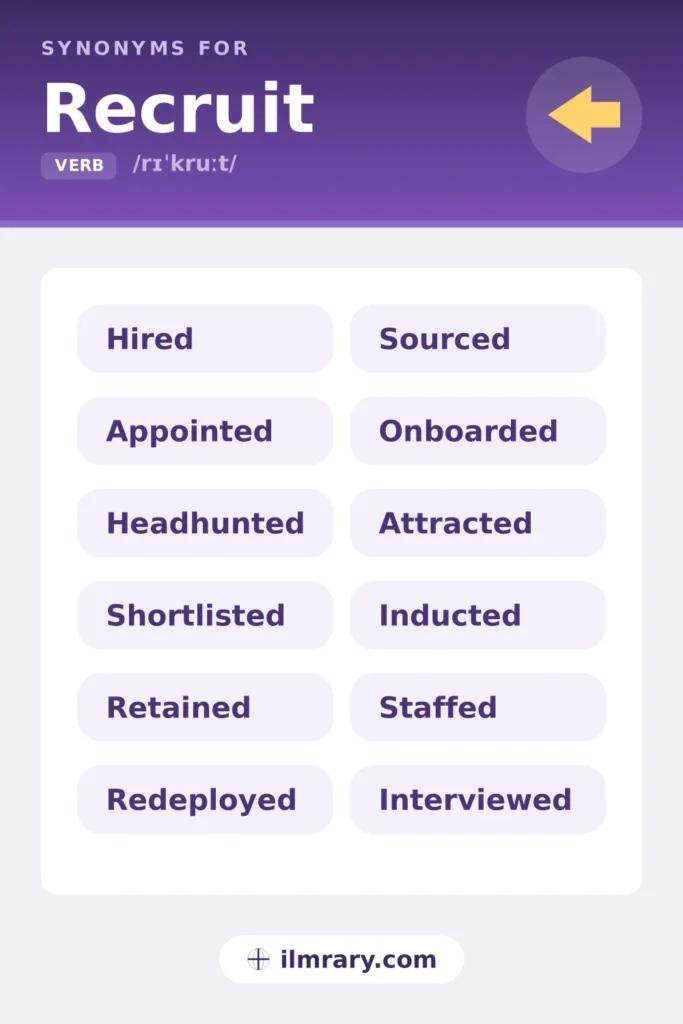
Where Recruit Means Finding and Attracting People
Sourcing words cover the work before anyone applies. Their proof is usually a channel that produced candidates nobody else was reaching.
Headhunted
Cover letter
Meaning
Approached somebody who was not looking for a job.
When to use it
It claims direct approach rather than advertising, which is the harder half of hiring. British usage runs to it more than American, where recruiters say sourced.
- Headhunted the two specialists the sector had assumed were unavailable.
- Headhunted rather than advertised after three failed rounds.
Sourced
Resume bullet
Meaning
Found candidates through direct search rather than applications.
When to use it
Technical recruiting fixed the sense, where sourcing is a distinct measurable activity. It claims pipeline rather than decisions.
- Sourced eleven engineers in a market where the agency had produced two.
- Sourced candidates from adjacent industries the job description had excluded.
Attracted
Cover letter
Meaning
Drew applicants in through what the role or organisation offered.
When to use it
It credits the proposition rather than the search, which suits employer brand and outreach work. Application numbers are the natural evidence.
- Attracted four hundred applications to a post that had previously drawn nine.
- Attracted returners by rewriting the hours before the advert went out.
Shortlisted
Resume bullet
Meaning
Narrowed a field down to those worth interviewing.
When to use it
Screening rather than deciding is the claim, and it is a defensible one because criteria usually exist. It concedes somebody else made the offer.
- Shortlisted against a scoring matrix that survived two equality reviews.
- Shortlisted sixty applicants down to nine in a single afternoon.
Interviewed
Resume bullet
Meaning
Assessed candidates in person against the role.
When to use it
Volume is easy to state and easy to check, which makes it a plain and credible claim. It says nothing about whether the decision was yours.
- Interviewed for every clinical post across two sites for four years.
- Interviewed as panel chair once the previous head left.
Appointed
Resume bullet
Meaning
Made the decision to give somebody the role.
When to use it
Shared with the position family, where it marks the decision rather than the work. It is the strongest hiring claim because the responsibility stops with you.
- Appointed the first two permanent staff the service had ever held.
- Appointed against the panel's preference and defended it in writing.
Hired
Resume bullet
Meaning
Brought somebody into employment.
When to use it
The plainest verb here and the most transatlantic, and it blurs sourcing and deciding deliberately. American usage prefers it wherever British usage says appointed.
- Hired nineteen people in a year and lost one inside probation.
- Hired the whole night team from a single open evening.
Words for Keeping People Once They Arrive
Retention words describe the half of hiring that costs most when it fails. Figures for them are more persuasive than any recruitment number, because turnover is expensive and everybody knows it.
Retained
Resume bullet
Meaning
Kept people in post who might otherwise have left.
When to use it
It claims a counterfactual, so the evidence is a turnover figure against a baseline. Recruiting well and retaining well are separately valued and rarely separately stated.
- Retained ninety-one per cent of the cohort through a year of pay restraint.
- Retained all four specialists after a competitor opened two miles away.
Onboarded
Everyday
Meaning
Brought somebody through joining and into productive work.
When to use it
Shared with the train family, and broader than induction since it covers systems and culture too. Technology and services writing use it far more than the public sector.
- Onboarded eleven remote hires without any of them visiting an office.
- Onboarded the acquired team onto our systems inside a quarter.
Inducted
Resume bullet
Meaning
Took new arrivals through what they need to start.
When to use it
Shared with the train family, where arrival is the whole context. It claims a defined short programme that ends when the person is functioning.
- Inducted every clinical hire across two sites for three years.
- Inducted forty seasonal staff in a fortnight without a single early leaver.
Staffed
Resume bullet
Meaning
Provided the people a service or shift needed.
When to use it
Coverage rather than individuals is the claim, which suits rotas, projects and openings. It stays silent about how the people were found.
- Staffed a seven-day service with the headcount funded for five.
- Staffed three simultaneous sites through the whole of the summer programme.
Resourced
Cover letter
Meaning
Supplied the people and means a piece of work required.
When to use it
Broader than staffed since money and equipment travel with it, and vaguer for the same reason. Programme and consultancy writing use it constantly.
- Resourced four concurrent workstreams from a team of nine.
- Resourced the pilot properly and the rollout needed no rescue.
Redeployed
Resume bullet
Meaning
Moved existing staff into different roles rather than hiring.
When to use it
It claims you solved a staffing problem without new headcount, which finance readers value highly. Restructuring and closure work depend on it.
- Redeployed twenty-two staff during the closure with two compulsory losses.
- Redeployed rather than recruited and closed the vacancy gap in a quarter.
Telling the Recruit Synonyms Apart
Name the part you owned. Sourcing takes headhunted or sourced where you approached people who were not applying, and attracted where the proposition rather than the search did the work. Selection takes shortlisted for screening against criteria and interviewed for volume, both of which concede the decision was elsewhere. Appointed is the strongest verb available because the responsibility stops with you, and hired blurs the whole sequence in a way American readers accept more readily than British ones. Keeping people takes retained, which claims a counterfactual and needs a turnover figure, and redeployed, which solves the problem without new headcount at all. Recruited spans everything and settles nothing.
Say which half was yours, headhunted or sourced for finding people, appointed for deciding, retained or redeployed for what happened afterwards.
Opposite Words for Recruit
- Dismissed
- Laid off
- Lost
- Understaffed
- Turned away
Test Your Word Choice
Question 1: You approached specialists who were not looking for a job. Which verb fits?
Headhunted claims a direct approach to someone not applying. Attracted credits the proposition for drawing applicants and shortlisted narrows a field that already exists.
Question 2: Which verb claims the decision stopped with you?
Appointed names the decision to give somebody the role. Interviewed assesses candidates and sourced builds the pipeline, and neither implies the offer was yours.
Question 3: Which verb solves a staffing gap without new headcount?
Redeployed moves existing staff into different roles instead of hiring. Staffed provides the people a service needed and onboarded brings new arrivals into productive work.
Questions That Follow a Recruit Claim
What is a stronger word than recruited on a resume?
Stronger than recruited are appointed where the decision was yours, headhunted where you approached people who were not applying, and retained where keeping staff was the achievement. Each names one part of hiring, while recruited spans sourcing, selecting, deciding and keeping without committing to any of them.
What is the difference between hired and appointed?
Hired and appointed differ mostly by geography and by how much they claim. American writing uses hired for the whole sequence of finding, choosing and starting somebody, while British and public sector writing reserves appointed for the decision itself, which makes it the sharper claim of the two.
Why is retention worth stating separately from hiring?
Retention is worth stating separately because replacing somebody costs far more than hiring them the first time, and that cost is the part employers feel. A turnover figure measured against a baseline reads as a commercial result, where a count of appointments only reads as activity.
Is sourced too much recruiter jargon for a resume?
Sourced reads as fluency inside recruitment and technology hiring, where it is the expected term for approaching people who never applied. Outside those industries it narrows your audience, and approached directly or found says the same thing to a general reader without the trade vocabulary.