
One word means a job and an opinion, and another word for position keeps them apart. A resume that mixes them reads as careless.
Position slides between the two. Held a senior position and took a firm one are unrelated claims that share a sentence shape.
Those two senses need different proof. A title, a grade and dates back the first. An argument and somebody who disagreed back the second, and a panel notices when they blur.
Position Synonyms for a Job Held and for a Stance Taken
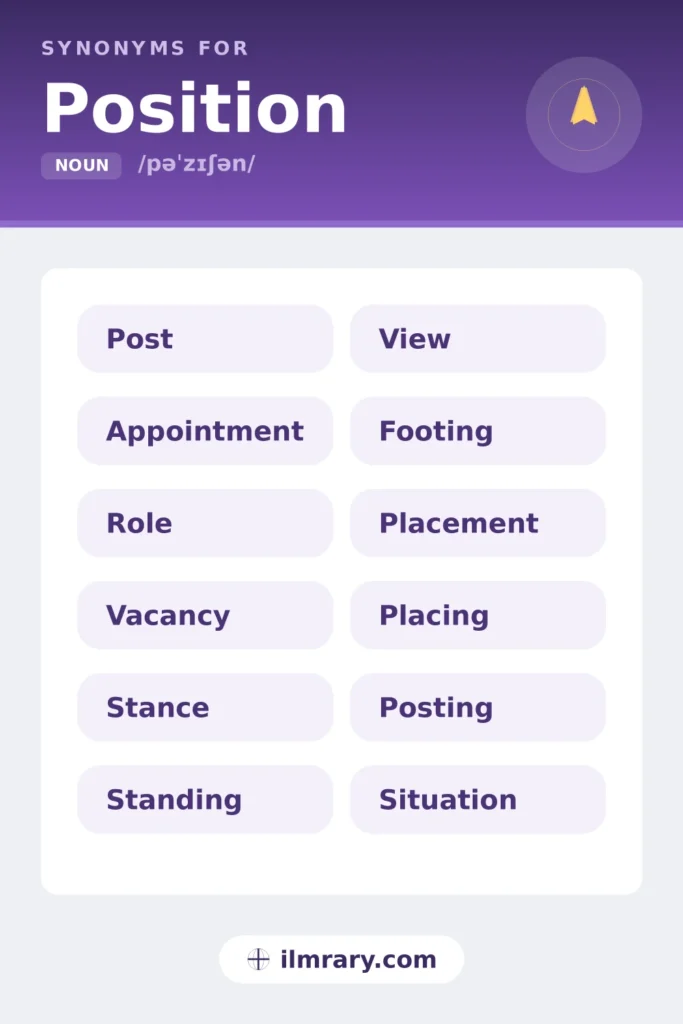
Position Words for a Job Somebody Holds
Employment senses differ by whether the word names the slot, the selection or the duties. Recruiters read the distinction closely because each implies a different stage of the process.
Post
Resume bullet
Meaning
A funded place in an organisation that somebody occupies.
When to use it
British public sector usage keeps it precise, where a post exists whether or not anyone fills it. It emphasises the structure rather than the person.
- The post had been vacant for eleven months before she took it.
- Two posts were frozen and one was upgraded in the same review.
Appointment
Cover letter
Meaning
The act of being formally chosen for a role.
When to use it
It marks the decision rather than the work, which is why announcements use it. Academia, medicine and public bodies treat it as a status with a date.
- Her appointment was confirmed by the board in September.
- A substantive appointment followed two years of acting up.
Role
Resume bullet
Meaning
The set of duties and expectations attached to a job.
When to use it
It names what somebody does rather than where they sit, which makes it the natural noun for describing work. Recruitment adopted it so completely that role is now the default in job adverts.
- The role covered casework, supervision and the whole training programme.
- She grew the role well past its original description.
Vacancy
Everyday
Meaning
A position currently unfilled and open to applicants.
When to use it
It describes the gap rather than the job, so it belongs to advertising and workforce reporting. Nobody holds a vacancy.
- Three vacancies went unfilled through the whole recruitment round.
- The vacancy was advertised internally before it went out.
Placement
Cover letter
Meaning
A temporary position arranged as part of training.
When to use it
Education and professional training fix the sense, where a placement is supervised and time-limited by design. Calling a permanent job a placement misleads.
- A twelve-month placement in the finance team preceded the graduate scheme.
- Her placement turned into an offer before the year ended.
Posting
Everyday
Meaning
An assignment to a particular location or duty.
When to use it
Military, diplomatic and multinational usage own it, and relocation is normally implied. It emphasises where rather than what.
- A three-year posting to the regional office ended early.
- Each posting brought a different regulatory regime.
Seat
Everyday
Meaning
Membership of a body that decides things.
When to use it
Boards, councils and parliaments give it a precise sense, where a seat is a place with a vote. Law firms also use it for rotation through practice areas.
- She held a seat on the audit committee for four years.
- A seat on the board came with the merger and went with it.
Words for a Stance or a Standing
Argument senses describe where somebody stands rather than where they work. Policy, legal and commercial writing rely on them, and confusing them with the employment senses reads as carelessness.
Stance
Cover letter
Meaning
A publicly stated attitude toward a question.
When to use it
Deliberateness is implied, so a stance was chosen and can be defended. Politics and negotiation use it constantly and it never describes a private opinion.
- The trust took a stance on disclosure that the sector later copied.
- Her stance on the merger cost her the chairmanship and gained her the argument.
Standing
Cover letter
Meaning
The reputation or status somebody holds among others.
When to use it
Others confer it, which is what separates it from every other noun here. Legal writing gives it a second technical sense about the right to bring a case.
- Her standing in the field opened doors the job title never would.
- The firm's standing survived the fine and barely survived the coverage.
View
Everyday
Meaning
An opinion held about a matter.
When to use it
The plainest of these and the least committed, since a view can shift without anyone calling it a reversal. Reports and advice use it to keep options open.
- The auditors took the view that the treatment was defensible.
- Her view changed once the second dataset arrived.
Footing
Everyday
Meaning
The terms on which something stands or operates.
When to use it
It describes stability of arrangement rather than opinion, and equal footing and firm footing are the phrases that carry it. Finance and diplomacy use it about relationships.
- The service moved onto a permanent footing after the pilot.
- Both parties negotiated on an equal footing for the first time.
Placing
Everyday
Meaning
The rank something reached in a comparison.
When to use it
Competition and league tables own it, and British usage prefers placing where American usage says placement or finish. It measures against others rather than a standard.
- A second placing in the national awards followed the pilot.
- Their placing slipped two years running and nobody investigated why.
Situation
Everyday
Meaning
The circumstances somebody or something is in.
When to use it
It once meant a job, which survives only in the phrase situations vacant. The modern sense is circumstances, and using the old one now sounds antique.
- The financial situation changed twice during the negotiation.
- Situations vacant columns disappeared with the local paper.
Which Position Synonym Fits What You Did
Split the employment sense from the argument sense first, since nothing else in the choice matters until that is settled. For a job, post names the funded slot, appointment names the decision, role names the duties, and vacancy names the gap nobody has filled. For a stance, view is the least committed, stance is the one you chose and can defend, and standing is the only noun here that somebody else confers on you. Footing describes the terms of an arrangement rather than an opinion at all. Position survives best in fixed phrases like position paper, where the sense arrives before the reader has to guess.
Whether you mean the job or the argument decides it: post, role or appointment for the first, stance, view or standing for the second.
Opposite Words for Position
- Unemployment
- Vacancy
- Neutrality
- Indecision
- Obscurity
Test Your Word Choice
Question 1: The slot existed and was funded for eleven months with nobody in it. Which noun fits?
A post exists whether or not anybody occupies it, so it names the structure. An appointment is the act of choosing somebody and a role is the duties attached.
Question 2: Which noun can only be conferred by other people?
Standing is reputation held among others, so nobody awards it to themselves. A stance is chosen and a view is held privately or stated at will.
Question 3: Which word once meant a job and now sounds antique in that sense?
Situations vacant is the last living trace of situation meaning employment. Placing measures rank in a comparison and footing describes the terms of an arrangement.
Common Questions About Position Synonyms
What is another word for position in a job application?
Role, post and appointment each replace position in a job application: role names the duties, post names the funded slot in a structure, and appointment names the decision to choose you. Role is the safest default, because recruitment writing already uses it that way.
What is the difference between a post and a role?
A post is a place in a structure and a role is the work attached to it. Two people can hold the same post and shape very different roles inside it, which is worth spelling out on a resume where the title alone hides what you actually did.
Is stance too political for business writing?
Stance belongs in business writing, since negotiation, regulation and commercial strategy all turn on stated attitudes somebody has to defend. Where you want a softer noun that leaves room to move later, view does the same work without committing you to a position you must hold.
When does standing matter more than a job title?
Standing matters more than a job title in professions where influence travels through peers rather than hierarchy. Academia, medicine and law all contain people whose standing outranks their post, and saying somebody is cited or consulted by name is a stronger claim than the title alone.