
A named buyer and a guess about next year are not the same, and other ways to say prospect keep them apart. The difference is whether somebody has a name.
Prospect means both. A company with a budget and a hunch about demand are both prospects, and a recruiter cannot value either.
A prospect in the pipeline has a buyer somebody can ring. A forecast names a number nobody can ring, and only the first is a prospect anybody can act on.
Prospect Synonyms for a Named Buyer and for a Likelihood
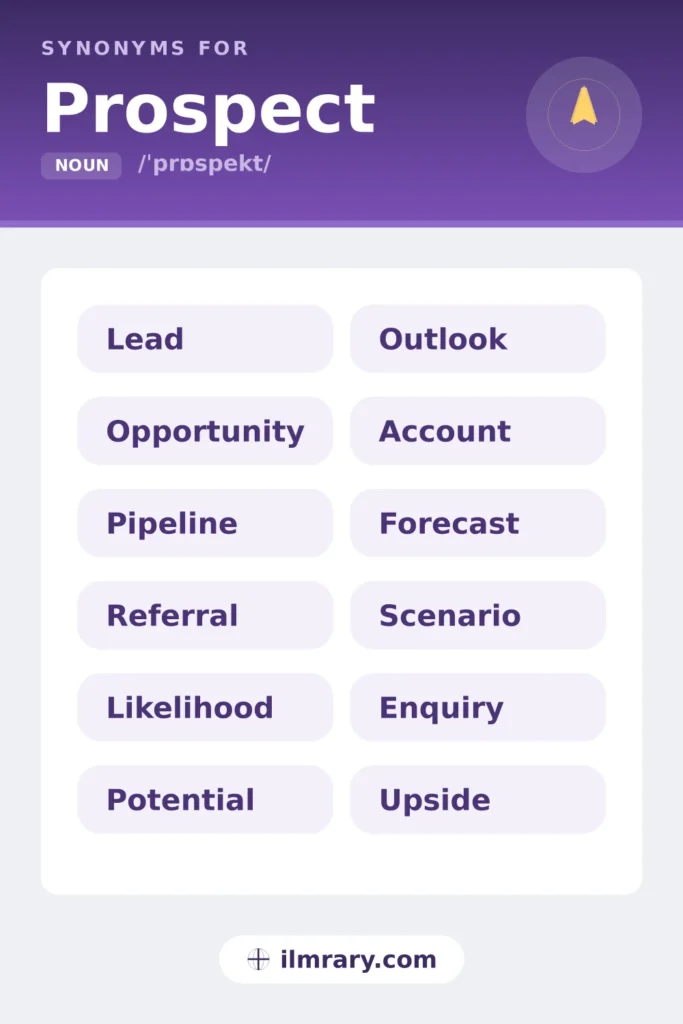
Prospect Words for Somebody Who Might Buy
Commercial stages are defined by what has been established rather than by how hopeful anybody feels. Each stage should have an entry test somebody applied.
Lead
Resume bullet
Meaning
A contact who has shown any interest at all.
When to use it
It claims nothing beyond existence, which is why lead volume flatters and lead quality decides. Counting them without a qualification stage measures activity alone.
- Leads doubled after the campaign and conversions did not move.
- Leads were counted at the top and nobody measured what happened to them.
Opportunity
Resume bullet
Meaning
A qualified prospect with a defined possible deal.
When to use it
Shared with the opportunity family, and in sales it names something that passed a test. Value and expected close date both attach to it, which makes the pipeline forecastable.
- Opportunities were qualified against three criteria and the forecast stopped missing.
- An opportunity that had sat at ninety per cent for eleven months.
Pipeline
Resume bullet
Meaning
The whole set of opportunities at all stages.
When to use it
Its value depends on stage discipline, since a pipeline where nothing is ever removed is a list. Coverage ratio against target is the figure that matters.
- Pipeline coverage reached three times target and the close rate explained why that was needed.
- Pipeline grew every quarter because nothing was ever taken out of it.
Account
Resume bullet
Meaning
An existing customer relationship.
When to use it
Shared with the customer family, where it names the relationship rather than the person. Growing an account is a different claim from winning one.
- Grew the account from a single site to eleven across three years.
- The account was profitable and impossible, which the renewal reflected.
Referral
Resume bullet
Meaning
A prospect introduced by somebody who vouches for you.
When to use it
Shared with the escalation family, where it moves a case sideways. In sales it converts at a far higher rate, which makes referral counts worth reporting separately.
- Referrals converted at three times the rate of anything the campaign produced.
- Referrals arrived without a process and stopped when the person who made them left.
Enquiry
Cover letter
Meaning
Somebody asking about what you offer.
When to use it
It claims contact initiated by them, which is a stronger starting position than outbound. British usage prefers the initial e where American usage says inquiry.
- Enquiries rose a third after the listing changed and the source was never identified.
- Enquiries were answered within a day and the conversion figures moved with it.
Bid
Resume bullet
Meaning
A formal offer made in a competition.
When to use it
The furthest stage before a decision, and win rate against bid count is the only honest measure. Bidding for everything is how a team looks busy and wins less.
- Won a place on the framework against four incumbent suppliers.
- Bid selectively and the win rate went from one in six to one in three.
Words for Something That Might Happen
Likelihood words describe a possible future rather than a person. Their honesty depends entirely on whether anybody put a number or a condition on them.
Likelihood
Cover letter
Meaning
How probable something is.
When to use it
Shared with the risk family, where it is the axis hazard omits. Its plainness suits reporting better than probability, which implies a calculation.
- Likelihood was low and impact was total, which drove the whole design.
- Reassessed likelihood after the second incident and the rating doubled.
Potential
Resume bullet
Meaning
Capacity to become something more.
When to use it
It is entirely about the future, which is why potential is the word used about people nobody can yet evidence. Naming the condition it depends on rescues it.
- Potential in the northern region depended on a distributor nobody had approached.
- Potential was cited for four years and the results never arrived.
Outlook
Cover letter
Meaning
How things are expected to develop.
When to use it
Forecasting and finance use it for a directional view rather than a number. It claims a considered expectation rather than a hope.
- The outlook was revised twice in a quarter and neither revision reached the plan.
- Outlook remained positive throughout a year that ended in restructuring.
Forecast
Resume bullet
Meaning
A predicted figure rather than an intended one.
When to use it
Shared with the target family, where prediction and intention get confused constantly. Forecast accuracy is a separate and more revealing measure than performance.
- Forecast within one per cent for eight consecutive quarters.
- The forecast became the target the moment it reached the board.
Scenario
Cover letter
Meaning
One possible future set out in enough detail to plan against.
When to use it
It claims a described path rather than a point estimate, which is why planning uses several. A single scenario is a forecast wearing a longer word.
- Modelled three scenarios and the middle one arrived almost exactly.
- Scenarios were produced and the plan was built against one of them.
Upside
Everyday
Meaning
The better of the possible outcomes.
When to use it
Investment writing owns it, and it names the good case without claiming it is likely. Reporting upside without downside is the standard optimism failure.
- The upside was three years saved and the downside was a year of rework.
- Upside was modelled in detail and the downside in a sentence.
Choosing a Prospect Synonym That Holds Up
Say what stage it reached and who tested it. Commercial stages are defined by what was established, so a lead claims existence alone and lead volume flatters, an opportunity has passed a qualification test with a value and a date attached, and a pipeline is worth something only where stage discipline removes things as well as adding them. Referrals convert far better and are worth counting separately. Future words describe possibility rather than a person, and their honesty depends on a number or a condition, since potential is what gets said about anything nobody can yet evidence, a scenario claims a described path where a single one is a forecast in disguise, and upside reported without downside is the standard optimism failure.
The stage and the test are what a reader checks: lead or opportunity where somebody qualified it, likelihood or scenario where the claim is about a future nobody has seen.
Opposite Words for Prospect
- Dead end
- No chance
- Closed lost
- Certainty
- Non-starter
Test Your Word Choice
Question 1: What decides whether a pipeline is worth anything?
A pipeline where nothing is ever removed is a list rather than a forecast. Size and growth both increase when nothing is qualified out.
Question 2: Which converts at a substantially higher rate and is worth counting separately?
Somebody vouching for you removes most of the trust problem at the outset. Enquiries are self-initiated and better than outbound, and leads claim existence alone.
Question 3: What is a single scenario?
Scenario planning works by describing several possible futures, so one is just a point estimate with more words. A plan is what you do and a risk assessment weighs likelihood and harm.
Prospect Synonyms: Questions Applicants Ask
What is the difference between a lead and an opportunity?
A lead has shown interest, and an opportunity has passed a qualification test with a value and a date attached. Anyone who downloaded a document counts as a lead, which is why lead volume flatters a pipeline. Reporting lead volume without conversion measures activity rather than results.
Why does potential read weakly on a resume?
Potential reads weakly because it describes a future nobody can check yet. Naming the condition the claim depends on, such as a distributor nobody has approached or a licence not yet applied for, turns it into something a reader can act on.
Is bidding for everything a strategy?
Bidding for everything is the appearance of a strategy rather than one. Selective bidding that moves a win rate from one in six to one in three is the stronger claim, because it names a rule somebody applied and a number that moved. Submission counts name neither.
Why should I report upside and downside together?
Report upside and downside together because giving only the good case is the commonest forecasting failure. One sentence modelling what happens if the distributor walks tells a reader more about the quality of the forecast than three pages describing the optimistic path.