
A priority claim is only real if something else lost, and synonyms for priority carry that. The loss is the proof, and most resumes leave it out.
Priority is claimed on every application and proved on almost none. Everything cannot come first, and a panel knows it.
Naming what came first is half a claim. Naming what stopped is the other half, and the second is the sentence a panel remembers.
Priority Synonyms for What Came First and What Was Dropped
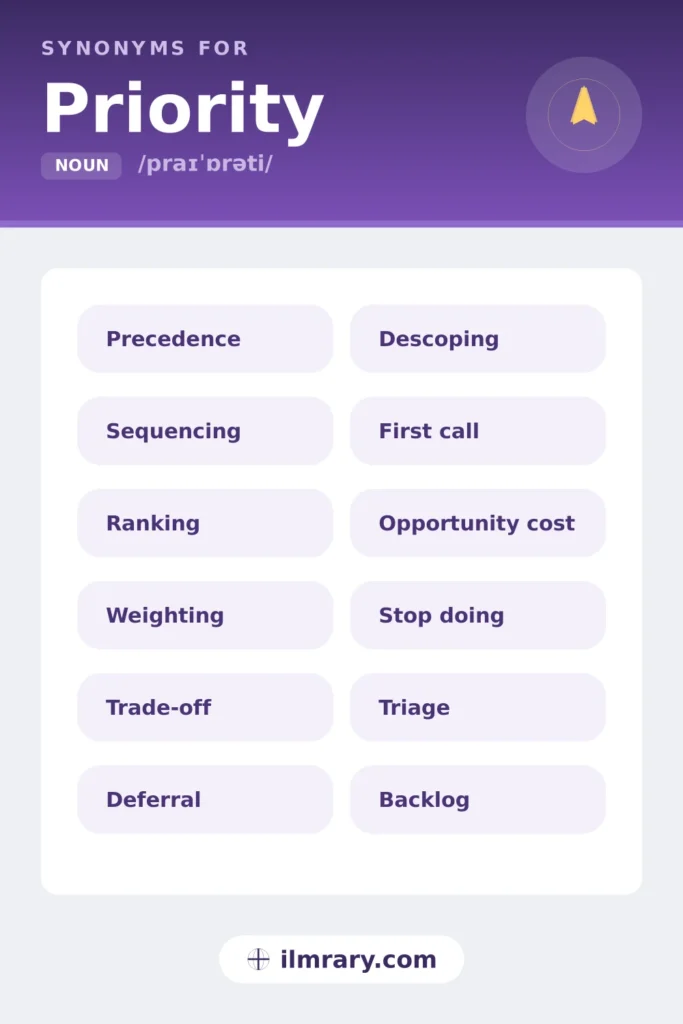
Priority Words for Ranking and Order
Ranking words put things in an order somebody could act on. Their honesty depends entirely on whether anything genuinely came last.
Precedence
Cover letter
Meaning
The right to come before something else.
When to use it
It names a rule rather than a preference, which is why legal and protocol usage owns it. Something takes precedence because a principle says so rather than because somebody chose.
- Statutory duties took precedence over every improvement project that year.
- Precedence was set in the constitution and nobody had read it in a decade.
Sequencing
Resume bullet
Meaning
The order in which things will be done.
When to use it
It concedes everything happens eventually, which is why it is the honest form of prioritising in programmes. What runs first and what waits are both stated.
- Sequencing put the data work first and the visible features second.
- Sequencing rather than scope was the argument that took three months.
Ranking
Resume bullet
Meaning
An explicit ordering from most to least.
When to use it
It forces a last place, which is what most priority lists avoid. Its bluntness is exactly why organisations resist producing one.
- Ranked eleven bids and published the scores.
- Ranking the risks exposed that three of the top five had no owner.
First call
Cover letter
Meaning
The claim that gets served before others.
When to use it
It describes access to a resource rather than importance, so first call on a budget or a specialist is a concrete arrangement. Plain and slightly informal.
- Emergency work had first call on the theatre list every afternoon.
- First call on the reserve went to whichever service was inspected next.
Weighting
Cover letter
Meaning
How much each factor counts in a decision.
When to use it
It quantifies priority rather than ordering it, which is how tenders and scoring frameworks work. Publishing the weighting is what makes a decision arguable.
- Social value carried ten per cent of the weighting and we wrote that section.
- The weighting was agreed after the bids arrived, which the challenge relied on.
Triage
Resume bullet
Meaning
Sorting incoming work by urgency and routing it.
When to use it
Shared with the escalation family, where a decision under time pressure is the claim. It prioritises continuously rather than once.
- Triage moved the queue from three days to the same afternoon.
- Triage criteria were written down after the second complaint and never before.
Critical path
Resume bullet
Meaning
The chain of tasks that determines the end date.
When to use it
Only work on it can delay the whole thing, which is a precise and frequently ignored fact. Everything else has float and can be deprioritised without cost.
- Two tasks on the critical path had been given to the least available person.
- Critical path analysis showed the training was not on it and everybody had assumed otherwise.
Words for What Got Displaced
Displacement words name the cost of choosing. They are the half that proves a priority was real, and the half almost every strategy document omits.
Trade-off
Cover letter
Meaning
What was given up in order to get something else.
When to use it
Shared with the strategy family, where naming it proves a choice was genuinely made. Boards respond to it because it shortens rather than lengthens the meeting.
- The trade-off was coverage for depth and the board accepted it in writing.
- Named the trade-off explicitly and the argument finished in one meeting.
Deferral
Resume bullet
Meaning
Deliberately postponing something to a stated point.
When to use it
Shared with the solve family, where it claims a decision rather than a failure. The reason and the revised date both belong in the sentence.
- Deferred the migration by a quarter and used the time to fix the data.
- Deferral was recorded with reasons, which the audit found and approved.
Descoping
Resume bullet
Meaning
Removing work from what was agreed.
When to use it
It is the honest word for making a plan fit, and doing it early rather than under pressure is the achievement. Naming what came out is what proves it.
- Descoped two workstreams and the delivery date became achievable.
- Descoping happened at week thirty rather than week four, which cost the whole contingency.
Opportunity cost
Cover letter
Meaning
The value of what you did not do instead.
When to use it
Economics fixed it, and it names the invisible half of every choice. Quoting it turns a decision into an argument rather than a preference.
- The opportunity cost was a year of the analytics work nobody costed.
- Opportunity cost never appears in a business case and decides most of them.
Stop doing
Everyday
Meaning
Work deliberately discontinued to release capacity.
When to use it
A stop doing list is the practical form of prioritising and the rarest document in any organisation. Its plainness is what makes it hard to produce.
- The stop doing list was one page and released four staff days a week.
- Nobody would sign the stop doing list and every priority stayed a priority.
Backlog
Resume bullet
Meaning
Work that has arrived and not yet been done.
When to use it
Shared with the capacity family, where age beats size. In prioritisation it is where deprioritised work actually goes, which is worth admitting.
- Cleared a backlog of eleven months in six weeks with a task force.
- Backlog size fell and the oldest case in it got older.
Telling the Priority Synonyms Apart
Prove the priority by naming what lost. Ranking words put things in order, and only some force a last place, since precedence names a rule rather than a preference, sequencing concedes everything happens eventually, and ranking is the blunt form organisations resist producing. Critical path is the precise version, because only work on it can move the end date and everything else has float. Displacement words are the proof, so a trade-off names what was surrendered, descoping names what came out of the plan, and opportunity cost names the invisible half of the decision. A stop doing list is the rarest document in any organisation and the only unambiguous evidence that prioritising happened.
What lost is the proof of what won: sequencing or critical path for the order, trade-off or descoping for the work that had to go so the rest could run.
Opposite Words for Priority
- Afterthought
- Backlog
- Deferral
- Low priority
- Everything at once
Test Your Word Choice
Question 1: Only work on it can move the end date. What is it?
Tasks off the critical path have float and can slip without delaying the whole thing. A trade-off names what was surrendered and weighting quantifies how much factors count.
Question 2: Which is the rarest document in any organisation?
Deciding what to discontinue is the practical form of prioritising and almost nobody will sign it. Rankings and sequencing plans are produced routinely and often ignored.
Question 3: Which names a rule rather than a preference?
Something takes precedence because a principle or a statute says so. First call describes access to a resource and triage sorts by urgency case by case.
Questions That Follow a Priority Claim
How do I show I prioritised on a resume?
Prove you prioritised by naming what lost. Set three priorities and cut eleven other workstreams to fund them is evidence a recruiter can weigh, where a list of three priorities on its own is not. The cut is what proves a choice happened.
Why do priority lists with five items fail?
Priority lists with five items fail because nothing on them comes last. Priority claims an order, so five firsts rename the workload rather than ranking it, and the team goes on deciding case by case. Ranking means something where something genuinely came last.
What is opportunity cost in practice?
Opportunity cost is the value of whatever you did not do instead. Funding one programme means another waits a year, and that wait never appears in the business case that approved the first. Naming the cost turns a preference into an argument.
Is descoping an admission of failure?
Descoping early is planning rather than an admission of failure. Removing two workstreams at week four to make a date achievable protects the date, while removing them at week thirty once the contingency has gone is what failure looks like. Timing decides how it reads.