
Naming a danger and managing it are different claims, and risk synonyms keep them apart. The second is the one that shows judgement.
Risk covers the event itself and the work done about it. A line in a register and a mitigation plan both arrive under the word.
Hazard wording names what went wrong or nearly did. Control wording names what you did about it, and a panel wants both in the same sentence.
Another Word for Risk for the Harm Itself and for the Handling
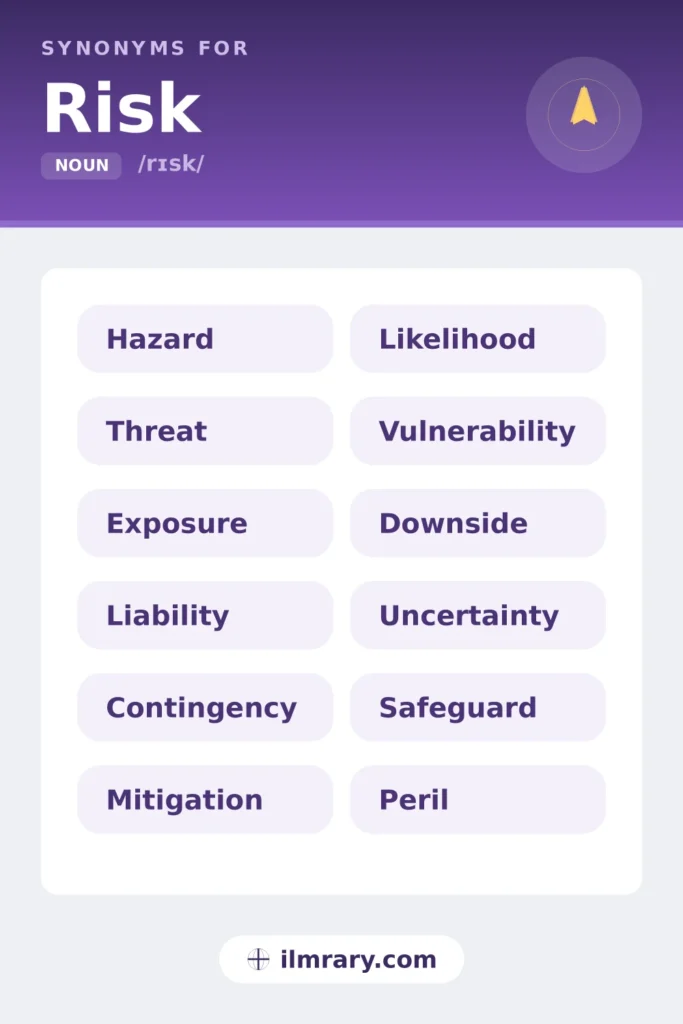
Risk Words for the Source of Harm
Source words name the thing that could hurt you, without saying how likely it is. Safety and security disciplines depend on keeping that separation clean.
Hazard
Resume bullet
Meaning
Something with the potential to cause harm.
When to use it
Likelihood is deliberately excluded, which is the technical distinction safety work is built on. A hazard becomes a risk only once exposure and probability are attached.
- Catalogued every hazard on the site before any risk scoring began.
- The hazard had been recorded for years and never assessed.
Threat
Cover letter
Meaning
An actor or force intending or capable of harm.
When to use it
Security usage implies intent, which distinguishes it from an accidental hazard. Business writing borrows it loosely for competitive pressure.
- The threat model covered insiders, which the previous review had not.
- Two competitors entered and the threat came from neither.
Vulnerability
Cover letter
Meaning
A weakness that harm could pass through.
When to use it
It names your side of the equation rather than the outside force, which is why it is fixable and a threat is not. Information security holds the strict sense.
- Closed the vulnerability the penetration test had found in the first hour.
- Vulnerability was structural and no amount of training addressed it.
Exposure
Resume bullet
Meaning
How much you stand to lose if the harm occurs.
When to use it
Shared with the knowledge family in a quite different sense. Here it names magnitude rather than likelihood, and finance and insurance treat it as the governing number.
- Reduced exposure to a single counterparty from forty per cent to nine.
- Exposure was capped by the indemnity and nobody had read the exclusions.
Liability
Cover letter
Meaning
Harm you would be legally answerable for.
When to use it
Legal responsibility rather than probability is the essence, so a small chance of large liability governs many decisions. Accounting gives it a second balance-sheet sense.
- The liability sat with the authority and the work sat with the contractor.
- Limiting liability took longer to negotiate than the price.
Peril
Everyday
Meaning
Serious and immediate danger.
When to use it
Insurance keeps it as a technical term for a named cause of loss, and general usage keeps it dramatic. The two registers rarely meet comfortably.
- The policy listed flood as a named peril and excluded groundwater.
- Nobody in the room thought the project was in peril until the audit.
Jeopardy
Everyday
Meaning
A state of being at risk of serious loss.
When to use it
It describes the position rather than the cause, so something is in jeopardy rather than being one. Formal and slightly literary outside legal usage.
- The funding was in jeopardy from the day the consultation opened.
- Two contracts and a licence were in jeopardy at the same time.
Words for Likelihood and What You Do About It
Response words describe how a risk was handled rather than what it was. These are the claims that belong on a resume, because handling is what somebody was paid for.
Contingency
Resume bullet
Meaning
Resource or a plan held back in case something goes wrong.
When to use it
It claims preparation rather than prediction, so having one and never using it is the successful case. Budget and programme writing use it constantly.
- Contained the overspend within the contingency the board had approved.
- Contingency covered a supplier failure that arrived a year later than modelled.
Likelihood
Cover letter
Meaning
How probable the harm is.
When to use it
It names the axis that hazard deliberately omits, and pairing the two is what a risk assessment does. Its plainness suits reporting better than probability does.
- Likelihood was low and impact was total, which drove the whole design.
- Reassessed likelihood after the second incident and the rating doubled.
Downside
Everyday
Meaning
The worse of the possible outcomes.
When to use it
Investment writing owns it, and it names the bad case without claiming it is likely. Its informality suits speech and internal argument.
- The downside was a year of rework and the upside was three years saved.
- Nobody had modelled the downside because nobody wanted to see it.
Uncertainty
Cover letter
Meaning
Not knowing which outcome will occur.
When to use it
It differs from risk precisely because the probabilities are unknown rather than merely unfavourable. Economics keeps the distinction and general use loses it.
- Uncertainty rather than risk was the problem, since nobody could price the outcomes.
- Uncertainty over funding heightened an anxiety the staff survey already recorded.
Safeguard
Resume bullet
Meaning
A control put in place to prevent harm.
When to use it
It names the control rather than the danger, which is the more creditable half of the sentence. Regulated settings expect the safeguard to be described, not just claimed.
- Built the safeguards the inspection had recommended two years earlier.
- Safeguards existed on paper and had never been tested in practice.
Mitigation
Resume bullet
Meaning
Action taken to reduce harm that cannot be removed.
When to use it
Shared with the solve family, where it concedes the cause survived. In risk work it is the standard adequate response rather than a fallback.
- Mitigation reduced the exposure to a level the committee accepted.
- Every high-scoring item had mitigation and three of them had none that worked.
Matching a Risk Synonym to the Evidence
Split likelihood from magnitude. Source words name what could cause harm without saying how probable it is, so hazard excludes likelihood by design, threat implies an actor with intent, and vulnerability names the weakness on your own side, which is the fixable half. Exposure and liability both name magnitude, one commercial and one legal. Response words are what a resume should carry, since contingency claims preparation, safeguard names a control somebody can inspect, and mitigation concedes the cause survived while reducing the harm. Uncertainty is the one that differs in kind, because the probabilities themselves are unknown. Risk collapses all of this into a word that fills registers nobody reads.
How likely and how bad are separate questions: hazard and vulnerability for the source, exposure for the size, mitigation and safeguard for what you actually did.
Opposite Words for Risk
- Safety
- Certainty
- Security
- Assurance
- Protection
Test Your Word Choice
Question 1: Which word deliberately excludes likelihood from its meaning?
A hazard is a source of potential harm regardless of probability, which is the distinction safety work is built on. Exposure names magnitude and downside names the worse outcome.
Question 2: Which word names the fixable half of the equation?
A vulnerability is a weakness on your own side and can be closed. A threat is an outside actor and a peril is a serious immediate danger.
Question 3: Nobody could price the possible outcomes at all. Which word is technically right?
Uncertainty means the probabilities themselves are unknown, which economics distinguishes sharply from risk. Risk implies the odds can be estimated and liability names legal answerability.
Risk Synonyms: What Panels Ask Next
What is the difference between a hazard and a risk?
Hazard names a source of harm on its own, and risk combines that hazard with how likely the harm is and how much you stand to lose. Safety work keeps the two apart because a catalogued hazard and an assessed risk call for different actions and different sign-off.
Which risk words belong on a resume?
Risk words that belong on a resume are the response ones. Contingency claims you prepared, safeguard names a control somebody can inspect, and mitigation concedes the cause survived while the harm came down, whereas hazard, threat and exposure only describe the situation you walked into.
Is mitigation an admission of failure?
Mitigation is not an admission of failure but the standard adequate response where a cause cannot be removed. Claiming elimination where mitigation happened is the weaker move, since the surviving cause turns up in the interview and the overclaim goes with it.
When should I write uncertainty instead of risk?
Write uncertainty instead of risk when nobody can put numbers on the outcomes at all. Risk implies a quantification that was available, and applying it to something unpriceable overstates what anyone knew, which readers in finance and policy notice immediately and hold against the rest of the sentence.