
Severity is what a marker hears first, and another word for critique sets it. Two words can describe the same paper and sound nothing alike.
Critique holds the middle. A careful review and a public denunciation both count, so the word alone sets no level.
Measured words report judgement and keep the heat low. Harsher words report an attack, and using one for a mild review overstates what the writer did.
Critique Synonyms From a Measured Reading to an Attack
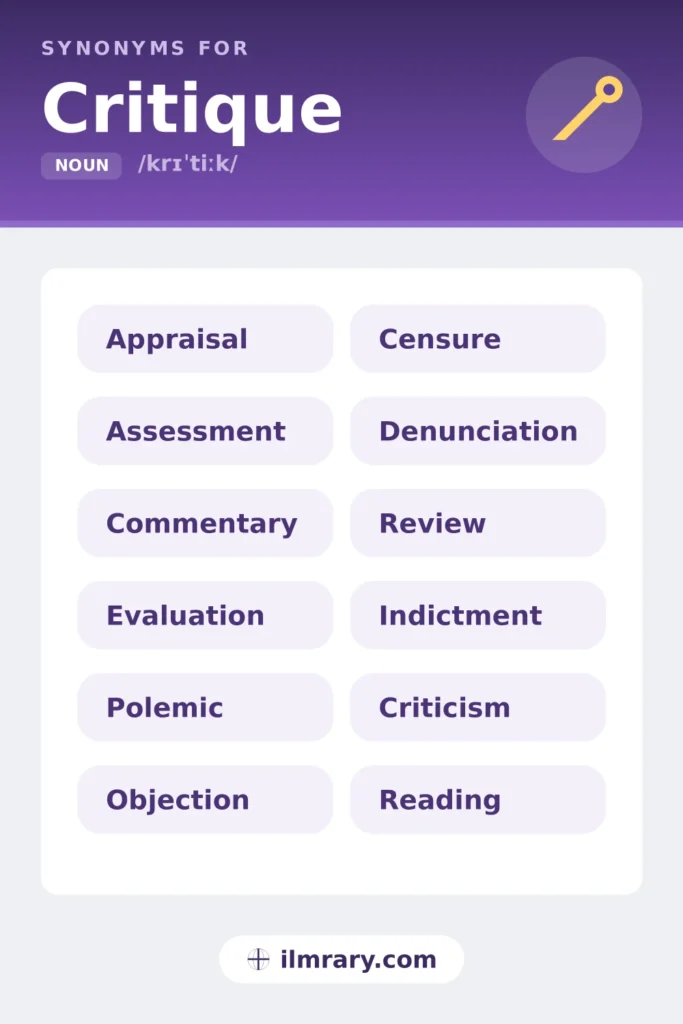
Critique Words for Balanced Assessment
Even-handed assessment reports strengths alongside weaknesses. Words reward it because it demonstrates the writer read for understanding rather than for faults.
Appraisal
Academic writing
Meaning
A formal assessment of value or quality.
When to use it
Shared with the review family, where the people sense sits beside the options sense. Balance is built into the word, so a wholly negative appraisal reads as a misuse.
- A critical appraisal of the trial found strong design and weak reporting.
- Appraised four options and recommended the one with the lowest whole-life cost.
Assessment
Academic writing
Meaning
A judgement formed against criteria.
When to use it
Shared with the review family, where criteria are implied without a formal standard. It is the most neutral noun here and the least memorable.
- The assessment weighs three factors and gives most weight to access.
- An assessment that names its criteria can be argued with, which is the point.
Commentary
Academic writing
Meaning
Running remarks on something as it proceeds.
When to use it
It follows the text rather than standing back from it, which is why a commentary follows the original's structure. Depth is traded for coverage.
- The commentary works line by line and never states an overall view.
- A commentary rather than an argument, which the preface admits.
Review
Academic writing
Meaning
An account and assessment of existing work.
When to use it
Shared with the review family, where the material already exists and belongs to somebody else. A review is never original inquiry, which is its precision.
- The article reviews the evidence for a link nobody has tested directly.
- Reviewing the earlier trials showed the same flaw repeated four times.
Evaluation
Academic writing
Meaning
Weighing something to determine its value or effect.
When to use it
Shared with the review family, where a method and an outcome measure are implied. Programme evaluation is a discipline with standards of its own.
- Evaluated the pilot against the outcomes the funder had specified.
- The evaluation found no effect and a great deal of goodwill.
Reading
Academic writing
Meaning
One interpretation among several a text will bear.
When to use it
Shared with the claim family, where rivals are admitted by the word itself. It reports understanding rather than judgement, which is a different act from critique.
- The reading is persuasive and rests on a passage never quoted in full.
- Two readings fit the poem and the chapter argues for the harder one.
Analysis
Academic writing
Meaning
Breaking something down to see how it works.
When to use it
It claims explanation rather than judgement, which is why analysis and critique are not the same instruction. Many essays deliver the first when asked for the second.
- The analysis is thorough and the chapter never says whether the policy was right.
- Analysis stops where evaluation begins and the difference is the mark scheme.
Words for Assessment That Leans Hard
Severe assessment abandons balance deliberately. Using one of these when you meant a fair reading tells a word you decided before you read.
Censure
Academic writing
Meaning
Formal expression of strong disapproval.
When to use it
Institutions censure rather than individuals, and it names an official act in parliaments and professional bodies. Applied to a book it sounds like an overreaction.
- The committee censured the department and named nobody.
- Censure carried no penalty and ended two careers.
Polemic
Academic writing
Meaning
A forceful attack on a position, written to persuade.
When to use it
Balance is abandoned by design and everybody knows it, which is what makes a good polemic honest. Calling a work polemical is criticism only when it claimed to be even-handed.
- The book is a polemic and is far more honest for saying so.
- A polemic against the reforms that changed more minds than the evidence did.
Denunciation
General writing
Meaning
Public condemnation of something as wrong.
When to use it
Moral rather than analytical, which is why it belongs to politics and rarely to scholarship. It leaves no room for anything the target got right.
- The pamphlet is a denunciation rather than an argument.
- Denunciation of the scheme reached the front pages and none of its detail did.
Indictment
General writing
Meaning
A case setting out what is wrong with something.
When to use it
Legal in origin and now standard for a damning verdict on a system rather than a person. It claims the evidence assembled amounts to a case.
- The report is an indictment of a procurement system nobody had reviewed in a decade.
- A quiet indictment, built entirely from the department's own figures.
Criticism
Academic writing
Meaning
Judgement of faults, or the discipline of judging works.
When to use it
It carries both senses at once, since literary criticism is a field and criticism is what you get for being wrong. Context separates them and students frequently do not.
- The criticism is fair and the tone is not.
- Literary criticism as a discipline predates the novel it mostly discusses.
Objection
Academic writing
Meaning
A specific reason for not accepting something.
When to use it
It is narrow by design, which makes it the most usable unit of disagreement. Answering three objections is more persuasive than announcing a critique.
- Two objections survive the author's response and one does not.
- The objection is narrow and fatal, which is the best kind.
How to Choose the Right Synonym for Critique
Set the severity before writing the first line. Balanced assessment weighs both sides, so an appraisal is even-handed by definition, an evaluation brings a method and an outcome measure, and a review reports on material somebody else produced. Analysis is the one students most often deliver when a critique was asked for, since explaining how something works is not judging whether it is right. Severe assessment abandons balance on purpose, and a polemic is honest about it, which is why calling something polemical is criticism only when it claimed neutrality. Denunciation and censure are moral and institutional rather than analytical. Objection is the most usable of all, because three answered objections persuade more than any announced critique.
Severity has to be set honestly: appraisal or evaluation where you weighed both sides, objection where the disagreement is narrow, polemic only where you abandoned balance on purpose.
Opposite Words for Critique
- Endorsement
- Praise
- Approval
- Defence
- Apologia
Test Your Word Choice
Question 1: Which do students most often deliver when a critique was asked for?
Analysis explains how something works without judging whether it is right, which is a different instruction. Polemic abandons balance and appraisal weighs both sides.
Question 2: When is calling a work polemical actually a criticism?
A polemic abandons balance openly, so the label is descriptive. It becomes a criticism only where the work presented itself as even-handed and was not.
Question 3: Which is the most usable unit of disagreement?
An objection is narrow and specific, so it can be stated and answered. Denunciation condemns morally and censure is a formal institutional act.
Critique Synonyms: Questions Examiners Ask
Does critique mean the same as criticise?
Critique means a reasoned assessment of strengths and weaknesses, while criticise means finding fault, and the confusion costs marks constantly. An essay that lists only faults has answered a different question from the one set, however well each of those faults is evidenced.
What is the difference between analysis and critique?
Analysis explains how something works, and critique judges whether it succeeds. Plenty of essays deliver thorough analysis and never state a view, which is exactly where the marks go. A critique has to end on a position the reader could disagree with.
Is a polemic a legitimate academic form?
Polemic is legitimate in academic writing where it announces itself. A book that says it is arguing one side is honest about its purpose, and the same book presented as a balanced survey misleads the reader about what it is actually doing.
How do I make a critique persuasive?
Make a critique persuasive by answering specific objections rather than announcing a general one. Two narrow objections with evidence behind them do more than a paragraph declaring the argument flawed, because the reader can test each objection against the text in front of them.