
Culture claims on a resume are easy to write and impossible to check, and culture synonyms are where that shows.
Culture names the result and hides the cause. A team that speaks up and a bonus scheme that rewards silence both belong under the word.
What people do is one half, and a colleague would recognise it. What drives them to do it is the other, and a bonus scheme is the honest place to point.
Another Word for Culture for What People Do and What Drives Them
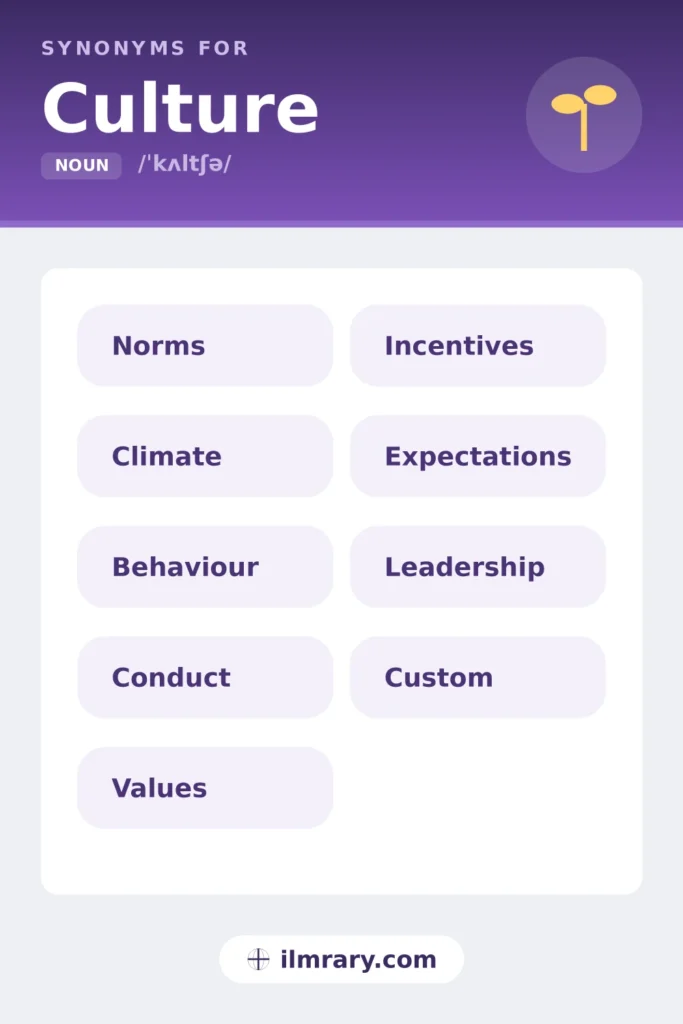
Culture Words for How People Actually Behave
Behaviour words describe what happens rather than what is stated. The gap between the two is where most culture work either succeeds or quietly fails.
Norms
Cover letter
Meaning
The unwritten rules people actually follow.
When to use it
They exist whether or not anybody approves of them, which is why they outlast policies. Naming a norm you changed is far more credible than naming a value you published.
- The norm was that nobody challenged the consultant, and two years of training had not touched it.
- Norms shifted once the first challenge went unpunished in public.
Custom and practice
Cover letter
Meaning
What has been done long enough to count as a rule.
When to use it
Employment law gives it real force, since custom and practice can create contractual rights nobody wrote down. It is the most concrete cultural fact in British workplaces.
- Custom and practice had made the overtime rate contractual without anybody agreeing it.
- Changing custom and practice took longer than changing the policy by a factor of five.
Climate
Cover letter
Meaning
How the place feels to work in at a given time.
When to use it
It changes faster than culture and is measured by surveys rather than observed. A climate can improve while the underlying culture stays exactly where it was.
- Climate improved sharply after the restructure and the same behaviours returned by autumn.
- Safety climate scores rose and the incident rate did not move.
Behaviour
Resume bullet
Meaning
What people actually do.
When to use it
The plainest and most observable word available, and the only one anybody can evidence directly. Behavioural standards are what regulators inspect rather than culture.
- Behaviour changed once escalation stopped costing people their reputation.
- Behavioural standards were written and never referred to in any conversation.
Conduct
Resume bullet
Meaning
Behaviour judged against a standard.
When to use it
It implies a code and consequences, which makes it the formal and enforceable half of behaviour. Professional bodies use it for exactly that reason.
- Conduct proceedings took eleven months and changed the guidance in a fortnight.
- A code of conduct existed and nobody had been referred under it in six years.
Working practices
Resume bullet
Meaning
The habitual ways work gets done.
When to use it
Concrete and changeable, which is why it is a better target than culture. Naming a practice you altered is evidence and naming a culture you changed is assertion.
- Changed the handover practice and repeat incidents fell by half.
- Working practices had grown up site by site with no reference to each other.
Tone from the top
Cover letter
Meaning
What senior behaviour signals to everybody else.
When to use it
Governance and compliance writing made it a standard phrase, and it names an observable thing rather than an atmosphere. What leaders tolerate is the message received.
- Tone from the top changed when the chief executive attended the first debrief.
- Tone from the top said quality and every metric measured volume.
Words for What Shapes the Behaviour
Mechanism words explain why people behave as they do. Changing one of these is what actually moves a culture, and it is the part applications almost never describe.
Incentives
Resume bullet
Meaning
What people are rewarded for, formally or otherwise.
When to use it
They predict behaviour better than any stated value, which is why a performance regime rewarding volume produces volume. Changing one is the most concrete cultural act available.
- Rewrote the incentives so response time stopped beating resolution.
- Incentives rewarded volume and the quality figures fell for two years.
Values
Cover letter
Meaning
The principles an organisation states it holds.
When to use it
Stated rather than observed, which is why published values and actual behaviour so often diverge. They matter when they are used to refuse something.
- The values were on the wall and the incentives were in the contract.
- Values became real the first time a profitable piece of work was turned down on them.
Expectations
Resume bullet
Meaning
What people believe they will be held to.
When to use it
Belief rather than policy is what governs, so expectations follow from what happened last time rather than from what was written. Setting them explicitly is cheap and rare.
- Expectations were set in the first week and never had to be enforced.
- Expectations came from watching what happened to the last person who raised it.
Psychological safety
Cover letter
Meaning
Confidence that speaking up will not be punished.
When to use it
Research fixed the term and it names a measurable condition rather than a mood. Its absence is the mechanism behind almost every concealed failure.
- Psychological safety showed up in the reporting rate rather than the survey.
- Psychological safety was assumed until the first person who raised a concern left.
Leadership
Cover letter
Meaning
The manner in which those in charge conduct themselves.
When to use it
Shared with the leadership family, where style and office split. Applied to culture it names what people copy rather than what anybody instructs.
- Leadership set the pattern by attending the difficult meetings personally.
- Leadership talked about openness and cancelled the listening events twice.
Custom
Everyday
Meaning
A long-established way of doing something.
When to use it
Age is the whole claim, which gives it force and makes it hard to shift. Custom survives restructures that remove everybody who created it.
- Custom put the difficult shift on the newest arrival for thirty years.
- Custom outlived two mergers and a change of ownership.
Choosing a Culture Synonym That Holds Up
Change a mechanism rather than announcing a culture. Behaviour words describe what happens, so norms are the unwritten rules people follow regardless of policy, custom and practice can create contractual rights nobody wrote down, and climate can improve while the underlying culture does not move at all. Conduct is behaviour judged against a code and is the enforceable half. Mechanism words explain why, and incentives predict behaviour better than any stated value, which is why a regime rewarding volume produces volume. Values matter the first time they are used to refuse something profitable, expectations follow from what happened to the last person, and psychological safety is measured in reporting rates rather than surveys. Culture is the outcome of all of it and the target of none.
The mechanism is the part worth naming: incentives or expectations where you changed what people were rewarded for, norms or working practices where you changed what they actually did.
Opposite Words for Culture
- Anomie
- Disorder
- Policy on paper
- Stated intent
- Indifference
Test Your Word Choice
Question 1: Which predicts behaviour better than any stated value?
People do what they are rewarded for, which is why a regime measuring volume produces volume. Values are stated rather than observed and climate is how the place currently feels.
Question 2: Which can create contractual rights nobody ever wrote down?
Employment law recognises custom and practice, so a long-standing arrangement can become binding. Norms and expectations shape behaviour without any legal force.
Question 3: Where does psychological safety show up most reliably?
People who expect no punishment report problems, so the rate is the observable measure. Surveys record what people will say and values statements record what leaders would like.
Culture Synonyms: Questions Applicants Ask
What can I write instead of changed the culture?
Instead of changed the culture, name the mechanism you moved. Rewrote the incentives so response time stopped beating resolution, or changed the handover practice and halved repeat incidents, both describe something a reference could confirm actually happened.
Why do published values so often fail?
Published values fail because they are stated and never enforced. A value becomes real the first time somebody uses it to refuse profitable work, and until that happens the incentives written into the contract are what people read instead.
What is the difference between climate and culture?
Climate is how the place feels now, and culture is what it reliably rewards. Climate improves after a restructure and reverts within months unless the mechanisms underneath it changed, which is why survey scores rise while the same behaviour carries on.
How is psychological safety evidenced?
Psychological safety is evidenced through the reporting rate rather than the survey. A tripled incident reporting rate after blame-free debriefs shows people risking the consequence of speaking, where a survey score shows only what they were willing to write down.