
Sector wording gives a resume away faster than anything else, and another word for customer proves it. A recruiter notices it on the first pass.
Customer fits a shop and jars in a hospital. Someone reading a council or NHS application sees the mismatch in the first line.
Money changing hands calls for one set. A duty of care calls for another, and using the wrong one marks you as new to a council or a hospital.
Customer Synonyms for Trade and for Public Service
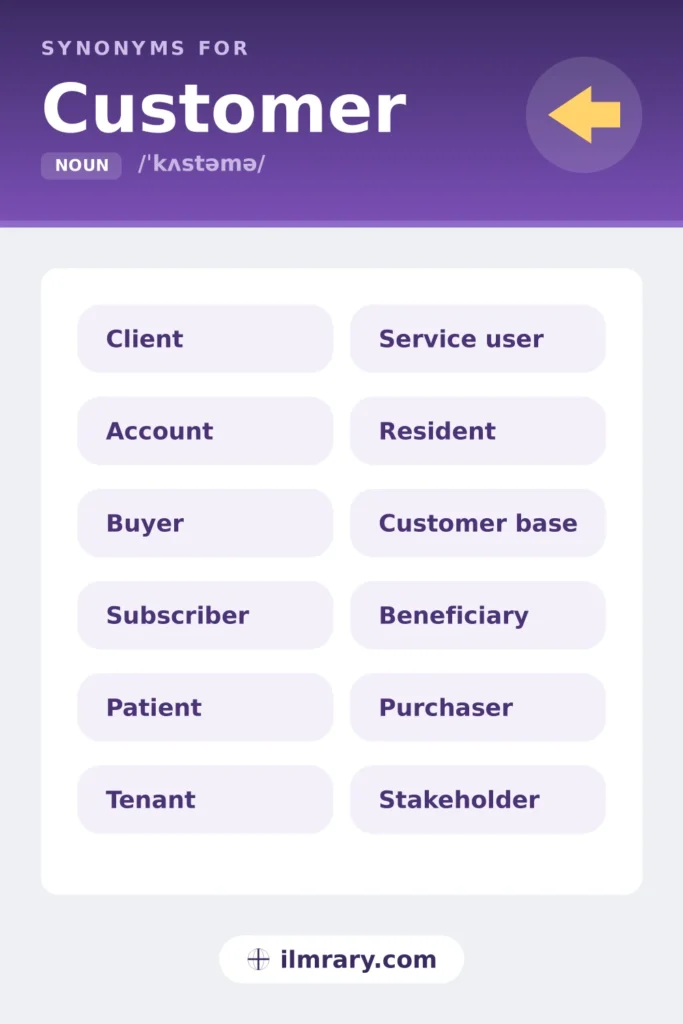
Customer Words for a Commercial Relationship
Commercial words assume a transaction and usually a choice. They differ by how long the relationship lasts and how much advice travels with it.
Client
Resume bullet
Meaning
Somebody who buys professional services rather than goods.
When to use it
Advice and a continuing relationship are both implied, which is why law, agencies and consultancy prefer it. Social work uses it for a quite different relationship.
- Managed eleven clients across two sectors for four years.
- The client had changed procurement lead three times during the engagement.
Account
Resume bullet
Meaning
A customer relationship considered as a commercial unit.
When to use it
It names the relationship rather than the person, which is why sales structures are built around it. Growing an account is a different claim from serving a client.
- Grew the account from a single site to eleven across three years.
- The account was profitable and impossible, which the renewal reflected.
Buyer
Cover letter
Meaning
The person who makes the purchasing decision.
When to use it
It names a role in a transaction rather than a relationship, and in large organisations the buyer is rarely the user. Naming that gap is often the whole insight.
- The buyer sat in procurement and the user sat in the ward.
- Buyers wanted the lowest price and users wanted the shorter lead time.
Subscriber
Everyday
Meaning
Somebody paying on a recurring basis for continued access.
When to use it
Recurrence is the whole model, so churn rather than sale becomes the measure. Publishing and software use it precisely.
- Subscribers doubled in a year and churn stayed flat.
- Every subscriber had cancelled once and come back.
Customer base
Resume bullet
Meaning
The whole body of people an organisation serves.
When to use it
It describes a population rather than an individual, which is what makes it right for strategy and analysis. It flattens people into a market, sometimes deliberately.
- Grew the customer base into two regions the company had ignored.
- The customer base aged faster than the product range did.
Purchaser
Cover letter
Meaning
The party formally buying, especially an organisation.
When to use it
Contracts and public procurement use it for the legal buyer, which is often a body rather than a person. Health commissioning gave it a specific institutional life.
- The purchaser was the authority and the recipient was the family.
- Purchaser and provider had been separated by legislation a decade earlier.
End user
Resume bullet
Meaning
The person who actually uses what was bought.
When to use it
It exists because the buyer and the user so often differ, and technology and procurement writing rely on the distinction. Never use it where the two are the same person.
- End users were consulted after the contract was signed, which explained the rest.
- Two thousand end users across a licence nobody had counted.
Words for Public and Professional Services
Public service words carry duties rather than transactions. Getting one wrong in an application to that sector is read as a sign you have not worked in it.
Service user
Resume bullet
Meaning
Somebody receiving a public or social service.
When to use it
British social care and mental health settled on it because customer implied a choice that rarely exists. It is standard in that sector and opaque outside it.
- Service users sat on the panel that redesigned the intake process.
- Four hundred service users across a team of nine.
Patient
Resume bullet
Meaning
Somebody receiving clinical care.
When to use it
Duties of care and consent travel with it, which no commercial noun carries. Attempts to replace it with customer in health settings have failed repeatedly and noisily.
- Patients waited eleven weeks and the target was six.
- Patient feedback changed the discharge process within a quarter.
Resident
Everyday
Meaning
Somebody living in a place a service covers.
When to use it
Local government and care settings both use it, meaning quite different things in each. Residency rather than transaction is what creates the relationship.
- Residents objected and the route changed twice as a result.
- Every resident had a named worker by the end of the year.
Tenant
Cover letter
Meaning
Somebody renting a property from a landlord.
When to use it
A legal relationship with statutory rights on both sides, which is why housing writing never says customer. Getting this wrong in a housing application is immediately visible.
- Tenants were consulted before the stock transfer and voted it down.
- Tenant satisfaction rose after the repairs service was insourced.
Beneficiary
Cover letter
Meaning
Somebody who gains from a scheme or a trust.
When to use it
Charity, grant and legal writing use it, and it implies the person did not pay. Some readers find it faintly patronising, which is worth knowing before you use it.
- Beneficiaries reported the change eighteen months before the evaluation did.
- Two hundred beneficiaries across four partner organisations.
Stakeholder
Cover letter
Meaning
Anybody with an interest in what an organisation does.
When to use it
So broad that it includes people who receive nothing, which is why it has become the least informative noun in public sector writing. Name the group instead wherever the sentence allows.
- Stakeholders in that programme included two regulators and a residents association.
- Stakeholder engagement had happened and nobody could say with whom.
Which Customer Synonym Fits What You Did
Take the noun from the sector rather than from habit. Commercial relationships divide by duration and advice, so client implies professional services and a continuing relationship, account names the commercial unit rather than the person, and subscriber makes churn the governing measure. Buyer and end user exist because the two are so often different people, and naming that gap is frequently the whole insight. Public services divide by duty, so patient carries consent and care, tenant carries statutory rights on both sides, and service user was adopted precisely because customer implied a choice nobody had. Stakeholder covers everyone and describes no one, which is why it has stopped working.
The sector's own word is the safe one: client or account in commercial work, patient, tenant or service user where duties rather than transactions define the relationship.
Opposite Words for Customer
- Supplier
- Provider
- Vendor
- Competitor
- Bystander
Test Your Word Choice
Question 1: Statutory rights run in both directions and rent is paid. Which noun is correct?
Tenant names a legal relationship with rights on both sides. Customer implies a commercial choice and beneficiary implies the person did not pay.
Question 2: Which noun exists because the person paying and the person using are often different?
End user names whoever actually uses what was bought, which procurement writing needs precisely because the buyer sits elsewhere. Subscriber pays recurrently and client buys professional services.
Question 3: Which noun has become the least informative in public sector writing?
Stakeholder includes anybody with an interest, including people who receive nothing at all. Resident and service user both name a definable group.
Common Questions About Customer Synonyms
Should I write customer in a health or social care application?
Write patient or service user rather than customer in health and social care, because those are the sector's own words. Customer implies a choice most people receiving those services never had, and readers who work in that field notice the wrong noun immediately.
What is the difference between a client and a customer?
A client buys professional services that come with advice and a continuing relationship, and a customer buys goods or a defined service. Law firms, agencies and consultancies say client for exactly that reason, and customer in those settings reads as an outsider's word.
Why does stakeholder read as an empty word?
Stakeholder reads as empty because it includes everybody and excludes nobody. Naming the actual groups, two regulators and a residents association, does the work the word was meant to do and takes barely more space on the page.
Is beneficiary a safe word in charity applications?
Beneficiary is standard in grant and trust writing, and a minority of readers in charities find it faintly patronising. Where the organisation itself says participant or member, following their usage costs nothing and signals that you read their material before applying.