
What happens when a date slips is the whole question, and another word for deadline answers it. Recruiters read the consequence, not the calendar.
Deadline says nothing about consequence. A date you set yourself and a date fixed by statute both go by the same name.
Hard dates carry a penalty when they pass, and statute is what fixes most of them. Planning dates move when the work moves, and a panel reads the two differently.
Deadline Synonyms for Dates With a Penalty and Dates Without
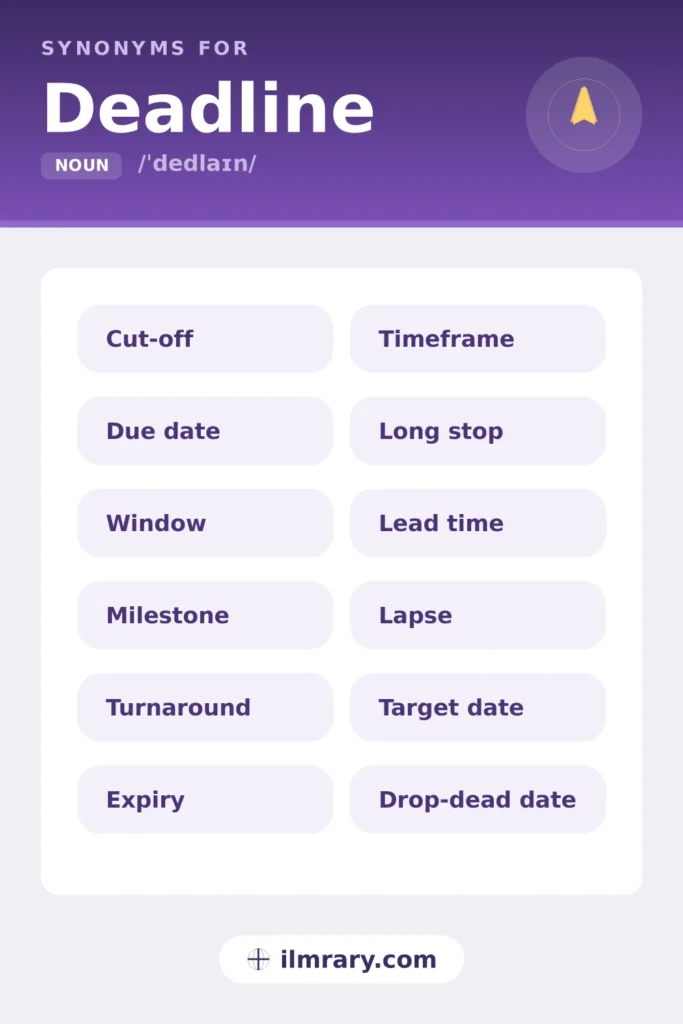
Deadline Words for Dates That Bite
Hard dates have a cost attached that somebody can name. Meeting them is worth reporting precisely because missing them would have been visible to other people.
Cut-off
Resume bullet
Meaning
The moment after which something can no longer be accepted.
When to use it
A door closes, so late is the same as never rather than merely late. Applications, submissions and trading all use it and the finality is the whole point.
- Every submission cleared the cut-off with a day in hand across four rounds.
- The cut-off was midnight and the portal closed at eleven fifty.
Statutory deadline
Cover letter
Meaning
A date fixed in law that carries a legal consequence.
When to use it
Missing it is a breach rather than a disappointment, which is why regulated sectors count them obsessively. Naming the statute makes the claim unarguable.
- Met every statutory deadline through two changes of framework.
- The statutory deadline did not move and the funding decision did.
Long stop
Everyday
Meaning
A final date after which a contract right is triggered.
When to use it
Commercial and legal drafting fix the sense, where a long stop date lets a party walk away. It is the hardest date in any agreement.
- Completed three weeks before the long stop date.
- The long stop concentrated everybody's attention in a way the milestones had not.
Due date
Resume bullet
Meaning
The date something is required by.
When to use it
The plainest term available and the most transatlantic, and it says nothing about consequence. Its neutrality suits scheduling and understates real pressure.
- Held every due date across a programme with eleven dependencies.
- The due date moved twice and the completion date never did.
Expiry
Cover letter
Meaning
The point at which something ceases to be valid.
When to use it
The thing ends rather than the work being late, which is a different kind of pressure. Licences, contracts and consents all run to it.
- Renegotiated three agreements before expiry rather than after.
- Expiry of the consent would have restarted a two-year process.
Lapse
Everyday
Meaning
The point at which a right or a status is lost through inaction.
When to use it
Nobody takes it away, it just goes, which is what makes lapses so easy to allow. Insurance, registration and funding writing use it precisely.
- Prevented the lapse of four professional registrations during the freeze.
- The permission lapsed and the site sat empty for another two years.
Drop-dead date
Everyday
Meaning
The last possible date before a plan becomes unviable.
When to use it
Informal and vivid, and it names the point beyond which the whole thing changes rather than merely slipping. Speech carries it and formal documents rarely do.
- The drop-dead date was the start of term and everybody knew it.
- We had a drop-dead date and three optimistic plans.
Words for Dates With Room in Them
Soft dates give a period rather than a moment. Naming them honestly protects you from claiming a pressure that never existed.
Window
Resume bullet
Meaning
A period during which something can happen.
When to use it
Duration rather than a moment, so the constraint is the length rather than the endpoint. Maintenance, migration and trading work all run to windows.
- Delivered the cutover inside a four-hour window with no rollback.
- The window was two weekends and the third one was never available.
Timeframe
Cover letter
Meaning
The period something is expected to take.
When to use it
It describes an expectation rather than a commitment, which is why plans use it and contracts do not. Vagueness is built in and occasionally honest.
- Delivered inside the timeframe the business case had assumed.
- The timeframe was described as ambitious, which everybody understood to mean impossible.
Milestone
Resume bullet
Meaning
A significant point reached on a longer journey.
When to use it
Shared with the achievement family, where it concedes the work continues. Project management fixed the sense, so a date is expected beside it.
- The first regulatory milestone cleared eight weeks early.
- Three milestones in a row landed without a change request.
Turnaround
Resume bullet
Meaning
The time taken from receiving something to returning it.
When to use it
Shared with the deliver family, and it names a standard rather than a single date. Service work measures it constantly and quoting the figure is what makes it evidence.
- Turnaround fell from ten days to three across the whole caseload.
- Turnaround was the only measure in the contract and it shaped everything.
Lead time
Cover letter
Meaning
The delay between ordering something and receiving it.
When to use it
It belongs to supply rather than effort, so it is somebody else's clock. Procurement and manufacturing treat it as the constraint that plans have to bend around.
- Lead time on the components ran to nine months and the design changed instead.
- Cut lead time by qualifying a second supplier before the shortage arrived.
Target date
Resume bullet
Meaning
A date aimed at rather than committed to.
When to use it
Shared with the target family, and the word target does the work of admitting the date can move. Honest planning distinguishes it from a commitment and most reporting does not.
- The target date held and the commitment date had a month of float behind it.
- Target dates slipped quietly until somebody published both columns.
Matching a Deadline Synonym to the Evidence
Say what happens when the date passes. Hard dates carry a named cost, so a cut-off closes a door and makes late identical to never, a statutory deadline turns a miss into a breach, and a long stop lets a counterparty walk away from the contract entirely. Expiry and lapse both end something rather than delaying it, which is a different and often larger problem. Soft dates give a period, so a window constrains by length, a timeframe describes an expectation, and a target date admits in its own name that it can move. Turnaround and lead time are standards rather than dates, one measuring your clock and one measuring somebody else's. Deadline covers all of them and prices none.
Attach the consequence to the date, cut-off or statutory deadline where missing it cost something, window or target date where the pressure was real and the wall was not.
Opposite Words for Deadline
- Open-ended
- Indefinite
- Unscheduled
- Rolling
- No fixed date
Test Your Word Choice
Question 1: Which date lets a counterparty walk away from the contract?
A long stop date triggers a contract right, usually to terminate. A cut-off closes acceptance and a due date states when something is required.
Question 2: Which word describes a right lost through inaction rather than taken away?
A lapse happens because nobody acted, which is what makes lapses easy to allow. Expiry is the end of validity by design and turnaround measures time from receipt to return.
Question 3: Which term measures somebody else's clock rather than yours?
Lead time is the delay between ordering and receiving, controlled by the supplier. A window is a period you work inside and a milestone marks progress on your own route.
Deadline Synonyms: What Panels Ask Next
What can I write instead of worked to tight deadlines?
On a resume, worked to tight deadlines counts only when you name the consequence of missing one. Cleared every statutory deadline through two framework changes, or delivered inside a four-hour window with no rollback, both say what a late finish would have cost and who would have seen it.
What is the difference between a target date and a commitment date?
A target date is aimed at, and a commitment date is promised to somebody outside the team. Honest programme reporting publishes both columns, while most reporting publishes one and lets the reader assume it was the second, which is where trust goes.
Why is a cut-off different from an ordinary deadline?
Cut-off dates differ from ordinary deadlines because late equals never. Once acceptance closes, no version of the work still counts, which is a sharper pressure than a date that merely disappoints somebody and gets renegotiated the week after.
Should I mention lead time on a resume?
Mention lead time on a resume where you managed around it rather than merely reported it. Qualifying a second supplier before a shortage arrived is a planning claim, and lead time is the term that makes that achievement legible to anyone working in supply.