
Counting activity is not the same as counting effect, and another word for measure decides which you reported. Panels are trained to spot the swap.
Measure covers a real outcome and a stand-in for one. Calls answered and complaints resolved both get counted, and only one says anything about the service.
An outcome names the change that happened. A stand-in names something easier to count, and a panel knows the difference even when a report does not.
Measure Synonyms for Real Outcomes and for Stand-Ins
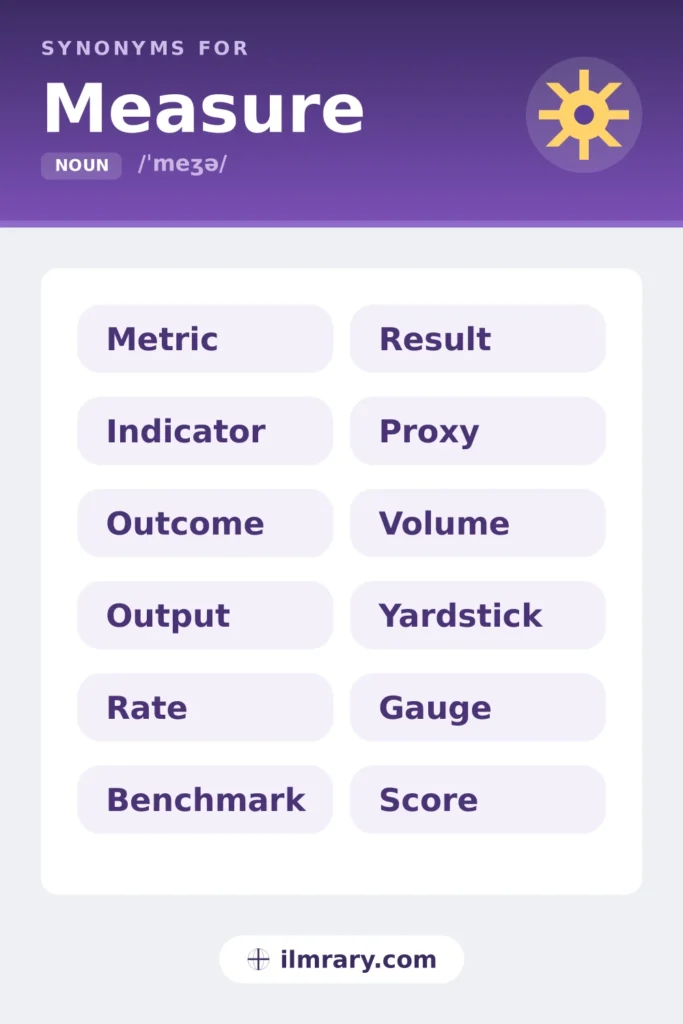
Measure Words for Numbers Close to the Result
Direct quantities count the thing itself. They are harder to collect and much harder to game, which is why they persuade experienced readers fastest.
Outcome
Resume bullet
Meaning
What actually happened to the people or things served.
When to use it
The end result rather than the activity, and health, education and social policy all treat the distinction as fundamental. Outcome data is slow and expensive, which is why so little of it exists.
- Outcomes improved for two years before the activity figures caught up.
- Outcome measurement took eighteen months to build and settled every argument after.
Result
Resume bullet
Meaning
The measurable end of an effort.
When to use it
Shared with the achievement family, and it exists whether or not anybody admires it. Commercial writing treats it as the only currency.
- Results held through two quarters of falling market volume.
- A result that size had not been reached since the depot opened.
Rate
Resume bullet
Meaning
A count expressed against a denominator.
When to use it
The denominator is where the argument lives, since the same numerator produces very different rates. Naming both is what separates analysis from assertion.
- The error rate fell from four in a hundred to under one.
- Rate per thousand told the opposite story to the raw count.
Metric
Resume bullet
Meaning
A defined quantity tracked over time.
When to use it
It implies a definition somebody wrote down, which is more than measure claims. Technology and operations writing use it as the default and it has spread from there.
- Cut the reported metrics from forty to nine and the reviews got shorter.
- Every metric had a definition and two of them contradicted each other.
Benchmark
Cover letter
Meaning
A level derived from what comparable others achieve.
When to use it
Shared with the target family, where comparison rather than instruction is the source. It measures you against peers rather than against a standard.
- Beat the national benchmark on both measures within eighteen months.
- The benchmark came from four similar trusts and none had our caseload.
Yardstick
Everyday
Meaning
An informal standard used for comparison.
When to use it
Older and plainer than benchmark, and it implies rough judgement rather than published data. Speech and commentary carry it better than reports.
- Response time became the yardstick everybody used and nobody had agreed.
- A crude yardstick beat a precise measure of the wrong thing.
Score
Everyday
Meaning
A number produced by applying a scoring method.
When to use it
A method sits behind it, so scores are comparable only where the method held. Assessment and inspection work depend on that caveat and often skip it.
- Scores rose after the moderation and the underlying work had not changed.
- A score of that kind compresses eleven judgements into one digit.
Words for Numbers Standing at a Distance
Indirect quantities count something nearby because the real thing is unaffordable to collect. Admitting the distance is what keeps them honest.
Indicator
Resume bullet
Meaning
A quantity that signals how something is going without measuring it directly.
When to use it
It points rather than counts, which is why leading indicators are valuable and often wrong. Its honesty is that the word never claimed to be the thing.
- Two leading indicators moved a quarter before the outcome data did.
- Indicators looked healthy throughout the year that ended in the inspection.
Proxy
Cover letter
Meaning
A stand-in measure used because the real one is unavailable.
When to use it
It admits the substitution openly, which is the most honest word in this family. Naming what it stands in for is what makes the analysis credible.
- Attendance was a proxy for engagement and a poor one.
- Used spend per head as a proxy until the outcome data arrived.
Output
Resume bullet
Meaning
What the work produced, counted as volume.
When to use it
Activity rather than effect, so outputs can rise while outcomes fall. Funders ask for outputs because they are cheap to count and everybody knows it.
- Outputs doubled and the outcome data showed no movement at all.
- Reported outputs monthly and outcomes annually, which suited nobody.
Volume
Resume bullet
Meaning
The raw count of things handled.
When to use it
The plainest quantity available and completely silent about quality. It is the right measure for capacity questions and the wrong one for value.
- Volume rose a third and the team stayed at nine.
- Volume was the only figure the contract measured, which shaped the whole service.
Key performance indicator
Cover letter
Meaning
A tracked measure formally designated as governing.
When to use it
The designation rather than the measurement is what the phrase adds, and organisations designate far too many. Naming how many there were is often the more revealing fact.
- Reduced the governing indicators from thirty-one to six.
- Every department had its own indicators and none of them reconciled.
Gauge
Everyday
Meaning
A rough reading of how something stands.
When to use it
Approximation is admitted, which suits early assessment and informal reporting. It never claims precision and earns its place precisely for that.
- Used the first fortnight as a gauge before committing the budget.
- A gauge of sentiment rather than a survey, and it turned out to be right.
Which Measure Synonym Fits What You Did
State how close the number stands to the thing. Direct quantities count the result, so outcome counts what happened to people, rate makes the denominator explicit, and metric implies somebody wrote a definition down. Score compresses several judgements into one digit and is comparable only where the method held. Indirect quantities count something nearby, and each admits it differently, since indicator points rather than counts, proxy names the substitution outright, and output counts activity that can rise while outcomes fall. Volume is the plainest and the most silent about quality. Measure spans all of it, which is why improved the measures persuades nobody who has been responsible for any.
What the number counted is the whole question: outcome or rate where it counted the result, proxy or indicator where it stood at a distance and you knew it.
Opposite Words for Measure
- Guesswork
- Impression
- Anecdote
- Assumption
- Hearsay
Test Your Word Choice
Question 1: Attendance stood in for engagement because engagement could not be measured. Which noun is exact?
A proxy openly stands in for a measure that is unavailable. An indicator signals how something is going and an output counts what the work produced.
Question 2: Which quantity can rise while the thing it serves gets worse?
Outputs count activity, so volume can climb while outcomes fall. Outcomes count what happened to people and results measure the end of an effort.
Question 3: Where does the argument usually live in a rate?
The same count produces very different rates depending on what it is divided by. Naming the denominator is what separates analysis from assertion.
Common Questions About Measure Synonyms
What is the difference between an output and an outcome?
An output counts what the work produced, and an outcome counts what changed for the people it served. Outputs are cheap to collect, which is why funders ask for them and why they mislead: sessions delivered can rise every quarter while the thing the sessions existed to change gets worse.
Is proxy a weak word to use in a job application?
Proxy is the strongest word available when a proxy is what you actually had. Naming the substitution shows you knew the limits of the data, which reads as competence rather than apology. Hiding it and describing the proxy as the outcome is what a numerate reader catches.
How many indicators should an organisation govern by?
Few enough indicators that the people governing can name them from memory, which in practice means somewhere near six. Cutting thirty-one indicators to six is a common and credible achievement, because indicators multiply until nobody reads any of them and the board discusses whichever one moved.
Why do scores need a caveat?
Scores need a caveat because a score is comparable only where the scoring method held constant. Moderation, rule changes and a new set of assessors all move scores without anything underneath them changing at all, which is why a three-point rise means nothing on its own.