
Whether the work stopped or only slowed is the difference, and another word for obstacle carries it. The size of the block sets up whatever you did next.
Obstacle covers both. A missing signature that halted a launch and a slow form that annoyed everybody both count.
A hard block means work stood still until somebody moved. Friction means it kept going and cost more, and a panel counts them as different problems.
Obstacle Synonyms for What Stopped Work and What Slowed It
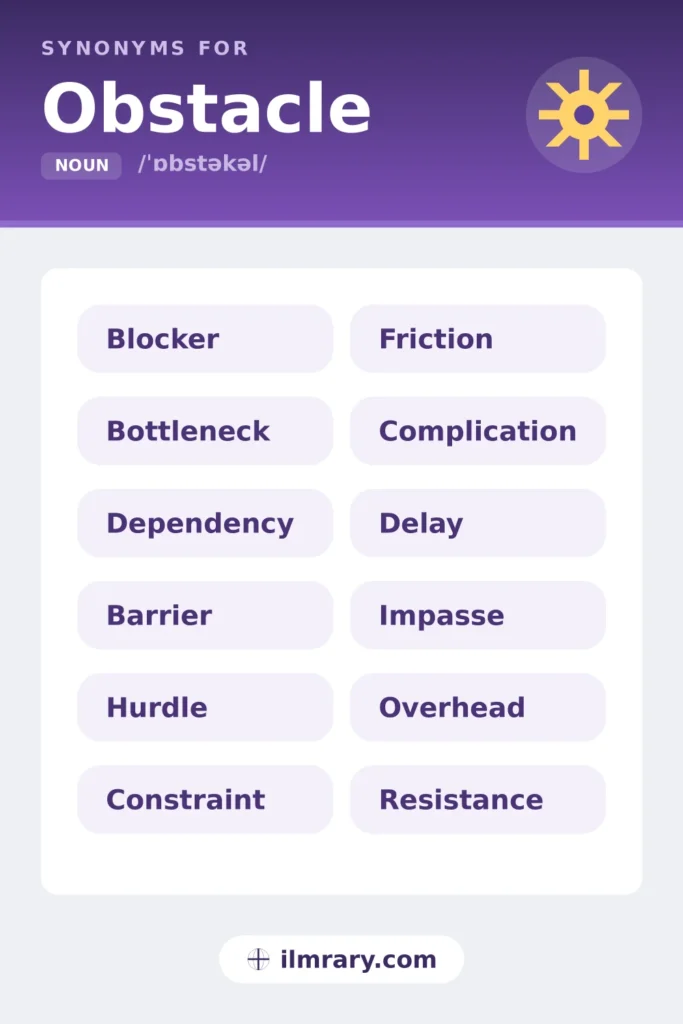
Obstacle Words for What Stops Work Entirely
Hard blocks halt progress until removed. Naming one accurately is what gets it escalated, since a blocker and a difficulty are treated very differently.
Blocker
Resume bullet
Meaning
Something that stops work until it is cleared.
When to use it
Software practice fixed it as a status with an escalation attached, which is why stand-ups exist to surface them. Calling a difficulty a blocker devalues the word.
- The blocker was a licence approval and everything else had already been done.
- Blockers were surfaced daily and cleared within a day, which is the whole point.
Bottleneck
Resume bullet
Meaning
The single stage that limits the whole flow.
When to use it
Shared with the capacity family, where only one exists at a time. Relieving anything else changes nothing at all, which is the insight most improvement work misses.
- The bottleneck was a single signatory and everything upstream had been optimised twice.
- Found the bottleneck in week two and the rest took a month.
Dependency
Resume bullet
Meaning
Something that must happen elsewhere before you can proceed.
When to use it
It locates the constraint outside your control, which changes the response from working harder to managing somebody else. Dependency mapping is what prevents most programme surprises.
- Eleven dependencies were mapped and three of them belonged to organisations that had not been told.
- The dependency arrived four months late and the plan had assumed a fortnight.
Barrier
Cover letter
Meaning
Something preventing a group from reaching or using something.
When to use it
Shared with the inclusion family, where naming the specific barrier is the fact most claims omit. It implies a structural block rather than a temporary one.
- The barrier was a form requiring a permanent address.
- Barriers were listed in the strategy and none of them was removed.
Impasse
Cover letter
Meaning
A position from which neither side can move.
When to use it
Shared with the conflict family, where genuine deadlock rather than reluctance is claimed. Somebody outside is usually needed to break one.
- The impasse broke when a third party proposed something neither side could have.
- An impasse on price and agreement on everything else.
Constraint
Resume bullet
Meaning
Anything that stops output rising further.
When to use it
Shared with the capacity family, where naming the kind is what makes it actionable. A constraint can be legal or financial rather than physical.
- The binding constraint was the licence rather than the building.
- Constraints were listed in every paper and ranked in none of them.
Veto
Cover letter
Meaning
Somebody's power to stop something proceeding.
When to use it
Shared with the influence family, where negative power alone is the claim. A veto held informally is harder to work with than one written down.
- The finance director held a veto and used it twice in six years.
- A veto in practice rather than in the constitution, which everybody understood.
Words for Things That Slow Rather Than Stop
Soft obstacles cost time and effort without halting anything. Distinguishing them from blockers is what keeps escalation routes working.
Hurdle
Everyday
Meaning
Something to be got over on the way.
When to use it
Passable by definition, which is why the metaphor implies effort rather than deadlock. It concedes the obstacle was surmountable, which is honest and modest.
- The approval hurdle added three weeks and never threatened the outcome.
- Two hurdles rather than a barrier, which the update said plainly.
Friction
Cover letter
Meaning
Ordinary difficulty that slows things without stopping them.
When to use it
Shared with the conflict family, where it is expected rather than exceptional. Removing all of it is neither possible nor desirable.
- Friction between the two teams was constant and never once stopped the work.
- Friction over the handover disappeared when the form changed.
Complication
Cover letter
Meaning
Something that makes a task harder than expected.
When to use it
It claims added difficulty rather than a stop, and clinical usage gives it a precise sense about an unwanted development. Naming it prevents an outcome looking like underperformance.
- The complication was a second system nobody had documented.
- Complications were reported as they arose rather than at the end.
Delay
Resume bullet
Meaning
Time lost against the plan.
When to use it
It names the effect rather than the cause, which is why delay reporting without a reason is useless. Cause and duration together make it actionable.
- Delay of eleven weeks traced to a single approval step.
- Delays were reported and never attributed, which the review changed.
Overhead
Cover letter
Meaning
Effort spent on something other than the work itself.
When to use it
Shared with the budget family in a cost sense. Here it names the tax that process imposes, which is invisible until somebody measures it.
- Reporting overhead took a day a week from every practitioner.
- Overhead was accepted as unavoidable until somebody counted it.
Resistance
Cover letter
Meaning
People declining to cooperate with a change.
When to use it
It usually has a reason, and treating it as an obstacle rather than information is the standard change-management error. What people are resisting is the interesting question.
- Resistance came from the team that had implemented the previous version.
- Resistance was treated as a communications problem and turned out to be a rota problem.
Matching an Obstacle Synonym to the Evidence
Name what was in the way. Hard blocks stop work entirely, so a blocker is a status with escalation attached and calling a difficulty one devalues the word, a bottleneck is the single limiting stage where relieving anything else changes nothing, and a dependency puts the constraint outside your control and changes the response from working harder to managing somebody else. A barrier implies a structural block rather than a temporary one. Soft obstacles cost time without halting anything, and separating them is what keeps escalation routes working, since a hurdle concedes it was surmountable and friction is expected rather than exceptional. Resistance usually has a reason, and treating it as an obstacle rather than information is the standard change-management error.
What it blocked and what moved it are the two halves: blocker or dependency where the work stopped, hurdle or friction where it only cost time.
Opposite Words for Obstacle
- Clear run
- Enabler
- Facilitator
- Open path
- Green light
Test Your Word Choice
Question 1: Which changes the response from working harder to managing somebody else?
A dependency sits outside your control, so effort inside the team achieves nothing. A bottleneck is a stage in your own flow and a hurdle is passable with effort.
Question 2: What does calling a difficulty a blocker do?
Blocker is a status with escalation attached, so applying it to ordinary difficulty means real blockers stop being treated differently. Escalation only works while the category is honest.
Question 3: What is the standard change-management error?
Resistance usually has a reason, so treating it as information rather than a barrier is what finds the rota problem underneath. Communication and pace are symptoms of missing that.
Obstacle Synonyms: What Panels Ask Next
What can I write instead of overcame significant obstacles?
Instead of overcame significant obstacles, name the obstacle and the fix. The bottleneck was a single signatory, or eleven dependencies mapped with three of them belonging to organisations nobody had told, both describe work a reader can picture and neither claims anything the file cannot support.
Why does dependency mapping matter on a project?
Dependency mapping matters because it surfaces work owned by people who do not yet know it is theirs. Most programme surprises are dependencies on teams or organisations nobody asked whether the date was possible, and the answer arrives too late to move anything.
Is friction worth reporting as an obstacle?
Friction belongs in a report as context, not as an obstacle. Constant friction between two teams that never once stopped the work is an honest description of conditions, and calling it an obstacle overstates it to a reader who has managed both kinds and can tell them apart.
How should I handle resistance to a change?
Handle resistance by finding out what is being resisted. Resistance from the team that implemented the previous version usually contains information about why the previous version failed, and treating it as an obstacle to push through discards that information at the point it would have been worth most.