
Depth is the claim nobody can check on a resume, and other ways to say expertise decide how far you go. Overreach here is easy and costly.
Expertise claims the top of the scale. A weekend course and fifteen years both hide behind it, and a recruiter reads the word as inflation.
Formal depth points at a qualification somebody can verify. Practical know-how points at a problem you fixed, and both need a witness.
Expertise Synonyms for Formal Depth and for Practical Know-How
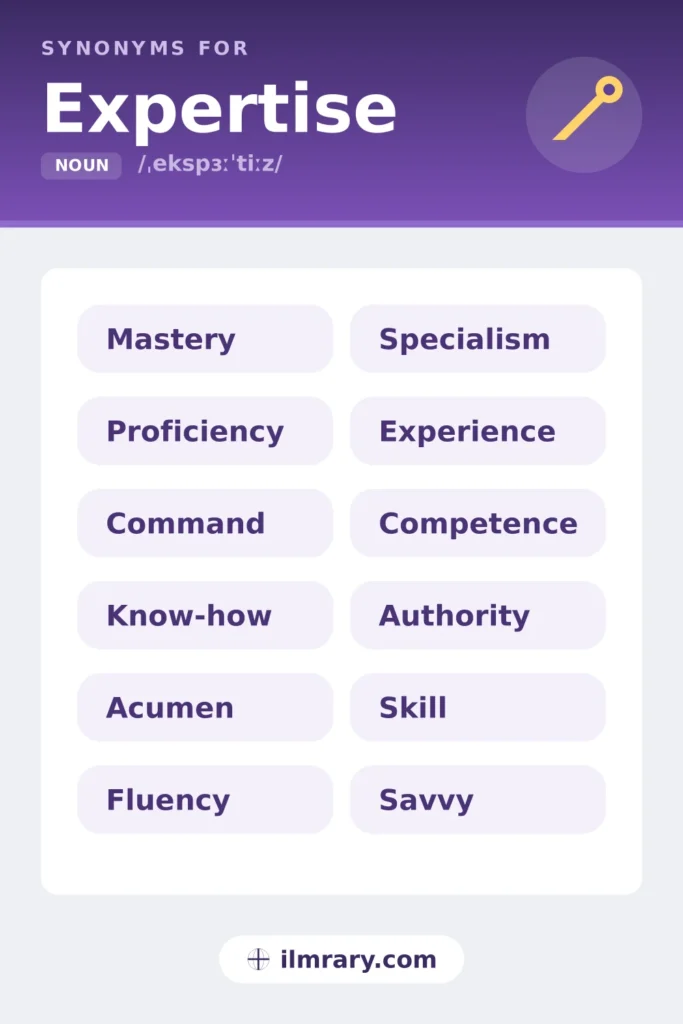
Expertise Words for Demonstrated Command of a Craft
Command words describe what a person can do under observation. Assessment, accreditation and portfolios support them, which is why they hold up when a panel starts probing.
Mastery
Cover letter
Meaning
Complete command of a discipline and its exceptions.
When to use it
The ceiling of this family, and it invites comparison with the best in the field rather than the average. Applied to a tool it flatters, applied to a discipline it dares the reader to test you.
- Mastery of the tariff rules made her the last stop for every disputed classification.
- Mastery takes a decade in this trade and nobody pretends otherwise.
Proficiency
Resume bullet
Meaning
Reliable competence at a defined standard.
When to use it
Language testing and technical certification fixed its meaning, so it reads as measured rather than modest. It admits a ceiling, which is exactly why hiring managers trust it.
- Proficiency in Portuguese confirmed at the higher tier of the framework.
- Proficiency across the whole toolchain, with specialism in the reporting layer.
Command
Cover letter
Meaning
Confident control of a body of knowledge in use.
When to use it
Shared with the leadership family, where it names authority over people rather than material. Applied to a subject it suggests fluency under pressure, which is a performance claim.
- Her command of the regulations survived four hours of cross-examination.
- Command of the source material showed in every answer she gave unprepared.
Fluency
Cover letter
Meaning
Ease and speed in using a body of knowledge without hesitation.
When to use it
Languages own the primary sense and technical fields borrowed it for the same idea, working without stopping to look things up. It claims speed rather than depth, and the two come apart.
- Fluency in the query language cut report turnaround from days to hours.
- Fluency, not vocabulary, is what the placement year built.
Competence
Resume bullet
Meaning
Sufficient ability to do the job to standard.
When to use it
Regulated professions treat it as a formal threshold, and outside them it reads as faint praise. Say competence where a framework defines it and something warmer everywhere else.
- Competence signed off against all nine units of the assessment framework.
- Annual competence checks kept the whole team in good standing.
Skill
Resume bullet
Meaning
A learned ability to perform a specific task well.
When to use it
Shared with the skill family, where the repetition problem is the whole subject. It is the smallest unit here, so name the skill or the noun does nothing.
- Skill at negotiating with reluctant suppliers, built across sixty renewals.
- The skill that mattered was reading a balance sheet fast.
Craft
Everyday
Meaning
Practised skill in work where judgement and finish both count.
When to use it
Trades, writing and design keep it warm, and it praises care rather than volume. It suggests something learned from people rather than from a syllabus.
- Her craft showed in joints nobody would ever see.
- Editing is a craft and the third pass is where it lives.
Words for Accumulated Knowledge and Judgement
Knowledge words describe what somebody has stored rather than what they can perform. Time is the usual proof, and they suit consultancy and advisory writing better than technical bullets.
Know-how
Everyday
Meaning
Practical knowledge of how to make something work.
When to use it
Workshop rather than library, and it claims nothing academic. Manufacturing and engineering use it as a compliment about the part that never got written down.
- Know-how from the old line kept the new one running through commissioning.
- Twenty years of know-how retired with him and the manual did not cover it.
Specialism
Cover letter
Meaning
A narrow field a person has concentrated on.
When to use it
British usage prefers specialism where American usage says specialty, and both name breadth traded for depth. It answers what rather than how much.
- Her specialism is procurement fraud in local government.
- A specialism that narrow takes years to build and minutes to explain.
Experience
Resume bullet
Meaning
Knowledge gathered by having done the work.
When to use it
Shared with the experienced family, and the most quantifiable noun here because years attach to it. Time alone proves exposure rather than quality, so pair it with what changed.
- Nine years of experience across three regulatory regimes.
- Experience of two failed migrations shaped how she planned the third.
Acumen
Cover letter
Meaning
Sharp judgement in a practical field.
When to use it
Business and commercial writing own it, and it praises decision quality rather than knowledge held. Its usual companions are commercial, financial and political.
- Commercial acumen turned a break clause into a renegotiation.
- Political acumen kept the proposal alive through two changes of minister.
Authority
Cover letter
Meaning
Standing that makes a person's view carry in a field.
When to use it
Shared with the leadership family, where it names the right to decide. Applied to knowledge it is conferred by others, so cite the citation rather than the adjective.
- She became the authority on coastal flood modelling in the region.
- Authority in this field arrives through publication and stays through peer review.
Savvy
Everyday
Meaning
Shrewd practical understanding of how something really works.
When to use it
Informal and modern, and it praises street sense over training. Digital savvy and media savvy have become fixed phrases, and formal documents avoid all of them.
- Media savvy kept a difficult story off the front page.
- She had the savvy to route the request through procurement first.
Which Expertise Synonym Fits What You Did
Grade the claim before choosing the noun. Command of a craft runs from competence, a threshold, through proficiency and fluency, both measured and both admitting a ceiling, to mastery, which invites comparison with the best in the field. Stored knowledge runs from know-how, practical and unwritten, through specialism and experience, which answer what and how long, to acumen and authority, where judgement and standing are the claim and somebody else usually confers them. Expertise itself works as a heading and collapses as a bullet, since the reader immediately asks which of these you meant.
The depth you would defend is the one to name: proficiency and fluency for measured command, know-how and acumen for judgement earned on the job.
Opposite Words for Expertise
- Inexperience
- Incompetence
- Ignorance
- Amateurism
- Unfamiliarity
Test Your Word Choice
Question 1: Which word admits a ceiling and is trusted for exactly that reason?
Proficiency names reliable competence at a defined standard, so it concedes there is more above. Mastery denies a ceiling and authority is conferred rather than claimed.
Question 2: The knowledge never made it into the manual. Which word fits?
Know-how names practical knowledge of making something work, learned on the floor. Specialism names a narrow field and fluency names speed of use.
Question 3: Which word praises the quality of decisions rather than knowledge held?
Acumen is sharp judgement in a practical field, usually commercial or political. Competence is a threshold of ability and craft praises care in execution.
Common Questions About Expertise Synonyms
What can I write instead of expertise on a resume?
Expertise on a resume needs the level and the field stated together. Proficiency with the standard attached, a specialism with the narrow subject named, or experience with a count of years all tell a recruiter what they are getting. Expertise alone leaves the reader asking which you meant.
Is mastery too strong a claim on a resume?
Mastery is too strong for most resumes, since the word invites comparison with the best practitioners in the field. Keep it for one tool or one corner of a discipline you would defend in front of such a person, and grade everything else as competence, proficiency or fluency.
What is the difference between proficiency and fluency?
Proficiency measures reliable performance against a standard, and fluency measures working without stopping to check. Somebody can be proficient and slow, or fluent and shallow, so the two claims come apart under questioning. Name whichever one a panel could actually verify.
Does know-how sound too informal for a cover letter?
Know-how reads as precise rather than informal in engineering, manufacturing and the trades, where it names the part of a job nobody ever wrote down. In academic or advisory letters, specialism or acumen matches what those readers expect, so pick the noun by the field you address.