
Causal claims are the easiest ones to overstate in an essay, and synonyms for cause keep them honest.
Cause claims the most of any of them. It says one event produced another, which is more than most undergraduate evidence can carry.
Distance from the outcome sets the order. Some words name a force that acted directly. Others name a condition behind it, or one influence among several, and that is the honest reading of most evidence.
Cause Synonyms Graded by Distance From the Outcome
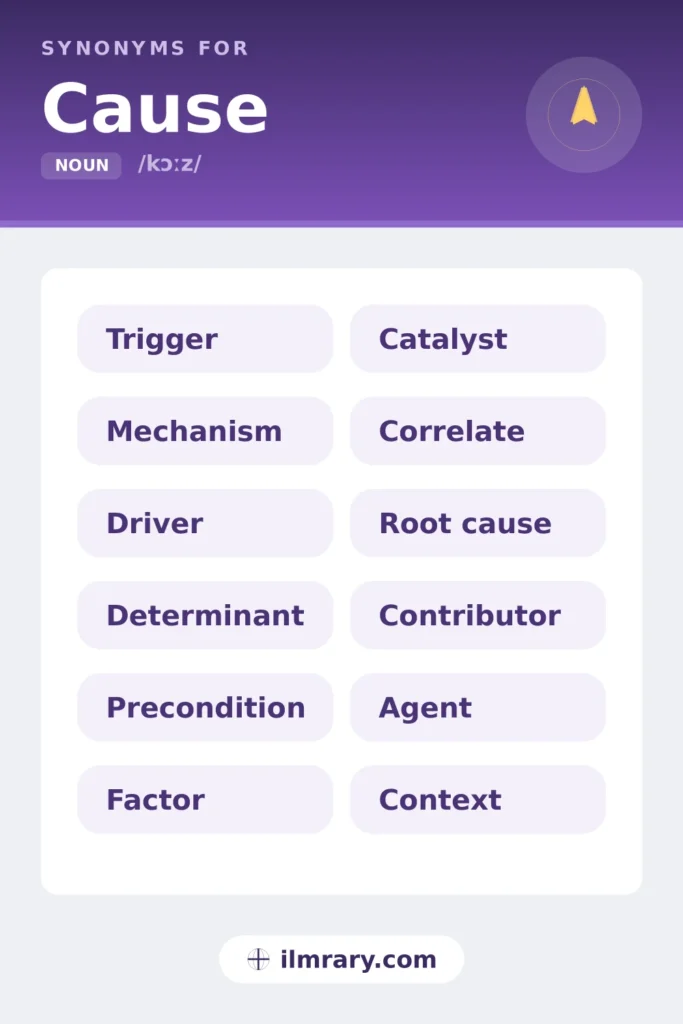
Words for Direct and Immediate Causes
Direct causes act on the effect without much between them. Their evidence is usually a mechanism somebody can describe step by step.
Trigger
Academic writing
Meaning
What sets something off at a particular moment.
When to use it
It decides the timing rather than the outcome, so a trigger explains why now and never why at all. Confusing it with a cause is the commonest error in incident analysis.
- The resignation triggered a collapse that three years of debt had made inevitable.
- The trigger was a routine update and the cause was eleven years of deferred work.
Mechanism
Academic writing
Meaning
The chain by which a cause produces its effect.
When to use it
It answers how rather than whether, and a plausible mechanism is what turns a correlation into a claim anybody will accept. Naming it is the strongest move available.
- The mechanism runs through household income rather than through the schools.
- Without a mechanism the association stayed unexplained for a decade.
Driver
Academic writing
Meaning
A force that keeps pushing an effect in one direction.
When to use it
It implies sustained influence rather than a single event, which suits trends and long-run change. Policy and business writing use it heavily and loosely.
- The main driver was demographic and every policy response addressed something else.
- Two drivers pulled in opposite directions and the net figure hid both.
Determinant
Academic writing
Meaning
A factor that substantially fixes an outcome.
When to use it
It claims strong influence rather than total control, and social determinants of health is the phrase that carries it. Stronger than factor and weaker than cause.
- Housing is the strongest determinant in the whole model.
- Determinants were listed and their relative weight never estimated.
Root cause
Academic writing
Meaning
The underlying cause behind the visible one.
When to use it
Incident analysis made it a formal technique, and the discipline is not stopping at the first plausible answer. Most root cause analyses stop too early.
- The root cause was a rota rule rather than the individual it was blamed on.
- Root cause analysis reached the third why and stopped.
Agent
Academic writing
Meaning
The thing that actively brings about a change.
When to use it
It implies something doing rather than a condition obtaining, which is why chemistry and epidemiology use it. Applied to people it names the actor rather than the influence.
- The causal agent was identified eleven years after the first outbreak.
- Agents of change is a phrase that names nobody in particular.
Source
General writing
Meaning
Where something originates.
When to use it
Origin rather than mechanism, so a source explains where and a cause explains why. Plain, and right where the origin is the disputed part.
- The source of the discrepancy was a single duplicated record.
- Tracing the source took three weeks and correcting it took an afternoon.
Words for Conditions and Contributing Factors
Indirect causes make an effect possible or more likely without producing it. Most real explanations are built from these rather than from a single cause.
Factor
Academic writing
Meaning
One of several things contributing to an outcome.
When to use it
It claims contribution without claiming weight, which is honest and often too weak to be interesting. Ranking the factors is where the analysis actually lives.
- Four factors were named and none was weighted.
- Cost was a factor and access was the reason.
Precondition
Academic writing
Meaning
Something that must be present for an effect to be possible.
When to use it
Necessary rather than sufficient, which is the distinction most causal writing loses. A precondition can hold for years without anything happening.
- Cheap credit was a precondition and the trigger was the rate decision.
- Every precondition was in place a decade before the collapse.
Catalyst
General writing
Meaning
Something that speeds up a change without being consumed by it.
When to use it
Chemistry gives the strict sense, where a catalyst is unchanged at the end. General usage has flattened it into a synonym for trigger, which loses the interesting part.
- The report was a catalyst and the pressure had been building for years.
- A catalyst rather than a cause, since nothing about it changed.
Correlate
Academic writing
Meaning
Something that moves together with an effect.
When to use it
Shared with the insight family, where association is claimed and cause denied. Naming a correlate rather than a cause is the honest move when the mechanism is missing.
- Deprivation correlates with every outcome in the study and explains none of them directly.
- Two correlates disappeared once age was controlled for.
Contributor
Academic writing
Meaning
Something that added to an outcome alongside others.
When to use it
It claims a share without claiming primacy, which suits multi-causal accounts. Incident reviews use contributory factor as a formal category.
- Fatigue was a contributory factor and the rota was the cause.
- Three contributors were identified and the report ranked them.
Context
Academic writing
Meaning
The surrounding conditions that shape what happens.
When to use it
It shapes rather than produces, which is why context explains variation between places more often than it explains events. Overuse has made it a way of saying nothing.
- The same policy produced opposite results and context explained the difference.
- Context was invoked in every paragraph and specified in none.
Which Cause Synonym Fits Your Evidence
Say how direct the link was. Direct causes act with little between them, so a mechanism answers how and turns an association into an accepted claim, a trigger fixes the timing and never the outcome, and a driver implies sustained pressure rather than an event. Root cause names the underlying answer, and the discipline is not stopping at the first plausible one. Indirect causes are what most real explanations are built from, since a precondition is necessary rather than sufficient and can hold for years, a contributory factor claims a share without primacy, and a correlate claims association while denying cause outright. Cause claims the strongest link available, which is why it is so often the wrong word.
The link has to be graded honestly: mechanism or trigger where it was direct, precondition or contributory factor where the effect needed several things at once.
Opposite Words for Cause
- Effect
- Consequence
- Outcome
- Symptom
- Result
Test Your Word Choice
Question 1: Which explains why now rather than why at all?
A trigger fixes the timing of an effect that other conditions had already made possible. A driver applies sustained pressure and a determinant substantially fixes an outcome.
Question 2: Which is necessary without being sufficient?
A precondition must be present for the effect to be possible and can hold for years with nothing happening. A mechanism describes how the effect is produced and an agent brings it about.
Question 3: What turns a correlation into a claim readers accept?
Naming the chain by which the cause produces the effect is what makes an association credible. Sample size and duration strengthen the association without explaining it.
Common Questions About Cause Synonyms
What can I write instead of caused?
Instead of caused, write triggered where the timing is the claim, drove where the pressure was sustained, and contributed to where the outcome had several sources. Each of those promises only what the evidence normally supports, and cause claims the strongest link available.
What is the difference between a trigger and a cause?
A trigger sets something off at a particular moment, and a cause is what makes the outcome happen at all. Blaming a routine update for a failure eleven years in the making confuses the two, which is the standard error in incident reporting.
When should I write correlate instead of cause?
Write correlate instead of cause whenever the mechanism is missing. Claiming cause without a mechanism invites the objection immediately, while naming the correlate and saying plainly that the mechanism is unknown is a position you can defend.
Why do root cause analyses stop too early?
Root cause analyses stop early because the first plausible answer is normally a person rather than a system. Reaching the rota rule behind an error, instead of the individual it was blamed on, takes more whys than most reviews have appetite for.