
What was at stake changes what the meeting was called, and other ways to say interview carry that. The name you use sets the reader's expectation.
Interview covers a disciplinary hearing and a coffee with a researcher. A reader has no way to tell how much rode on the record.
A record, a panel and a decision stand behind the formal half. Notes and a follow-up stand behind the other, and the two belong in different lines of a resume.
Interview Synonyms for High Stakes and for Gathering Information
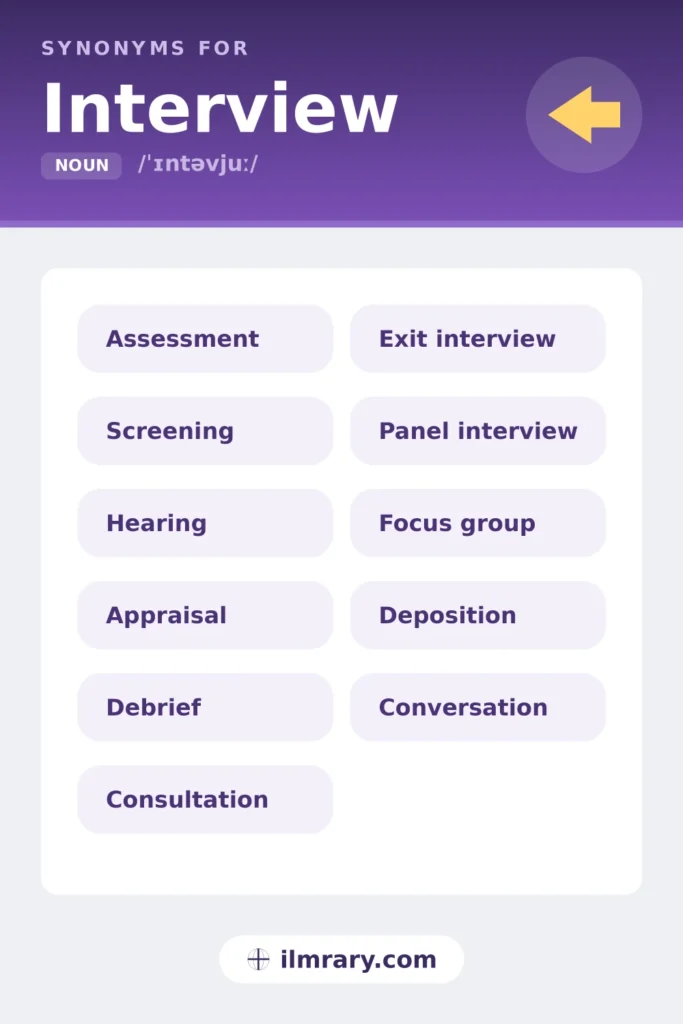
Interview Words for Conversations That Decide Something
Decision interviews have consequences for the person being interviewed. Fairness and consistency matter most here, and both are testable afterwards.
Assessment
Resume bullet
Meaning
A structured judgement about somebody against criteria.
When to use it
Shared with the review family, where criteria are implied. In recruitment and social care an assessment has a documented method and can be appealed.
- Assessed forty applications against a published scoring matrix.
- Assessment centres replaced the panel interview and the appeal rate fell.
Screening
Resume bullet
Meaning
A first pass to decide who goes further.
When to use it
Shared with the safeguarding family, where it sweeps a population. In recruitment it filters at speed, which makes consistency matter more than depth.
- Screening calls cut a field of two hundred to eighteen in a fortnight.
- Screening criteria were rewritten after the equality review.
Panel interview
Resume bullet
Meaning
Assessment by several people at once.
When to use it
Multiple assessors reduce individual bias and introduce group dynamics, which is why scoring independently before discussion matters. Its formality suits contested appointments.
- Chaired the panel interview for every senior post that year.
- Panel members scored independently and then reconciled, which changed two outcomes.
Hearing
Cover letter
Meaning
A formal occasion where evidence is given and a decision follows.
When to use it
Shared with the meeting family, where rules govern who speaks and in what order. Representation and the right to respond are usually part of it.
- The hearing ran two days longer than listed and the finding was published.
- Represented the authority at eleven hearings across two years.
Investigation interview
Cover letter
Meaning
Questioning as part of a formal inquiry.
When to use it
Procedural rules apply and what is said may be used in a decision about the person, which is why notice and support arrangements matter. It is not a conversation.
- Investigation interviews were recorded and transcripts shared before the finding.
- Conducted eleven investigation interviews and had every one countersigned.
Deposition
Everyday
Meaning
Sworn testimony taken outside court.
When to use it
American legal practice fixes it, and British procedure uses witness statements for the equivalent. Under oath is the whole difference from an interview.
- The deposition ran for six hours and produced two pages worth reading.
- Depositions were taken from every party before the case management hearing.
Appraisal
Resume bullet
Meaning
A formal assessment of somebody's performance.
When to use it
Shared with the feedback family, where a record and a cycle both exist. It decides about somebody who continues working for you, which changes the dynamic entirely.
- Appraised a team of fourteen across three annual cycles.
- Appraisal happened annually and the real conversations happened in between.
Words for Conversations That Gather Information
Research and learning conversations are for finding something out. The person answering usually gains nothing, which puts the obligation on the interviewer.
Exit interview
Resume bullet
Meaning
A conversation with somebody who is leaving.
When to use it
The person has nothing left to lose, which is why exit interviews contain information nothing else produces and why so few organisations act on them.
- Exit interviews named the same manager eleven times before anything happened.
- Exit interviews were conducted by the line manager, which explained the findings.
Debrief
Resume bullet
Meaning
Structured discussion after an event about what happened.
When to use it
Shared with the feedback family, where the system rather than the individual is examined. Blame-free rules are what make the information appear at all.
- Debriefed after every serious incident and the trust later mandated it.
- Debriefs stayed blame-free and the reporting rate tripled within a year.
Consultation
Cover letter
Meaning
A clinical or professional conversation to reach a view.
When to use it
Shared with the engagement family in a different sense. Here it names a professional encounter where expertise is being applied to somebody's situation.
- Consultations ran to fifteen minutes and the complexity had doubled since the standard was set.
- A consultation model that assumed one problem per appointment.
Focus group
Cover letter
Meaning
A guided discussion among several participants.
When to use it
The interaction is the point rather than a limitation, since people build on each other. Dominant voices are the standard risk and moderation is the skill.
- Focus groups surfaced a concern that four hundred survey responses had missed.
- Focus groups were held with people who had accepted the service and nobody who had refused it.
Fieldwork interview
Cover letter
Meaning
A research conversation conducted in somebody's own setting.
When to use it
Setting shapes what people say, which is why fieldwork is done where the work happens rather than in an office. Rapport and access are the constraints.
- Fieldwork interviews were conducted on the ward rather than in the meeting room.
- Fieldwork interviews took eleven months to arrange and four weeks to conduct.
Conversation
Everyday
Meaning
An exchange without a formal structure.
When to use it
Its informality is what produces candour, which is why so much is learned in corridors. Calling something a conversation signals it carried no consequences.
- The conversation was informal and changed the whole approach.
- A conversation rather than an interview, which is why anybody said anything.
How to Choose the Right Synonym for Interview
Say what was at stake and for whom. Decision conversations affect the person being interviewed, so fairness and consistency are testable afterwards, which is why panel members scoring independently before discussion changes outcomes and why screening criteria attract equality review. An investigation interview is not a conversation, since what is said feeds a decision about the person and procedural rules apply. Information conversations put the obligation on the interviewer, because the person answering usually gains nothing, which is exactly why exit interviews contain what nothing else produces and why conducting them through the line manager destroys them. Interview names the form and settles nothing about the stakes.
The stakes and the rules are what a reader needs. Assessment or hearing where a decision followed, exit interview or debrief where somebody spoke without having to.
Opposite Words for Interview
- Guesswork
- Assumption
- Hearsay
- No consultation
- Unstructured chat
Test Your Word Choice
Question 1: Why do exit interviews contain information nothing else produces?
Somebody leaving has no stake in the consequences, which removes the reason to soften. Length and recording change little about candour.
Question 2: What changes panel outcomes most reliably?
Independent scores recorded before conversation prevent the first opinion voiced from anchoring the rest. Adding members or time without that changes the dynamic very little.
Question 3: What destroys an exit interview?
The most common reason people leave is their manager, so having that manager collect the reason guarantees the finding. Channel and timing matter far less.
Interview Synonyms: Questions Recruiters Ask
What can I write instead of conducted interviews?
Instead of conducted interviews, name the purpose and the stakes. Chaired panel interviews for every senior post, or conducted eleven investigation interviews with transcripts shared before the finding, both tell a reader what the work demanded and who it affected.
Why is an investigation interview not a conversation?
An investigation interview is not a conversation because what is said feeds a decision about the person answering. Notice, representation and a written record all apply, and treating the meeting informally is the failure that most often gets a finding overturned on appeal.
What is the skill in running a focus group?
Moderation is the skill a focus group depends on. The interaction between participants is the reason to run one rather than six separate conversations, and the standard risk is that two confident voices manufacture a consensus nobody else in the room held.
Should fieldwork interviews happen on site?
Fieldwork interviews should happen on site wherever access allows, because the setting shapes what people say. A ward conversation and an office conversation with the same person about the same subject produce noticeably different material, and only one of them shows you the work.