
Where an obligation comes from changes what breaking it costs, and synonyms for duty carry that. One kind ends up in court and one ends up in an appraisal.
Duty covers both sources. A statutory duty and a line in your job description are equally duties, so the word alone tells a panel nothing.
Obligations set by law or a regulator hold whether or not the role changes. Scope written into a job description moves with the post, and only the first survives a change of employer.
Duty Synonyms for Obligations From Outside and From the Role
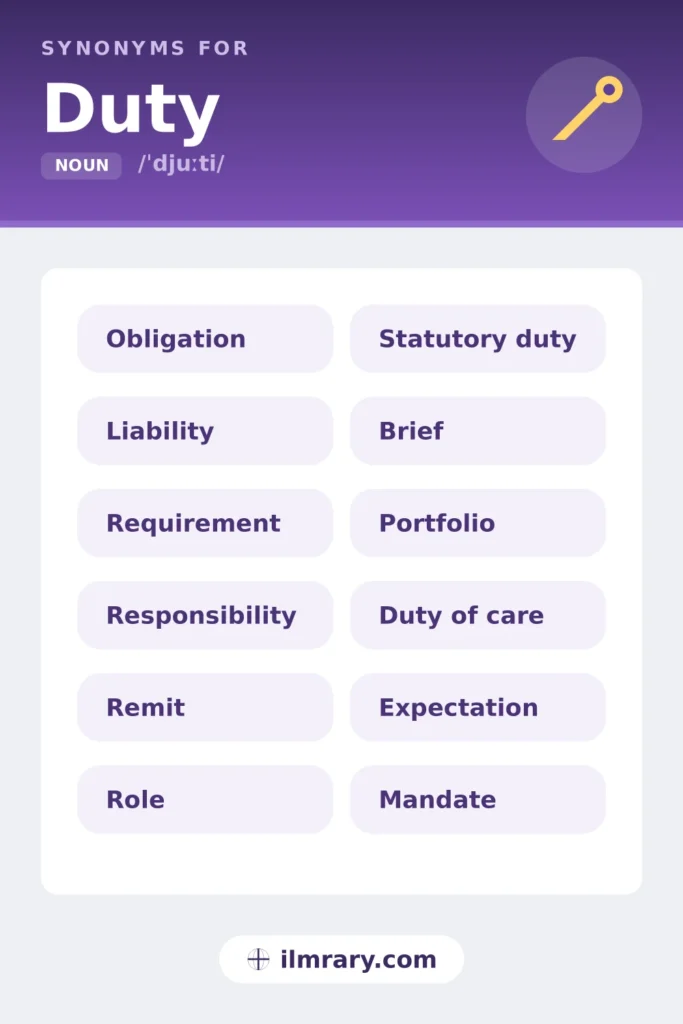
Duty Words for Obligations With External Force
Externally grounded duties are enforceable by somebody outside the organisation. That enforcement is what makes them the strongest claims in this family.
Statutory duty
Resume bullet
Meaning
An obligation created by legislation.
When to use it
Shared with the compliance family, where breach is a legal event. Naming the statute makes the claim unarguable and most applications leave it out.
- Discharged the statutory duties of the role for eighteen months as acting head.
- The statutory duty sat with the authority and the work sat with the contractor.
Obligation
Cover letter
Meaning
Something you are bound to do.
When to use it
It is the general term and it names the binding without naming the source. Contractual, legal and moral obligations behave completely differently and share the word.
- Obligations under the agreement were met in full and the relationship still failed.
- Every obligation was listed and none of them was costed.
Liability
Cover letter
Meaning
Harm you would be legally answerable for.
When to use it
Shared with the risk family, where it exists independently of fault. It names what happens after a duty is breached rather than the duty itself.
- The liability sat with the authority and the work sat with the contractor.
- Limiting liability took longer to negotiate than the price.
Professional obligation
Cover letter
Meaning
A requirement imposed by a regulating body.
When to use it
Registration can be removed, which makes it enforceable in a way employment obligations are not. It can require acting against your employer's preference.
- Professional obligation required reporting the concern regardless of what the employer wanted.
- Professional obligations and employer instructions conflicted twice in four years.
Requirement
Resume bullet
Meaning
Something that must be satisfied.
When to use it
Shared with the instruction family, where it names the condition rather than the imposer. Each should be individually testable, which is what makes specifications work.
- Specified the requirements the tender was scored against.
- Two requirements contradicted each other and the bidders spotted it first.
Duty of care
Cover letter
Meaning
The legal obligation to take reasonable care of somebody.
When to use it
Shared with the safeguarding family, where it exists whether or not anybody writes it down. Negligence claims turn on whether it was discharged.
- Duty of care extended to the volunteers as well as the people they visited.
- The duty of care was the authority's and the delivery was the contractor's.
Mandate
Cover letter
Meaning
An instruction carrying authority to require compliance.
When to use it
Shared with the governance family, where it authorises as well as requires. Holding one is a permission and a duty at the same time.
- The mandate covered three outcomes and funded one of them.
- Operating under a mandate that changed with each reshuffle.
Words for Obligations Inside the Role
Internally grounded duties come from the job rather than the law. They are enforced by employment consequences and by expectation, which is softer and often more immediate.
Responsibility
Resume bullet
Meaning
Work that is yours to see done.
When to use it
Shared with the responsibility family, where the whole question is whether anybody measured you on the outcome. It describes the work honestly without claiming accountability.
- Responsibility for the whole intake process across two sites.
- Responsibility without authority is the position every application should describe honestly.
Remit
Resume bullet
Meaning
The range of matters somebody may be asked about.
When to use it
Shared with the accountability family, where it bounds as well as binds. Anything outside it is genuinely somebody else's answer to give.
- The remit covered three services and the pressure came from a fourth.
- Widening the remit without widening the budget produced predictable results.
Brief
Cover letter
Meaning
The specific task or area somebody has been given.
When to use it
Shared with the report family in a document sense. Here it names an assignment, and holding a brief implies somebody handed it to you with an expectation.
- The brief was to close the gap and the resources funded half of it.
- A brief that changed three times before anybody wrote it down.
Portfolio
Resume bullet
Meaning
The set of areas somebody is responsible for.
When to use it
Shared with the workload family, where breadth rather than depth is the claim. Senior roles use it and it says nothing about how much of each area.
- The portfolio covered estates, procurement and information governance.
- A portfolio that wide meant nothing got more than a day a week.
Role
Resume bullet
Meaning
The set of duties and expectations attached to a job.
When to use it
Shared with the position family, where it names duties rather than a place on a chart. Recruitment writing adopted it as the default word for the work itself.
- The role covered casework, supervision and the whole training programme.
- She grew the role well past its original description.
Expectation
Resume bullet
Meaning
What somebody will be held to informally.
When to use it
Shared with the culture family, where belief rather than policy governs. It is the softest obligation and frequently the one people actually follow.
- Expectations were set in the first week and never had to be enforced.
- Expectations came from watching what happened to the last person who raised it.
Matching a Duty Synonym to the Evidence
Say what created the requirement. Externally grounded duties are enforced by somebody outside, so a statutory duty makes breach a legal event and naming the statute makes it unarguable, a professional obligation can cost you a registration and can require acting against your employer, and duty of care exists whether anybody records it or not. Liability names what follows a breach rather than the duty itself. Internal duties come from the job, so responsibility describes work without claiming the outcome, a remit bounds what you can be asked about and protects as well as limits, and expectation is the softest of all and frequently the one people actually follow. Duty names the obligation and hides its source.
The source and the enforcer are what a reader checks: statutory duty or professional obligation where somebody outside can act, remit or responsibility where the job itself is the ground.
Opposite Words for Duty
- Discretion
- Privilege
- Option
- Exemption
- Free choice
Test Your Word Choice
Question 1: Which can require acting against your employer's preference?
A regulating body can remove your registration, which outranks employment consequences. Responsibility and remit both derive from the job itself.
Question 2: Which exists whether or not anybody writes it down?
Duty of care arises in law from the relationship rather than from a document. Requirements and briefs are both stated by somebody.
Question 3: Which is the softest obligation and often the one actually followed?
Expectations govern because nobody has written down the exception, so people follow them without knowing they could depart. Mandates and obligations both have stated force.
Duty Synonyms: What Panels Ask Next
What can I write instead of duties included?
Duties included states the work and leaves out what created the requirement. Discharged the statutory duties of the role names a source somebody outside can enforce, and held a remit covering three services bounds what you could be asked about. Duty on its own names the obligation and hides where it came from.
What happens when a professional obligation conflicts with an employer's instruction?
A professional obligation governs, because the regulator can remove your registration and the employer can only end your job. Describing a conflict you handled that way is one of the strongest claims available, since it shows you knew which enforcement was the heavier one.
Is responsibility weaker than accountability?
Responsibility is narrower than accountability rather than weaker. Responsibility means the work is yours to see done, accountability means you answer for the outcome, and the two frequently belong to different people. Naming which one you held tells a panel how far your authority actually ran.
Why should I name the statute on a resume?
Naming the statute makes the claim unarguable. Anybody can write that they met their statutory duties, so the words alone prove nothing; the legislation and the period behind them turn the line into something a reference can confirm. A duty of care needs no such citation, because it exists whether anybody recorded it or not.