
What the data showed and what you concluded are two claims, and synonyms for insight separate them. The stronger the wording, the harder the follow-up.
Insight blurs them on purpose. It sounds like analysis and covers a hunch, which is why a panel asks how you got there.
A pattern in the data is there for anybody to find again. The conclusion you drew from it is yours to defend, and a panel goes straight there.
Insight Synonyms for What the Data Showed and What You Concluded
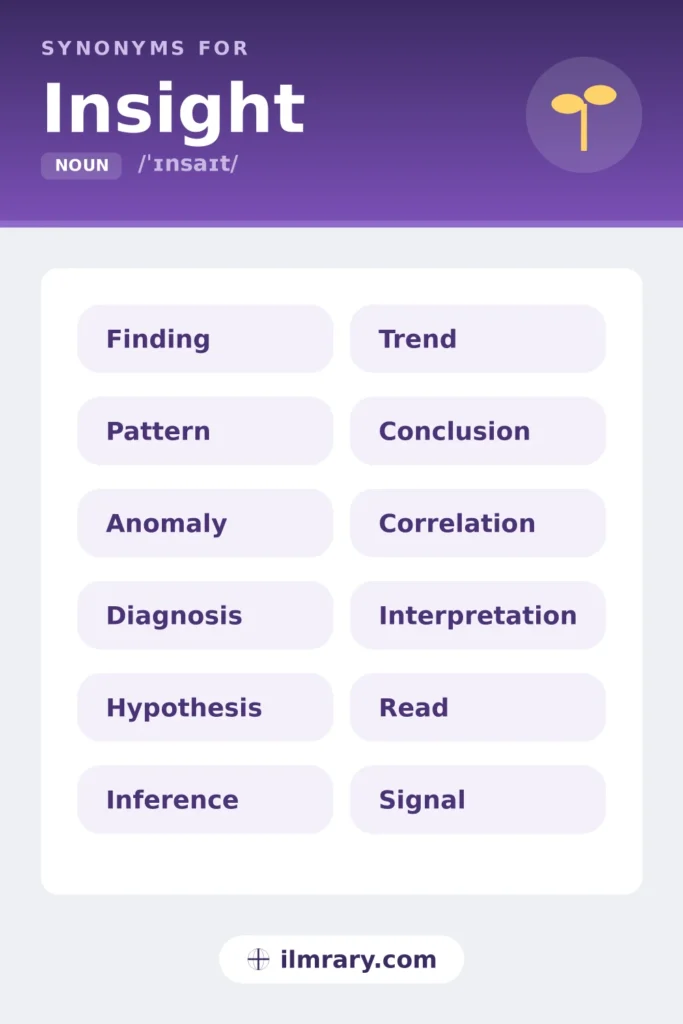
Insight Words for What the Evidence Showed
Observation words describe what was there to be seen by anybody looking properly. Their strength is that a second analyst would find the same thing.
Finding
Resume bullet
Meaning
Something an investigation established.
When to use it
Shared with the report family, where discovery rather than compilation is the claim. Something must have been unknown before, or the word overstates.
- The finding named no individual and changed the whole procedure.
- Two findings survived the challenge process and one did not.
Pattern
Resume bullet
Meaning
A regularity visible across many cases.
When to use it
It claims repetition rather than explanation, which is the honest stopping point for most analysis. A pattern with no mechanism behind it is still worth reporting.
- The pattern held across every region except the two with the oldest systems.
- Spotted a pattern in the refusals that the case notes had never coded.
Trend
Resume bullet
Meaning
A movement in one direction over time.
When to use it
Time is essential and short runs mislead constantly, so the period belongs in the sentence. Its familiarity makes it the most casually overclaimed word here.
- The trend ran for nine quarters before anybody revised the forecast.
- Two points is not a trend, which the report said in its second paragraph.
Correlation
Cover letter
Meaning
Two quantities moving together.
When to use it
It claims association and explicitly not cause, which is why the caveat has become a cliche and is still ignored. Naming the confounder you checked is what earns trust.
- The correlation was strong and disappeared once deprivation was controlled for.
- Correlation between the two measures had been driving policy for a decade.
Anomaly
Resume bullet
Meaning
A case that does not fit the pattern.
When to use it
It claims you noticed the exception, which is where most real discoveries begin. Explaining it is a separate and larger achievement.
- The anomaly turned out to be a coding change nobody had documented.
- Chased an anomaly for three weeks and found four hundred duplicate records.
Signal
Cover letter
Meaning
Movement that means something rather than noise.
When to use it
It claims you separated the meaningful from the random, which is a statistical assertion rather than an impression. Overuse in commentary has thinned it.
- The signal appeared in the complaints data six months before the inspection.
- Signal and noise looked identical until the series was long enough.
Observation
Cover letter
Meaning
Something noticed and recorded.
When to use it
The most modest word here and the most honest for a single case. Its lack of ambition is exactly what makes it credible in a report full of larger claims.
- The observation sat in an appendix and turned out to be the whole story.
- An observation from one visit prompted the audit that followed.
Words for What Somebody Worked Out
Inference words claim you explained the observation rather than only recording it. Each carries a different confidence, and overstating that confidence is the fastest error to make.
Diagnosis
Resume bullet
Meaning
An identified cause behind an observed problem.
When to use it
Shared with the solve family, where the finding rather than the fix is the claim. Clinical and engineering usage keeps the standard high.
- Diagnosed a fault two suppliers had attributed to user error.
- The diagnosis took a morning after eleven weeks of guessing.
Hypothesis
Cover letter
Meaning
A proposed explanation put forward to be tested.
When to use it
It concedes the explanation has not been confirmed, which is the honest state of most analysis. Saying how you tested it is what completes the sentence.
- The hypothesis was that referral routes rather than demand had changed.
- Tested three hypotheses and the least interesting one survived.
Conclusion
Cover letter
Meaning
What the evidence was found to show.
When to use it
Shared with the decision family, where it belongs to analysis rather than governance. Reports reach conclusions and boards make decisions.
- The conclusion held after two rounds of challenge from the supplier.
- Reached the same conclusion by a different route and published both.
Interpretation
Cover letter
Meaning
A reading of what the evidence means.
When to use it
It admits another reading is possible, which is honest and occasionally read as weakness. Naming the rival interpretation strengthens rather than undermines it.
- Her interpretation of the fall was seasonal and the second year disproved it.
- Two interpretations fitted the data and the department chose the cheaper one.
Read
Everyday
Meaning
A judgement about what a situation actually is.
When to use it
Informal and quick, and it claims judgement rather than analysis. Speech and internal argument carry it and formal writing rarely does.
- Her read on the negotiation was right and the modelling was not.
- A read of the room saved a proposal that the paper would have killed.
Inference
Cover letter
Meaning
A conclusion drawn from evidence that does not state it.
When to use it
It names the reasoning step explicitly, which is why statistics and logic use it precisely. Naming the inference invites somebody to check it, which is the point.
- The inference from the missing records was reasonable and turned out wrong.
- Every inference in the report was set out so the board could disagree with one.
Which Insight Synonym Fits What You Did
Say whether you saw it or worked it out. Observation words claim what a second analyst would also find, so pattern claims repetition without explanation, trend needs its period stated, correlation claims association and denies cause, and anomaly claims you noticed the exception, which is where most discoveries begin. Observation is the most modest and often the most credible. Inference words claim explanation, and their confidence varies sharply, since hypothesis concedes it is untested, interpretation admits a rival reading exists, and diagnosis claims the cause is identified. Inference names the reasoning step so somebody can check it. Insight claims all of this and specifies none, which is why a slide headed insight usually contains a percentage.
Where it came from is the question behind the claim: pattern or anomaly for what the data showed, diagnosis or hypothesis for what you worked out and tested.
Opposite Words for Insight
- Assumption
- Oversight
- Misreading
- Guesswork
- Blind spot
Test Your Word Choice
Question 1: Which word claims repetition without claiming any explanation?
A pattern is a regularity visible across cases and stops short of saying why. A diagnosis identifies a cause and an inference draws a conclusion the evidence did not state.
Question 2: Which word concedes the explanation has not been confirmed?
A hypothesis is proposed in order to be tested. A finding claims something was established and a signal claims meaningful movement was separated from noise.
Question 3: Where do most real discoveries begin?
An anomaly is the case that does not fit, and chasing it is what turns up the coding change or the duplicate records. Trends and correlations describe the pattern rather than its exceptions.
Common Questions About Insight Synonyms
What can I write instead of delivered insight?
Instead of delivered insight, say what you saw and what you worked out. Spotted a pattern the case notes had never coded, or diagnosed a fault two suppliers had blamed on users: both name the discovery and let a reader judge how far the reasoning went.
When should I say hypothesis rather than finding?
Say hypothesis rather than finding whenever the explanation is still untested. Most analysis stops at a plausible account of why the numbers moved, and naming it a hypothesis alongside the test you would run reads as rigour rather than hesitancy.
Does naming a rival interpretation weaken a report?
Naming a rival interpretation strengthens a report rather than weakening it. A reader who thinks of the alternative themselves and finds it unaddressed discounts the whole document, while one who sees it named and answered trusts everything that follows.
Why has insight lost its force?
Insight lost its force because research reporting attached it to every chart. The word now signals only that a slide exists, so naming the pattern, the anomaly or the diagnosis does the work insight was supposed to do and puts a number in front of the reader.