
A word you apply to yourself is free to write, and other ways to say innovative carry that problem. Proof has to arrive in the next clause.
Innovative describes a person and proves nothing about the work. A recruiter passes over it unless a named project follows in the same line.
Claiming a first puts you ahead of a field, which somebody can check. Describing a habit of mind stays softer, and both need a project beside them.
Innovative Synonyms for a New Thing and for a New Way of Thinking
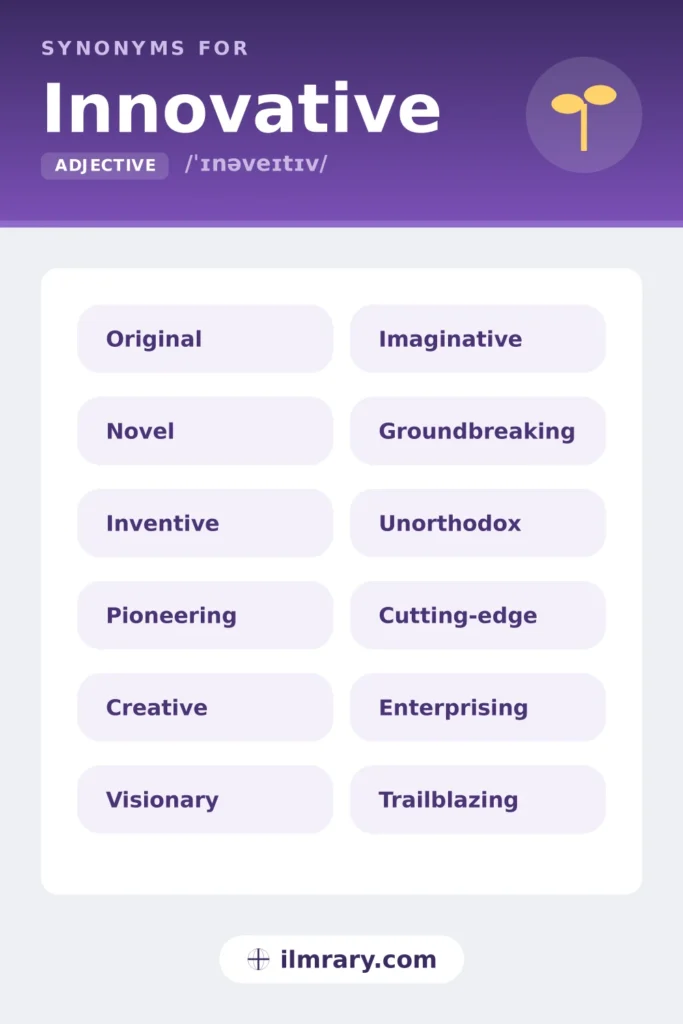
Where Innovative Claims the Work Itself Was New
Novelty words describe the output rather than the mind behind it. Every one of them invites the question of what came before, so keep the comparison ready.
Original
Cover letter
Meaning
Not copied or derived from anything earlier.
When to use it
The plainest novelty claim available, and the hardest to dispute because it only denies imitation. Its modesty is the advantage, since nobody asks whether an original approach also changed an industry.
- The scoring method was original and the regulator adopted it.
- An original brief beat three agency pitches.
Novel
Cover letter
Meaning
New in kind rather than merely recent.
When to use it
Academic and technical writing gave it a precise edge, so it reads as measured rather than promotional. It suits a method or an approach better than a product.
- A novel sampling method cut survey costs by half.
- The panel called the funding structure novel.
Groundbreaking
Cover letter
Meaning
So new that later work has to account for it.
When to use it
The heaviest word here and the easiest to overspend. Reserve it for work that others cited, copied or built on, because that is the standard the word invokes.
- Her groundbreaking audit reframed how the sector reports risk.
- Groundbreaking is a word the trade press used, not one we chose.
Pioneering
Resume bullet
Meaning
First into territory that others later occupied.
When to use it
It claims priority, not quality, which makes it checkable in a way most novelty words are not. The natural proof is a date and a field that followed.
- Pioneered remote assessment across the trust two years before the mandate.
- Pioneering work on consent flows became the department standard.
Cutting-edge
Everyday
Meaning
At the current frontier of a field or technology.
When to use it
Time punishes it faster than any other word here, since yesterday's frontier reads as ordinary within a year. It works in speech and product copy and ages badly on a resume.
- The lab runs cutting-edge sequencing on a shoestring.
- What was cutting-edge in the pilot is standard issue now.
Inventive
Everyday
Meaning
Skilled at devising new arrangements from existing parts.
When to use it
Warmer and smaller than groundbreaking, and it flatters ingenuity rather than scale. Craft, design and teaching all wear it comfortably.
- An inventive rota fixed the weekend gap without new hires.
- Her inventive use of the old dataset saved a year of collection.
Trailblazing
Everyday
Meaning
Opening a path that others go on to follow.
When to use it
Journalism keeps it alive and formal documents mostly avoid it. Applied to a person it reads generously, applied to a product it reads like advertising.
- Trailblazing work on accessible ballots changed three counties.
- She was trailblazing before the job title existed.
Words That Claim the Thinking Was Different
Mind words shift the claim from the output to the approach. Recruiters accept them more readily because they promise less and describe a person who can be interviewed.
Creative
Everyday
Meaning
Able to produce ideas that others did not reach.
When to use it
Overuse has thinned it in job ads, though it survives well next to a constraint. Creative under a fixed budget reads as evidence, creative alone reads as filler.
- Creative scheduling kept the theatre open through the refit.
- The brief rewarded creative answers over safe ones.
Imaginative
Cover letter
Meaning
Rich in the ability to picture arrangements that do not yet exist.
When to use it
Softer than creative and better suited to design, curriculum and policy work. It suggests range of thought rather than commercial output.
- An imaginative curriculum pulled attendance up two terms running.
- The imaginative part was the funding model, not the building.
Forward-thinking
Cover letter
Meaning
Planning for conditions that have not arrived yet.
When to use it
It claims foresight rather than invention, which is a different and often more credible boast. Anything dated ahead of the sector proves it neatly.
- Forward-thinking procurement locked prices before the shortage.
- A forward-thinking board funded the retraining early.
Unorthodox
Everyday
Meaning
Departing from the accepted way of doing something.
When to use it
Honest about friction in a way the other words avoid, since unorthodox methods annoy somebody by definition. Pair it with a result and the friction becomes the story.
- An unorthodox hiring route filled the roles the agencies could not.
- Her unorthodox reading of the rules survived legal review.
Visionary
Everyday
Meaning
Guided by a far-reaching picture of what could exist.
When to use it
Almost impossible to apply to yourself without cost, which is why it belongs in citations and profiles. Coming from a third party it ranks above every other word here.
- The trustees called the founder visionary and meant it.
- Visionary planning takes a decade to look obvious.
Enterprising
Resume bullet
Meaning
Ready to start ventures and take the attached risk.
When to use it
Shared with the initiative family, where it names the trait of acting unprompted. On a novelty page it claims commercial nerve rather than fresh thought.
- Enterprising outreach turned a mailing list into a revenue line.
- An enterprising trainee negotiated the supplier discount herself.
Choosing an Innovative Synonym That Holds Up
Decide first whether the newness belongs to the output or to the person. Output words run from original, which only denies copying, through novel and pioneering, which claim a new kind and a first arrival, to groundbreaking, which claims that others had to respond. Mind words run from creative and imaginative, both about range of thought, through forward-thinking, which claims foresight, to visionary, which nobody should award themselves. Unorthodox stands apart because it admits the friction, and a result attached to it does more work than any of the safer choices.
The word should match the evidence you can produce: original and inventive for craft, pioneering for priority, forward-thinking for foresight, and visionary is for somebody else to say about you.
Opposite Words for Innovative
- Derivative
- Conventional
- Imitative
- Orthodox
- Stagnant
Test Your Word Choice
Question 1: Your method arrived two years before the sector adopted it. Which word claims that precisely?
Pioneering claims priority, which a date proves. Cutting-edge claims current frontier and creative claims range of thought, and neither says who was first.
Question 2: Which word admits that the approach annoyed somebody?
Unorthodox names a departure from accepted practice, so friction is built in. Novel and original describe newness without any quarrel attached.
Question 3: Which word ages fastest once the technology becomes standard?
Cutting-edge is measured against a moving frontier, so it dates within a year. Inventive and imaginative describe the thinker and hold their value.
Innovative Synonyms: Questions Applicants Ask
What can I write instead of innovative on a resume?
Innovative earns its place on a resume only when you name the kind of newness you can prove. Pioneered fits a first arrival, original fits work nobody had copied, and redesigned or streamlined fits an improvement that was never new in kind, only new to the place that adopted it.
When should I keep the word innovative?
Keep innovative when the sentence around it does the proving. Innovative followed by a mechanism and a number reads far better than innovative followed by another adjective, so give the reader the redesign and the percentage and let the adjective earn its place.
What is the difference between novel and original?
Original denies copying; novel claims a new kind. Something can be original and still belong to a familiar category, while novel asserts the category itself moved, which is the larger claim and the one a reviewer will ask you to defend.
Can I call myself visionary on a resume?
Calling yourself visionary rarely works without a cost. The word carries best inside a citation, a reference or a press quote, and self-applied it invites the reader to start hunting for counter-evidence before they reach your first bullet.