
Claiming power you never held fails a reference check, and other ways to say influence keep you honest. The gap between the two is where applications come apart.
Influence covers the person who signed and the person who argued. A recruiter reads it as the second and checks for the first.
A name on a decision backs the formal half. People who listened to the argument back the other, and only the first is quick for a referee to confirm.
Influence Synonyms for Formal Power and for Standing
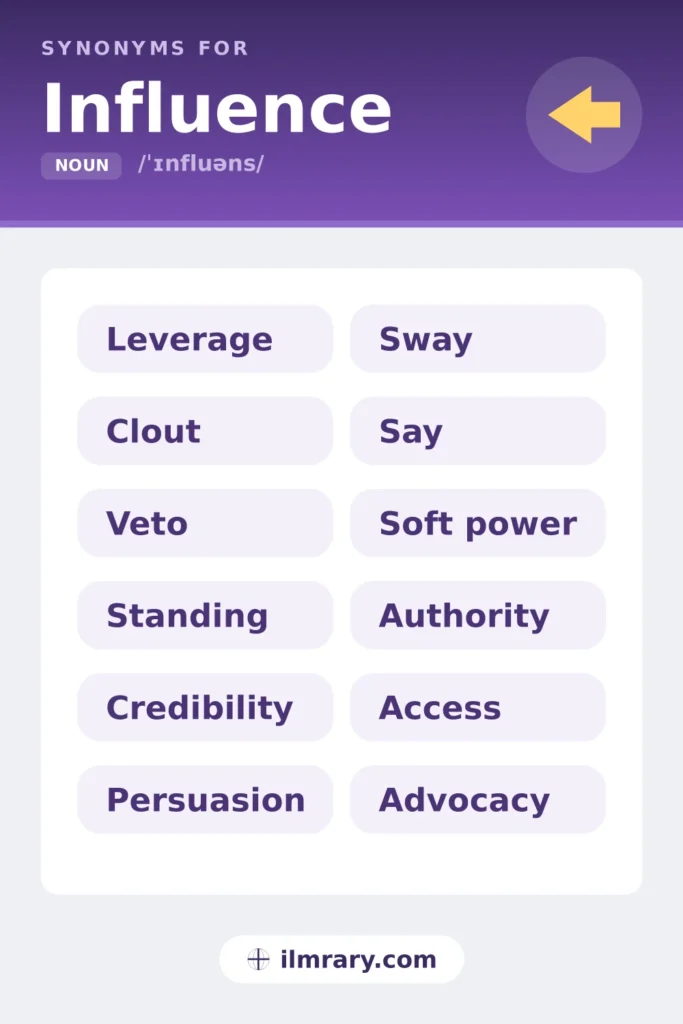
Words for Influence Resting on Position
Structural influence comes from where somebody sits rather than who they are. It transfers with the role, which is what distinguishes it from the personal kind.
Leverage
Cover letter
Meaning
An advantage that makes somebody else move.
When to use it
It names something concrete you hold, which is why negotiation writing uses it precisely. The verb use in business speech has thinned it badly.
- Leverage came from being the only accredited provider in the region.
- Leverage disappeared the day the second supplier was approved.
Clout
Everyday
Meaning
Practical power to get things done.
When to use it
Informal and unapologetic, and it describes what somebody can actually make happen rather than their title. Speech carries it and formal writing does not.
- She had the clout to move a decision three memos had failed to.
- Clout came from the budget rather than the job title.
Veto
Cover letter
Meaning
The power to stop something without the power to start it.
When to use it
Negative power only, which is a precise and frequently decisive position. Committees are full of people who can block and nobody who can proceed.
- The finance director held a veto and used it twice in six years.
- A veto in practice rather than in the constitution, which everybody understood.
Say
Everyday
Meaning
Being consulted before something is decided.
When to use it
The plainest word for participation in a decision, and having a say is different from having a vote. Its informality suits speech and internal argument.
- Had a say in every clinical appointment and a vote in none of them.
- No say in the timetable and full responsibility for the outcome.
Authority
Resume bullet
Meaning
The recognised right to decide.
When to use it
Shared with the leadership family, and it is precisely what influence is not. Naming the limit is what makes it concrete rather than atmospheric.
- Signing authority extended to purchases below fifty thousand.
- Authority for clinical decisions stayed with the consultant.
Access
Cover letter
Meaning
Being able to reach the people who decide.
When to use it
Shared with the inclusion family, and here it is the precondition for everything else. Access without a case to make is worth nothing and the reverse is worth less.
- Access to the chief executive shortened every escalation by a fortnight.
- Access came through a working group nobody else had wanted to join.
Convening power
Cover letter
Meaning
The ability to get the right people in a room.
When to use it
It names a specific and underrated form of influence, since a great deal of change requires only that the relevant people meet. Public and charitable bodies rely on it.
- Convening power was the whole contribution and it took eighteen months to build.
- Convening the four agencies did what four years of correspondence had not.
Words for Influence Resting on the Person
Personal influence leaves with the individual. It is harder to evidence and often more powerful, and the proof is always something that changed.
Standing
Cover letter
Meaning
Reputation that makes your view carry in a field.
When to use it
Shared with the trust family, where others confer it. Citing who conferred it turns the word into evidence rather than assertion.
- Her standing in the field opened doors the job title never would.
- Standing survived the fine and barely survived the coverage.
Credibility
Cover letter
Meaning
Being believed because your record supports it.
When to use it
Shared with the trust family, where it rests on things you were already right about. Slow to build and fast to lose, which is why it is worth naming the record.
- Credibility came from three forecasts that had turned out right.
- Credibility with the clinicians was the whole reason the project moved.
Sway
Everyday
Meaning
The power to move opinion.
When to use it
It describes effect on views rather than decisions, which is a step earlier in the chain. Slightly literary and it suits describing somebody else more than yourself.
- He held more sway with the members than the chair ever did.
- Sway over the debate and no part in the vote.
Soft power
Cover letter
Meaning
Getting outcomes through attraction rather than pressure.
When to use it
International relations coined it and organisations borrowed it for influence exercised without any lever. It claims people wanted to agree rather than had to.
- Soft power built through a training programme nobody was required to attend.
- Soft power is what remains when the funding relationship ends.
Persuasion
Resume bullet
Meaning
Bringing somebody to a view through argument.
When to use it
Shared with the persuade family, where naming the objection is the discipline. It is the active exercise of influence rather than the possession of it.
- Persuasion did what the escalation route had failed to for two years.
- Persuasion worked on the merits and reassurance worked on the risk.
Advocacy
Cover letter
Meaning
Arguing publicly for somebody's interests.
When to use it
Shared with the support family, where health, law and social care give it a formal role. It claims you spoke where somebody else could not.
- Advocacy for families through the tribunal process for four years.
- Her advocacy changed a policy the department had defended for a decade.
Matching an Influence Synonym to the Evidence
Name what the influence rested on. Structural sources transfer with the role, so leverage names something concrete you hold, a veto is negative power only and is decisive far more often than people expect, and convening power is the underrated form, since a great deal of change requires only that the right people meet. Access is the precondition for all of it. Personal sources leave with the individual, and they are harder to evidence and often stronger, so standing is conferred by others and gains from naming who, credibility rests on being right about things already, and soft power claims people wanted to agree rather than had to. Influence is the honest word for all of it and the proof is always something that changed.
Where the force came from and what moved are the two halves: leverage or veto for structural, standing or credibility for personal, with the changed decision beside it.
Opposite Words for Influence
- Powerlessness
- Irrelevance
- Being ignored
- No standing
- Exclusion
Test Your Word Choice
Question 1: Which is negative power only and decisive more often than expected?
A veto stops things without being able to start them, and committees are full of people who can block and nobody who can proceed. Leverage and clout both work in either direction.
Question 2: Which underrated form requires only that the right people meet?
Convening power gets the relevant people into a room, which is what a great deal of change actually needs. Soft power works through attraction and access reaches decision-makers.
Question 3: Which leaves the organisation when the person does?
Standing is a reputation others conferred on an individual, so it travels with them. Authority and veto attach to the role and pass to whoever holds it next.
Influence Synonyms: What Panels Ask Next
What can I write instead of influenced stakeholders?
Instead of influenced stakeholders, name what the influence rested on and what changed: credibility from three forecasts that proved right, or convening four agencies that four years of correspondence had not moved. Each version tells a reader why anybody listened to you.
Is influence a weaker claim than authority?
Influence is a narrower claim than authority rather than a weaker one. Moving an outcome without the right to decide is usually harder than exercising a delegated power, and matrixed employers run on exactly that. Naming which decision moved is what separates the claim from a boast.
What is convening power?
Convening power is the ability to get the right people into a room together. The form sounds slight and does a great deal, since many long-running problems persist mainly because the relevant parties have never met. On a resume it wants the meeting named and the outcome attached.
How do I evidence influence on a resume?
Evidence influence with the decision that changed. Writing that your recommendation rather than headcount moved the vendor decision gives a reader something to check, and describing yourself as influential gives them nothing. The proof is always the outcome, never the adjective.