
Reporting what an author does is half of any essay, and argue synonyms carry most of that weight.
Argues says almost nothing. Every writer with a view argues, so a marker learns that a position existed and no more.
Pressure grades the rest. Some report a writer pushing hard and expecting to be followed. Others report a reading offered with room left for disagreement, and a marker treats the two as different claims.
Another Word for Argue and How Much Pressure Each One Reports
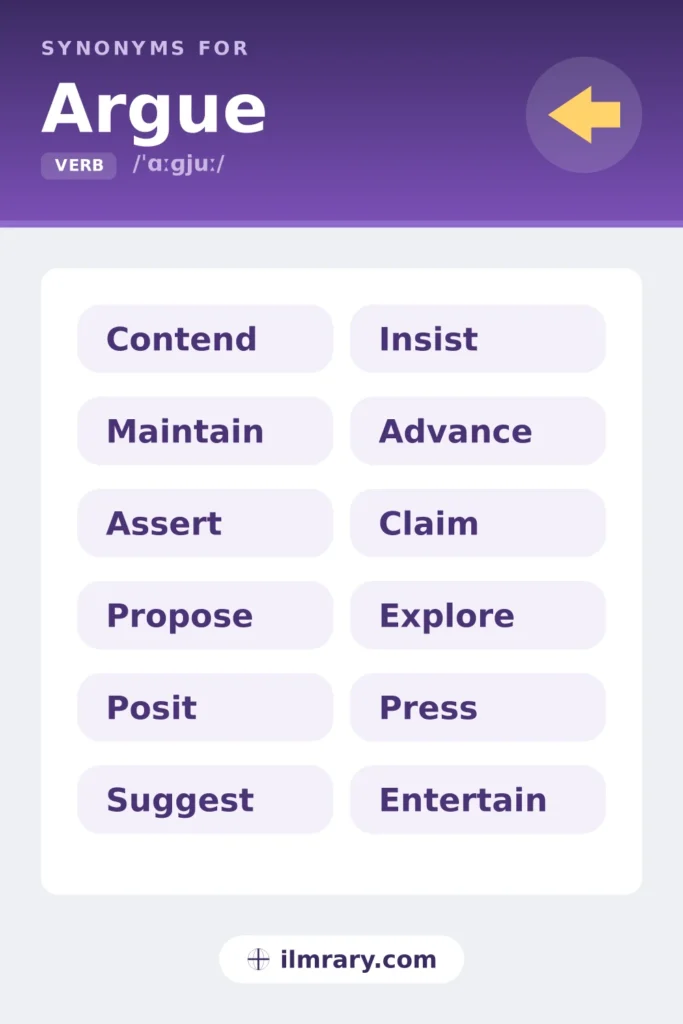
Where Argue Means Advancing a Position Firmly
Strong words report an author committing themselves. Their accuracy depends on whether anybody was disagreeing, which a reader familiar with the field will check.
Contend
Academic writing
Meaning
To argue a position knowing others differ.
When to use it
Shared with the emphasize family, where a live debate is presupposed. It is slightly more combative than argue and entirely standard in academic prose.
- Scott contends that resistance rarely announces itself as resistance.
- The chapter contends for a chronology no archaeologist accepts.
Maintain
Academic writing
Meaning
To hold to a position over time and against challenge.
When to use it
Shared with the emphasize family, where duration rather than volume is the claim. It is the neutral verb for reporting a contested view without judging it.
- Braudel maintains that the sea, not the state, held the region together.
- Both authors maintain a distinction their critics call artificial.
Assert
Academic writing
Meaning
To state something firmly without arguing for it here.
When to use it
Shared with the emphasize family, where the mild criticism is the point. Markers use it about student work in exactly that spirit.
- The introduction asserts a decline that the data never establish.
- She asserts the connection early and demonstrates it only in the final chapter.
Insist
Academic writing
Meaning
To maintain a point against opposition or doubt.
When to use it
Shared with the emphasize family, and it hints faintly that the insistence outran the evidence. A consensus view described this way reads oddly.
- Popper insists on falsifiability long after the discipline had moved on.
- The union insisted the clause had never applied to seasonal staff.
Claim
Academic writing
Meaning
To put forward a proposition as true.
When to use it
Shared with the claim family, where the verb stays neutral in most fields and reads sceptical in a few. Context and the surrounding sentence settle which.
- The paper claims a causal link that the design cannot support.
- Both studies claim the same effect and measure it differently.
Press
General writing
Meaning
To push a point persistently.
When to use it
Shared with the emphasize family, where persistence rather than proof is the claim. Applied to an author it suggests they returned more often than the evidence justified.
- He presses the analogy well past the point where it explains anything.
- Campaigners pressed the case through three consultations.
Champion
General writing
Meaning
To advocate a position publicly and over time.
When to use it
Shared with the support family, where persistence is implied and corporate overuse has thinned it. In intellectual history it names somebody who carried an unpopular view.
- She championed the revisionist account for two decades before it was accepted.
- Championing the position cost him the chair and won the argument.
Words That Offer Rather Than Insist
Tentative words report an author making room for disagreement. Words value them because undergraduate writing overclaims far more often than it underclaims.
Propose
Academic writing
Meaning
To put forward an idea for consideration.
When to use it
Shared with the plan family, where approval is pending. In argument it claims novelty and invites testing rather than agreement.
- The article proposes a third category that neither earlier scheme allows for.
- She proposes and does not defend the reading, which the conclusion admits.
Posit
Academic writing
Meaning
To put something forward as a starting assumption.
When to use it
It sets something up for the sake of argument rather than asserting it, which is the exact use philosophy and theory make of it. Confusing it with argue overstates the commitment.
- The model posits perfect information and the conclusions follow from that alone.
- Posit a closed system and the paradox disappears.
Suggest
Academic writing
Meaning
To offer a reading without insisting on it.
When to use it
Shared with the show family, where its caution is what markers most often want. Overuse produces prose that argues nothing at all.
- The repetition suggests the speaker is persuading himself rather than the audience.
- Two readings suggest themselves and the chapter pursues only one.
Advance
Academic writing
Meaning
To put a position forward into a debate.
When to use it
It claims the position entered the conversation without saying how firmly it was held. Formal and slightly neutral, which suits literature reviews.
- Three explanations have been advanced and none accounts for the northern data.
- The account advanced here differs from both earlier readings.
Explore
Academic writing
Meaning
To look into a position without committing to it.
When to use it
Shared with the explore family, where the outcome has to have been genuinely open. Using it for a conclusion already reached is the commonest dishonesty in essay prose.
- The chapter explores whether intention matters to the definition at all.
- Exploring the counter-case first strengthens the argument that follows.
Entertain
Academic writing
Meaning
To consider a position seriously without adopting it.
When to use it
It claims genuine consideration rather than a straw man, which is a real intellectual virtue. Slightly formal and increasingly rare in student writing.
- The author entertains the materialist reading for a chapter and rejects it carefully.
- Entertaining the objection properly costs a page and buys the whole argument.
Matching an Argue Synonym to the Strength of Your Claim
Match the verb to the pressure. Firm verbs report commitment, and each assumes something different about the field, since contend and insist both presuppose disagreement, maintain reports a held position neutrally, and assert quietly notes the support has not arrived. Claim stays neutral in most disciplines and reads sceptical in a few. Tentative verbs make room for disagreement, so propose claims novelty and invites testing, posit sets something up for the sake of argument, suggest offers a reading, and entertain claims the objection was taken seriously rather than knocked down. Explore is honest only where the outcome was genuinely open. Argue covers all of it and reports only that somebody had a view.
Report the pressure accurately, contend or insist where the field disagreed, posit or suggest where the author was making room rather than closing it.
Opposite Words for Argue
- Concede
- Retract
- Accept
- Abandon
- Leave unargued
Test Your Word Choice
Question 1: A model sets up perfect information so its conclusions can follow. Which verb fits?
Posit puts something forward as a starting assumption rather than asserting it as true. Contend and insist both claim the author is defending the position itself.
Question 2: Which verb quietly notes the support has not arrived?
An assertion is stated firmly without argument attached, which is why markers use the word about student work. Maintain reports a held position and advance puts one into a debate.
Question 3: Which verb claims an objection was taken seriously rather than knocked down?
Entertain means considering a position properly without adopting it. Explore looks into something open-endedly and suggest offers a reading of your own.
Argue Synonyms: What Tutors Ask Next
What can I write instead of the author argues?
Instead of the author argues, write contends where the field disagreed, maintains where the position was held over time, proposes where it was new, and posits where it was set up as a starting assumption rather than defended. Each reports how hard the author pushed.
Is assert a criticism in academic writing?
Assert carries a mild criticism in academic writing, and a precise one. Writing that an author asserts something signals the claim arrived without its support. Reporting that accurately is fair comment rather than an insult, and markers read it as close attention.
Why do markers prefer suggest to argues in student work?
Markers prefer suggest to argues in student work because undergraduate prose overclaims far more often than it underclaims. Suggest leaves room for evidence that is partial, which is the honest state of most essay arguments, and it costs nothing when the evidence turns out strong.
When is explore the wrong verb?
Explore is the wrong verb when the conclusion was decided before the paragraph started. Explore promises an open outcome to the reader, so using it for a position you always held is the commonest small dishonesty in essay writing.