
How much weight an author put behind a sentence is what a marker reads for, and claim synonyms report it.
Claim reports nothing. Every statement in a paper is one, so saying an author makes a claim tells your reader only that a sentence exists.
Something the author would defend under pressure is one kind. Something offered as one reading among others is another, and treating the two alike misreads the paper.
Another Word for Claim and How Far the Author Would Defend It
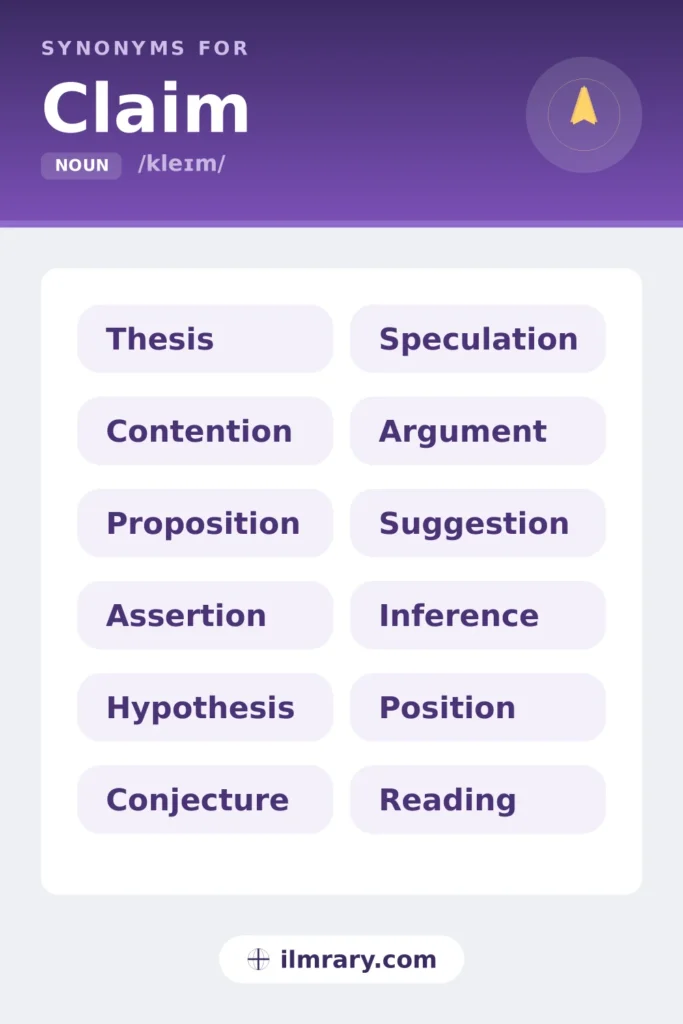
Words for Claims the Author Stands Behind
Committed claims are the ones an author would defend at length. Their weight shows in how much of the surrounding work depends on them.
Thesis
Academic writing
Meaning
The central claim a whole piece of work exists to support.
When to use it
Everything else in the work serves it, which is why a book has one and a paragraph does not. Identifying it correctly is half of any critical summary.
- The thesis is that the reform followed the crisis rather than causing it.
- Three chapters gather evidence and the thesis appears on the second page.
Contention
Academic writing
Meaning
A position argued for in the knowledge that others differ.
When to use it
Shared with the argue family, where a live debate is presupposed. It signals the author knows the ground is contested and has entered it deliberately.
- Her central contention is that resistance rarely announces itself as resistance.
- The contention survived two rounds of published criticism.
Proposition
Academic writing
Meaning
A statement capable of being true or false.
When to use it
Logic and philosophy hold the strict sense, where a proposition is the content rather than the sentence. It is the most neutral word available for the thing being asserted.
- The proposition is testable and nobody in the field has tested it.
- Two propositions do all the work and the rest is illustration.
Argument
Academic writing
Meaning
A claim together with the reasons offered for it.
When to use it
Reasons are included by definition, which is why a claim without them is not an argument. Students use the two interchangeably and markers separate them constantly.
- The argument runs from the funding change to the closure and skips a step.
- An argument the author never makes explicitly holds the chapter together.
Assertion
Academic writing
Meaning
A claim stated firmly without argument attached.
When to use it
Shared with the emphasize family, where the mild criticism is the point. Calling something an assertion says the support has not arrived.
- The introduction opens with an assertion the data never establish.
- Assertions outnumber arguments in the first half of the book.
Position
Academic writing
Meaning
The stance somebody has settled on in a debate.
When to use it
Shared with the position family, where it names where somebody stands rather than what they proved. Debates have positions and papers have claims.
- The position is defensible and the evidence offered for it is not.
- Two positions dominate the literature and a third is emerging.
Finding
Academic writing
Meaning
Something an investigation established.
When to use it
Shared with the insight family, where discovery rather than compilation is claimed. It carries more weight than a claim because a method stands behind it.
- The finding held across every subgroup except the smallest.
- Findings were accepted in full and the recommendations were not.
Words for Claims Offered Tentatively
Provisional claims invite testing rather than agreement. Recognising one correctly stops an essay attacking an author for overclaiming when they did the opposite.
Hypothesis
Academic writing
Meaning
A proposed explanation put forward to be tested.
When to use it
Shared with the insight family, where it concedes the explanation is unconfirmed. Saying how it would be tested is what completes it.
- The hypothesis was that referral routes rather than demand had changed.
- Tested three hypotheses and the least interesting one survived.
Conjecture
Academic writing
Meaning
A claim offered without sufficient evidence, awaiting proof.
When to use it
Mathematics uses it for a precise unproved statement and other fields use it more loosely for informed speculation. It invites disproof rather than agreement.
- The conjecture stood for forty years before anybody proved it.
- What the chapter calls a finding is closer to a conjecture.
Speculation
Academic writing
Meaning
Reasoning beyond what the evidence can support.
When to use it
It admits the evidence ran out, which is honest when labelled and damaging when not. Marking a paragraph as speculative protects everything around it.
- The final section is speculation and says so in its first line.
- Speculation about motive is where an otherwise careful book loses its footing.
Suggestion
Academic writing
Meaning
A reading offered without insistence.
When to use it
It claims the least of any word here, which is why it survives disagreement so well. Overuse produces prose that commits to nothing.
- The suggestion is tentative and the evidence for it is a single letter.
- Two suggestions in the conclusion became other people's research programmes.
Inference
Academic writing
Meaning
A conclusion drawn from evidence that does not state it.
When to use it
Shared with the insight family, where naming the reasoning step invites somebody to check it. That invitation is the point rather than a weakness.
- The inference from the missing records was reasonable and turned out wrong.
- Every inference was set out so the board could disagree with one.
Reading
Academic writing
Meaning
One interpretation among several a text will bear.
When to use it
Literary criticism uses it constantly, and it admits by its own name that others are available. Defending a reading means showing it fits more of the text than its rivals.
- The reading is persuasive and rests on a passage the author never quotes in full.
- Two readings fit the poem and the chapter argues for the harder one.
Matching a Claim Synonym to the Strength of Your Claim
Weigh how much the author staked. Committed claims carry the work, so a thesis is what a whole book exists to support, a contention enters a debate deliberately, and a finding brings a method with it, which is why it outranks a bare claim. An argument includes its reasons by definition, while an assertion is precisely the claim that arrived without them. Provisional claims invite testing, so a hypothesis concedes it is unconfirmed, a conjecture invites disproof, speculation admits the evidence ran out, and a reading admits rivals exist by its own name. Reporting a tentative claim as a firm one is the most common error in undergraduate summary, and claim itself makes it easy.
Report what the author staked, thesis or contention where the work rests on it, hypothesis or conjecture where they were inviting somebody to test it.
Opposite Words for Claim
- Evidence
- Proof
- Fact
- Refutation
- Concession
Test Your Word Choice
Question 1: Which word says the support has not arrived?
An assertion is stated firmly without argument attached. A proposition is only something capable of being true or false and a finding has a method behind it.
Question 2: What does an argument contain that a claim does not?
An argument is a claim together with the reasons offered for it, which is why a claim without reasons is not one. Evidence may support the reasons and a conclusion is what they lead to.
Question 3: Which word admits by its own name that rivals exist?
A reading is one interpretation among several a text will bear. A thesis is what a work exists to support and a contention is a position argued against opposition.
Claim Synonyms: What Tutors Ask Next
What can I write instead of the author claims?
Stronger verbs than the author claims are contends where the field disagreed, asserts where the support never arrived, hypothesises where the point was offered for testing, and reports a finding where a method stood behind it. Each names how much the author staked.
What is the difference between a claim and an argument?
An argument includes its reasons and a claim does not. Summarising an author's argument means reporting the reasons too, which is what separates analysis from paraphrase, and it is where most undergraduate summaries stop one step short.
Does calling something speculation criticise the author?
Speculation is not a criticism when the author labels it as such. A final chapter marked speculative protects everything before it, and attacking that chapter as though it were presented as evidence misreads the book.
How do I identify a thesis in an essay?
Identify a thesis by finding the claim everything else exists to support. Removing it should make the rest of the work pointless, and that test separates a thesis from an interesting contention raised along the way. A hypothesis fails the same test, since the work survives without it.