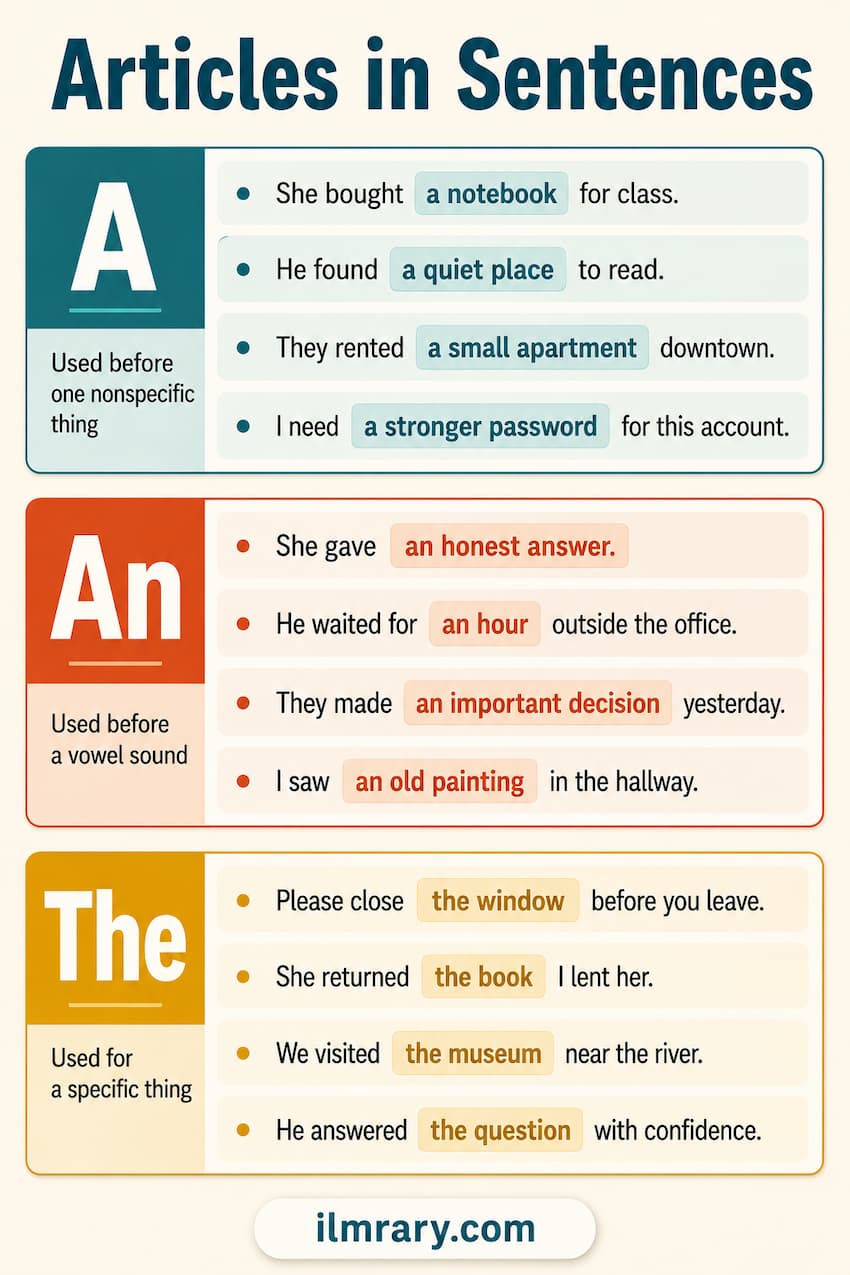
A and an mark a noun as new or general, the marks it as specific or known, and plural, uncountable, and proper nouns often take no article. The choice depends on the noun and its sound. For example, I saw a dog, and the dog was friendly.
Common Articles in Sentences With Examples
English has three articles, a, an, and the, plus the option of no article before some nouns.
A and an introduce something new, the points to something known, and the zero article leaves the noun bare.
| Article | Use | Example sentence |
|---|---|---|
| A | Before a consonant sound | I saw a dog in the park. |
| An | Before a vowel sound | She ate an apple after class. |
| The | For a specific or known noun | The dog barked all night. |
| No article | For general or proper nouns | Dogs are loyal animals. |
- I bought a new phone yesterday.
- She adopted an orange cat from the shelter.
- The sun rose behind the hills.
- We watched a film about the ocean.
- He is an honest worker.
- Please close the door behind you.
- They live in a small village near the coast.
- I need an umbrella because it is raining.
- The keys are on the kitchen table.
- My sister wants a dog for her birthday.
- We saw an elephant at the zoo.
- The teacher gave us homework.
- He plays the guitar every evening.
- I had a sandwich for lunch.
- She works as an engineer.
- Could you pass me the salt?
The Indefinite Article A in Sentences
Use a before a noun that starts with a consonant sound, for a first mention or a general singular thing.
- I read a book on the train.
- She wants to buy a car next year.
- We rented a house by the sea.
- He works in a bank downtown.
- They have a big garden.
- I saw a strange light in the sky.
- She picked a flower from the field.
- My brother is a teacher.
- We need a new printer for the office.
- He told me a funny story.
- I want a cup of coffee.
- She found a wallet on the street.
- They built a bridge across the river.
- I have a meeting at noon.
- He drives a truck for work.
- She studies at a university in the city.
The Indefinite Article An in Sentences
Use an before a noun that starts with a vowel sound, for a general singular thing.
Use an before a vowel sound, not just a vowel letter, so it is an hour and a university.
- I waited for an hour at the station.
- She is an honest person.
- He ate an apple for breakfast.
- We saw an owl in the tree at night.
- They offered me an umbrella at the door.
- It was an easy decision to make.
- She works as an artist in Paris.
- He is an only child.
- I need an answer by tomorrow.
- We had an interesting conversation.
- The shop gave her an MP3 player as a gift.
- He is an engineer at a tech firm.
- She adopted an elderly dog.
- I made an honest mistake.

The Definite Article The in Sentences
Use the when both the speaker and the listener know which noun is meant.
- The moon is bright tonight.
- Please turn off the lights.
- The children are playing outside.
- I left my bag in the car.
- The coffee in this café is excellent.
- She opened the window for fresh air.
- The president gave a short speech.
- We climbed the mountain near our town.
- The food at the party was delicious.
- He fixed the leak in the roof.
- The students passed their exams.
- I returned the book to the library.
- The weather changed in the afternoon.
- She washed the dishes after dinner.
- The train was late again this morning.
- Can you hear the music from next door?
The Zero Article in Sentences
Some nouns take no article, including names, meals, and set phrases.
Names, meals, and fixed phrases like go to school take no article at all.
- Dogs are loyal animals.
- Water is essential for life.
- She studies mathematics at college.
- We had breakfast at seven.
- They live in France.
- I visited Japan last summer.
- He goes to school by bus.
- We met on Monday after lunch.
- Cats love to sleep in the sun.
- She speaks French and Spanish.
- He was sent to prison for a year.
- We travel by car on weekends.
- Honesty matters in friendship.
- They play football every Saturday.
- I drink tea in the morning.
- Children need plenty of sleep.
Articles With Countable and Uncountable Nouns
A and an work only with singular countable nouns, while the works with all noun types.
- I need a pen to sign this.
- She drinks water every morning.
- Can you pass me the sugar?
- We bought an apple and some bread.
- The information you gave me helped.
- He has patience with beginners.
- I read a magazine on the flight.
- The furniture in this room is old.
- She offered me a piece of cake.
- Milk is good for your bones.
- I borrowed a chair from the office.
- The music at the concert was loud.
- We need money to fix the roof.
- He gave me the keys to the flat.
Articles With Proper Nouns and Place Names
Most names take no article, but some places need the.
Zero Article With Names of People and Countries
Names of people, cities, single mountains, and most countries take no article.
- Sarah lives next door.
- We flew to Brazil last year.
- Mount Everest is the tallest peak.
- They moved to London in spring.
- Lake Superior is very deep.
- He met David at the conference.
- She comes from Italy.
- We drove through Africa for a month.
The With Rivers, Seas, and Country Groups
Rivers, oceans, mountain ranges, and grouped country names take the.
- We sailed down the Nile.
- The Pacific is the largest ocean.
- They hiked across the Alps.
- She studied in the United States.
- The Netherlands is famous for tulips.
- We crossed the Atlantic by ship.
- The Himalayas stretch across several countries.
- Tourists visit the Thames every day.
Articles Before Adjectives and Nouns
The article comes before the adjective, and the adjective comes before the noun.
- She bought a blue notebook for class.
- He drives an old red car.
- The tall man asked for directions.
- I want a warm jacket for winter.
- We stayed in an expensive hotel.
- The small child waved at us.
- She wore a beautiful dress to the party.
- He told an interesting story.
- The broken window needs repair.
- I need a sharp knife for this.
- They adopted an energetic puppy.
- The quiet street felt peaceful at night.
A or An for Jobs and First Mentions
Use a or an for someone’s job and for a noun mentioned for the first time.
- She is a nurse at the local clinic.
- He works as an accountant.
- My uncle is a pilot.
- I saw a cat in the garden this morning.
- They hired a new manager last week.
- She wants to become an architect.
- We met a woman at the bus stop.
- He is a firefighter in the city.
- I heard a noise outside the house.
- My cousin is an electrician.
- She found a job in marketing.
- He bought a house near the park.
The for Specific and Repeated Nouns
Switch to the once a noun is known or has been named before.
- I read a book last week. The book was about space.
- She adopted a dog. The dog sleeps on her bed.
- We bought a car. The car broke down already.
- He told me a story, and the story made me laugh.
- I saw a film yesterday. The film was very long.
- They opened a shop. The shop sells fresh bread.
- She met a man at work, and the man later became her boss.
- I ordered a pizza. The pizza arrived cold.
- He found a wallet. The wallet had no money inside.
- We planted a tree. The tree grew quickly.
- She wrote a letter. The letter never reached him.
- I bought a ticket, but the ticket was for the wrong day.
The With Unique Things and Superlatives
Use the for one-of-a-kind nouns and with superlative forms.
- The sun gives us light and heat.
- The moon controls the tides.
- She is the best singer in the choir.
- The sky turned orange at sunset.
- This is the tallest building in the city.
- The earth orbits the sun.
- He is the fastest runner on the team.
- We watched the sunrise from the hill.
- It was the worst storm in years.
- The ocean covers most of the planet.
- She gave the longest speech of the night.
- The internet changed how we work.
How Do You Choose the Right Article in a Sentence
Three questions about the noun point you to the right article.
- Is the noun specific? If yes, use the: The car outside is mine.
- Is it a first mention? If yes, use a or an: I saw a bird today.
- Is it a general plural? If yes, use no article: Birds fly south in winter.
- Is it uncountable and general? If yes, use no article: Rice is cheap here.
- Is it a singular job? Use a or an: She is a doctor.
- Does it start with a vowel sound? Use an: He waited an hour.
- Is it a proper name? Use no article: We visited Spain.
- Is it already known? Use the: Pass me the book, please.
- Is it unique? Use the: The moon is full tonight.
- Is it a superlative? Use the: This is the best day.
Frequently Asked Questions
What Are Articles in English Grammar?
Articles are words placed before nouns to show whether the noun is specific or general. English has three: a, an, and the. Example: I bought a book, and the book was excellent.
What Are the Three Articles in English?
The three articles in English are a, an, and the. A and an are indefinite and mark a general or first-mention noun, while the is definite and marks a specific or known noun.
When Do You Use A or An?
Use a before a consonant sound and an before a vowel sound. The sound matters, not the letter. Example: a university, an hour.
Is It A Hour or An Hour?
It is an hour, because hour begins with a vowel sound. The letter h is silent, so the word sounds like it starts with a vowel. Example: I waited an hour.
Is It A University or An University?
It is a university, because university begins with a consonant sound. The u sounds like “you,” which is a consonant sound. Example: She studies at a university.
What Is the Zero Article?
The zero article means using no article before a noun. It applies to general plurals, general uncountable nouns, most names, and fixed phrases. Example: Cats are independent, and we go to school by bus.
When Do You Use No Article Before a Noun?
Use no article with plural and uncountable nouns in a general sense, with most proper names, and in set phrases. Example: Water is essential, and she lives in Japan.
What Is the Difference Between A and The?
A introduces a noun for the first time or treats it as general, while the points to a specific noun the listener already knows. Example: I saw a dog. The dog was friendly.
Do You Use Articles With Proper Nouns?
Most proper nouns take no article, such as names of people, cities, and countries. Some place names need the, like the United States, the Nile, and the Alps.
Can You Use A With Uncountable Nouns?
You normally cannot use a or an with an uncountable noun, since it cannot be counted as one unit. A unit word makes it possible. Example: a piece of advice, a cup of coffee.
Why Is The Sometimes Used With Uncountable Nouns?
The is used with an uncountable noun when it refers to something specific or already known. Example: The information you gave me was correct.
Do Articles Go Before or After Adjectives?
Articles go before the adjective, and the adjective goes before the noun. Example: She wore a red dress, and he bought the old car.