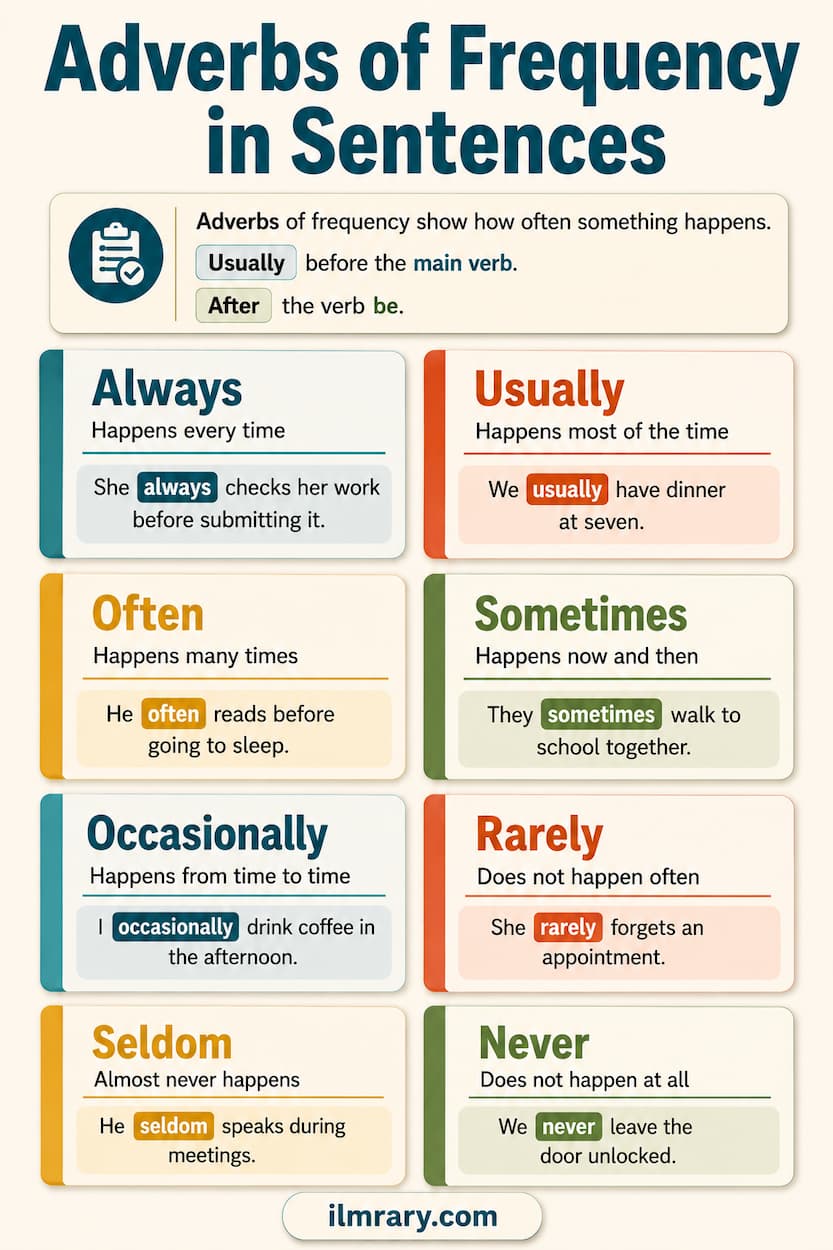
Adverbs of frequency in sentences tell you how often an action happens, from always at one end to never at the other. In most sentences the adverb goes before the main verb, after the verb to be, or between a helping verb and the main verb.
Common Adverbs of Frequency With Sentence Examples
These six adverbs run from full frequency down to zero, and each one answers how often before the main verb.
Always sits at 100% and never sits at 0%, with usually, often, sometimes, and rarely spread between them.
| Adverb | Frequency | Example sentence |
|---|---|---|
| Always | 100% | I always lock the door at night. |
| Usually | 80% | She usually walks to work. |
| Often | 60% | We often eat dinner together. |
| Sometimes | 50% | He sometimes skips breakfast. |
| Rarely | 10% | They rarely watch television. |
| Never | 0% | My dad never drinks coffee. |
- I always wake up before six on weekdays.
- She usually takes the train to the office.
- We often order pizza on Friday nights.
- They sometimes visit their grandparents on Sundays.
- My brother rarely asks for help with homework.
- The shop never opens on public holidays.
- He always checks his phone first thing in the morning.
- Our teacher usually starts the lesson with a short quiz.
- I often forget where I put my keys.
- The baby sometimes sleeps through the whole night.
- My neighbours rarely make any noise after ten.
- She never misses her favourite show.
- We always bring snacks for the road trip.
- The bus usually arrives a few minutes late.
- Tom often stays up reading past midnight.
- I sometimes cook a big meal on Saturdays.
- They rarely travel during the busy season.
- He never lends his bike to anyone.
Adverbs of Frequency Before the Main Verb
With an action verb, the adverb goes between the subject and the main verb.
- I always brush my teeth before bed.
- She usually finishes work by five.
- We often play football in the park.
- They sometimes take a different route home.
- My sister rarely eats meat.
- He never forgets a birthday.
- The dog always waits by the door for a walk.
- Students often ask questions at the end of class.
- I sometimes drink tea instead of coffee.
- Grandma usually bakes bread on Sunday mornings.
- We rarely argue about money.
- He always parks in the same spot.
- They often meet for lunch downtown.
- My phone sometimes freezes when I open too many apps.
- She never leaves the house without her umbrella.
- The cat usually sleeps on the windowsill.
- I rarely check my email on weekends.
- We always clean the kitchen after dinner.
Adverbs of Frequency After the Verb To Be
When the main verb is am, is, are, was, or were, the adverb comes right after it.
- I am always early for meetings.
- She is usually tired after a long shift.
- They are often late on rainy mornings.
- He is never rude to the staff.
- We are sometimes busy at the weekend.
- The roads are rarely empty at this hour.
- My boss is always calm under pressure.
- The kids are usually hungry by four o’clock.
- He was never good at remembering names.
- The weather here is often cold in spring.
- She is rarely wrong about directions.
- We are always happy to see old friends.
- The shop is sometimes closed on Mondays.
- I was usually the last one to leave the office.
- They are never satisfied with second place.
- The water is often too cold for swimming.
Adverbs of Frequency With Auxiliary and Modal Verbs
The adverb goes between the helping verb and the main verb.
With the Auxiliary Verbs Do and Have
With do, does, has, or have, the adverb sits before the main verb.
- I have always wanted to learn the guitar.
- She has never been to the mountains.
- They have often talked about moving abroad.
- We have rarely seen him this happy.
- He has sometimes missed the last train.
- You have always supported me.
- The team has never lost a home game.
- I do sometimes wonder what happened to her.
- She has usually finished by the time I arrive.
- We have often wished for more time.
With Modal Verbs Like Can, Will, and Should
With can, will, should, or must, the adverb comes after the modal and before the main verb.
- I can never remember his phone number.
- She will always help a friend in need.
- You should always read the instructions first.
- They can sometimes finish the work in one day.
- He must always check the locks before leaving.
- We will often stay late to meet a deadline.
- I can rarely stay awake past midnight.
- She would always sing in the car.
- You should never drive when you are tired.
- The machine will sometimes stop without warning.
- He can usually fix the problem in minutes.
- They must never leave the gate open.
Adverbs of Frequency in Questions
In a question, the adverb goes after the subject and before the main verb.
- Do you always take sugar in your tea?
- Does she often work from home?
- Do they usually eat out on Fridays?
- Have you ever been to Japan?
- Does he never answer his phone?
- Do we always need to book in advance?
- Does the bus usually come on time?
- Do your parents often visit you?
- Does it sometimes rain in the desert?
- Have they always lived next door?
- Do you rarely get sick in winter?
- Does she always arrive before nine?
- Do the children often play outside?
- Has he always been so quiet?
- Do you usually drive or take the train?
- Does your team often win away games?
Adverbs of Frequency in Negative Sentences
In a negative sentence, the adverb goes before the main verb, after don’t or doesn’t.
- I don’t usually stay up this late.
- She doesn’t often call during the week.
- We don’t always agree on everything.
- They don’t usually travel by car.
- He doesn’t often ask for advice.
- I don’t always remember to water the plants.
- The store doesn’t usually open before nine.
- We don’t often see snow in this town.
- She doesn’t always check her messages.
- They don’t usually finish on time.
- He hasn’t always been this confident.
- I haven’t often felt so tired.
- We don’t always take the same seats.
- The dog doesn’t usually bark at strangers.
- She isn’t always this strict.
- They aren’t often home before dark.

Adverbs of Frequency at the Start of a Sentence
Sometimes, usually, often, occasionally, and normally can open a sentence for emphasis.
Always, rarely, seldom, and never do not start a normal sentence.
- Sometimes I take the long way home just to think.
- Usually we meet at the same café on Saturdays.
- Often she stays after class to ask questions.
- Occasionally they invite the whole street to dinner.
- Normally I finish my coffee before I check email.
- Sometimes the train is so full I have to stand.
- Often my grandfather tells the same story twice.
- Occasionally we get a free afternoon at work.
- Usually the kids are asleep by eight.
- Sometimes it snows here as late as April.
- Normally he parks around the corner.
- Often the best ideas come at the worst time.
Adverbs of Frequency at the End of a Sentence
Some adverbs go at the end, along with time phrases like every day and once a week.
- She visits her aunt often.
- We go to the cinema occasionally.
- He travels for work frequently.
- I check the weather every morning.
- They meet for coffee twice a week.
- The cleaner comes once a month.
- My phone needs charging every night.
- We water the garden daily.
- She calls her parents every Sunday.
- The team trains three times a week.
- I take vitamins every day.
- He gets a haircut once in a while.
Definite Adverbs of Frequency in Sentences
Definite adverbs give an exact frequency and go at the end of the sentence.
- The newspaper arrives daily before seven.
- We hold the team meeting weekly.
- She pays the rent monthly.
- The festival takes place yearly in June.
- I go to the gym three times a week.
- They clean the office every evening.
- He visits the dentist twice a year.
- We shop for groceries once a week.
- The trains run hourly on this line.
- My sister calls every other day.
- The club meets fortnightly to plan events.
- I water the plants every second day.
- The bakery bakes fresh bread every morning.
- We back up the files nightly.
- The bus leaves every fifteen minutes.
- She updates the report monthly.
Adverbs of Frequency With the Present Simple
Adverbs of frequency pair with the present simple to describe habits and routines.
- I always start the day with a glass of water.
- She usually reads before she falls asleep.
- We often take the kids to the beach in summer.
- They sometimes order takeout on busy nights.
- He rarely watches the news anymore.
- My mum never leaves dishes in the sink.
- The shop always plays music in the morning.
- I often walk to clear my head.
- She usually wears bright colours to work.
- We sometimes skip dessert.
- He always locks his bike to the rack.
- They rarely miss a family dinner.
- I never check my phone at the table.
- The cat usually waits for food by six.
How Often Do You Questions in Real Sentences
Use how often to ask about frequency, then answer with an adverb.
- How often do you go to the gym? I go three times a week.
- How often does she cook at home? She cooks almost every day.
- How often do they travel abroad? They travel once a year.
- How often do you see your cousins? I see them rarely.
- How often does he work late? He works late occasionally.
- How often do you drink coffee? I drink it every morning.
- How often do the buses run here? They run every ten minutes.
- How often does it rain in summer? It rarely rains.
- How often do you eat fast food? I never eat it.
- How often do they meet up? They meet monthly.
- How often do you read for fun? I read often.
- How often does she call home? She calls every Sunday.
Frequently Asked Questions
What Are Adverbs of Frequency?
Adverbs of frequency are words that tell how often an action happens, such as always, usually, often, sometimes, rarely, and never. Example: She always drinks coffee in the morning.
Where Do Adverbs of Frequency Go in a Sentence?
Adverbs of frequency go before the main verb, after the verb to be, and between a helping verb and the main verb. Example: He usually walks to work, but he is never late.
What Is the Order of Adverbs of Frequency From Most to Least Frequent?
From most to least frequent, the order is always, usually, often, sometimes, rarely, never. Always means 100% and never means 0%, with the others spread between them.
Is Always an Adverb of Frequency?
Yes, always is an adverb of frequency that means every time, or 100% of the time. Example: I always lock the door before I leave.
Is Often an Adverb of Frequency?
Yes, often is an adverb of frequency that means many times, or about 60% of the time. Example: We often eat dinner together.
Can Adverbs of Frequency Go at the Beginning of a Sentence?
Yes, some adverbs of frequency can start a sentence for emphasis, including sometimes, usually, often, occasionally, and normally. Example: Sometimes I take the long way home.
Which Adverbs of Frequency Cannot Start a Sentence?
Always, rarely, seldom, and never do not start a normal sentence. They stay before the main verb or after the verb to be, as in She is never late.
What Tense Is Used With Adverbs of Frequency?
The present simple is the tense used with adverbs of frequency, since both describe habits and routines. Example: He always reads before bed.
What Is the Difference Between Definite and Indefinite Adverbs of Frequency?
Indefinite adverbs give a general sense of how often, like always, often, and never. Definite adverbs give an exact frequency, like daily or twice a week, and go at the end of the sentence.
Do Adverbs of Frequency Come Before or After the Verb To Be?
Adverbs of frequency come after the verb to be (am, is, are, was, were). Example: They are always friendly to new students, and she is rarely wrong.
What Is the Difference Between an Adverb of Frequency and an Adverb of Time?
An adverb of frequency answers how often, like always or weekly. An adverb of time answers when, like yesterday or now. Example: I often travel, and I left yesterday.