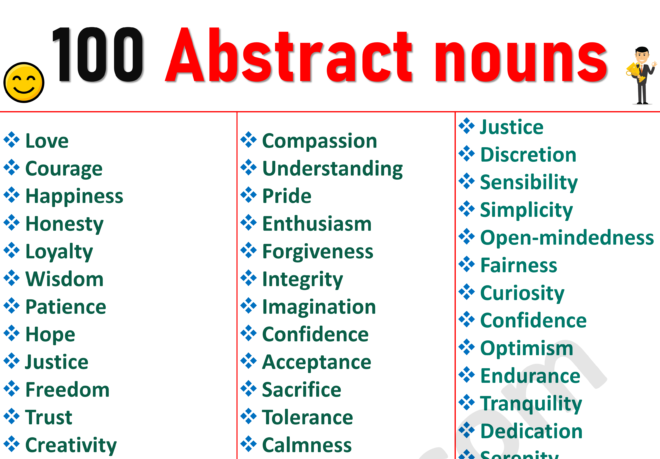
An abstract noun names something the senses cannot reach: a feeling, a quality, an idea, a state, or an experience. Unlike a concrete noun, it labels a thought rather than a physical object. Abstract nouns example sentences show how the word functions inside everyday English.
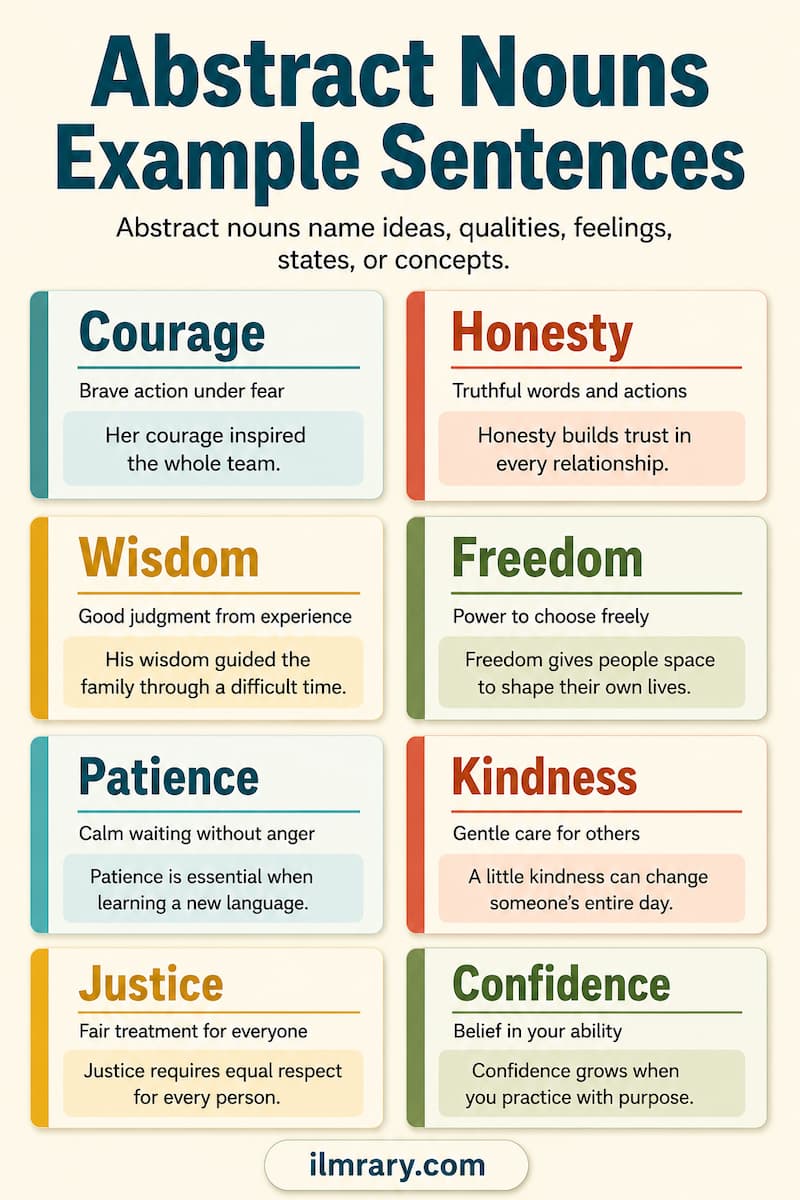
Quick Answer
Abstract nouns example sentences show this kind of word at work: Her kindness changed our day, We need patience with new learners, Their freedom came at a cost. Each abstract noun names a feeling, a quality, an idea, a state, or an experience the senses cannot reach. The most common are love, honesty, freedom, childhood, happiness, and knowledge.
Common Abstract Nouns With Sentence Examples
The most-used abstract nouns name a few core groups: emotions like love and anger, qualities like honesty and patience, states like freedom and poverty, ideas like justice and democracy, and experiences like childhood and adventure. The table maps the most common ones to their meaning and one model sentence.
| Abstract noun | Meaning | Example sentence |
|---|---|---|
| Love | Deep affection | Love changes how people see the world. |
| Honesty | Telling the truth | Honesty is the best policy. |
| Courage | Bravery in fear | Her courage saved three lives. |
| Freedom | Liberty to act | They fought for freedom. |
| Happiness | A state of joy | True happiness comes from within. |
| Knowledge | What a person knows | Knowledge opens new doors. |
| Patience | Calm waiting | Teaching kids takes patience. |
| Kindness | Gentle care for others | Her kindness helped a stranger. |
| Fear | Feeling of dread | Fear of failure stopped him. |
| Wisdom | Deep understanding | Wisdom comes with experience. |
| Trust | Belief in someone | He earned my trust over time. |
| Hope | Belief in a good future | Hope kept the family together. |
| Childhood | Early years of life | Her childhood was happy and quiet. |
| Justice | Fair treatment | The court delivered justice at last. |
| Friendship | A bond between friends | Their friendship lasted fifty years. |
A wider mix of abstract nouns example sentences spreads that set across everyday English:
- Love is patient and kind.
- His honesty made him a trusted friend.
- The team showed real courage under pressure.
- A sense of freedom filled her on the open road.
- Happiness is a quiet morning at home.
- She gained knowledge through years of study.
- The doctor’s patience calmed every patient.
- Kindness costs nothing and means everything.
- His fear of public speaking faded with practice.
- The old farmer’s wisdom guided the whole village.
- I lost all trust in that brand last year.
- Hope carried them through a difficult winter.
- Her childhood in the mountains shaped her career.
- The judge’s ruling restored justice for the family.
- Their friendship began on the first day of school.
- A wave of anger swept across the crowd.
- The painting showed real beauty in its detail.
- Peace returned to the village after the storm.
- His sudden success surprised even his parents.
- A spark of curiosity kept the child asking questions.
- The young writer found inspiration in old letters.
- Loyalty matters more than money to him.
- The team’s determination broke every record.
- Her grief lasted through the long winter.
- Faith carried people through impossible days.
Abstract Nouns for Emotions in Sentences
The rule. Emotion abstract nouns name an internal feeling: love, anger, joy, fear, sadness. The reader cannot touch them, only feel them. Most stay singular and uncountable: you say much joy, not many joys.
- Her love for music started in childhood.
- A sudden wave of anger filled the room.
- Joy spread across his face when he saw her.
- The child’s fear of the dark slowly faded.
- A deep sadness settled over the family.
- His excitement about the trip was hard to hide.
- Surprise appeared on every face at the door.
- Her disappointment showed in a quiet sigh.
- A flash of jealousy caught him off guard.
- The team felt real pride after the win.
- Hope kept her writing through every rejection.
- The teacher noticed his frustration with the puzzle.
- A sense of calm returned after the storm passed.
- Her enthusiasm for the project lifted the whole team.
- Loneliness hit him hard during the first month abroad.
- Compassion for stray animals shaped her career.
- His grief for his father lasted years.
- Affection for the puppy grew within a week.
Abstract Nouns for Qualities and Character Traits in Sentences
The rule. A quality abstract noun names what a person, place, or thing is like inside: honesty, courage, patience, kindness. Many come from adjectives by adding a suffix: kind becomes kindness, brave becomes bravery.
- Honesty is the foundation of every friendship.
- His courage under fire earned him a medal.
- The nurse showed remarkable patience with every child.
- Her kindness to strangers became her calling card.
- The witness’s integrity held up under hard questions.
- A teacher’s generosity with time matters more than gifts.
- Loyalty to family runs deep in their culture.
- Her modesty kept her from claiming credit.
- The mayor’s arrogance cost him the next election.
- His quiet humility surprised everyone in the room.
- A child’s innocence lit up the photograph.
- The judge praised the lawyer’s diligence on the case.
- Her creativity turned a small studio into a gallery.
- Sincerity matters more than polished words.
- The coach’s discipline shaped a winning team.
- A grandmother’s wisdom guided three generations.
- His stubbornness ended the negotiation early.
- Curiosity keeps a scientist asking better questions.
Abstract Nouns for States and Conditions in Sentences
State abstract nouns name a condition a person, place, or thing is in: poverty, wealth, health, sickness, freedom, captivity. They describe a way of being rather than a feeling or quality.
- Freedom of speech protects every citizen.
- The country struggled with deep poverty for decades.
- His wealth grew through small, patient choices.
- Health is harder to keep than to lose.
- A year of sickness taught him to slow down.
- The village lived in quiet peace for generations.
- Chaos broke out in the markets after the news.
- Their safety mattered more than the schedule.
- A sense of calm returned to the office on Friday.
- Hunger drove the family to new shelters.
- The painting captured the stillness of dawn.
- Confusion filled the new students’ faces.
- Equality between workers is written into the law.
- A short period of silence followed the announcement.
- Independence came to the country in 1947.
Abstract Nouns for Ideas, Concepts, and Beliefs in Sentences
These abstract nouns name larger ideas a culture or person holds: democracy, justice, truth, philosophy, faith. The reader cannot point at one in the world; the word names a system or principle.
- Democracy rests on the voice of every citizen.
- The court delivered justice for the missing family.
- Truth is the first thing a witness owes the court.
- Her faith kept her steady through the loss.
- Equality under the law is a basic right.
- The book traces the history of capitalism.
- Theology has shaped human history for centuries.
- A sense of duty brought him back to the farm.
- Honour still matters to the older generation.
- Loyalty to the cause kept the group together.
- The committee debated questions of ethics.
- Philosophy asks the questions science cannot answer.
- Religion plays a central role in many homes.
- A new theory of economics spread through the universities.
- His belief in second chances changed many lives.
Abstract Nouns for Experiences, Events, and Moments in Sentences
Some abstract nouns name an event or an experience rather than a feeling or quality: birthday, holiday, wedding, journey, adventure. The event itself is real, but the word does not point to a physical object.
- Her seventh birthday is her favourite memory.
- The wedding took place by the lake at sunrise.
- A long journey taught him patience and quiet.
- Their first vacation abroad changed their plans for life.
- The adventure through the mountains lasted three weeks.
- A promotion at work brought a new sense of purpose.
- The funeral drew friends from across the country.
- A graduation photo hangs above her desk.
- His arrival in the city felt like a fresh start.
- The meeting with the editor changed the whole project.
- A surprise reunion after twenty years left them speechless.
- The celebration lasted until the early morning.
- Her interview for the job went better than expected.
- The annual festival brings the village together every spring.
- A small ceremony marked the end of training.
Abstract Nouns for Time and Stages of Life in Sentences
Time-related abstract nouns name a period, an age, or a passage you cannot see directly: childhood, youth, adulthood, future, past. The reader feels the period but cannot touch it.
- Her childhood in the countryside shaped her love of nature.
- The story is set during his youth in Paris.
- Adulthood brings bills the school never warned about.
- The future of the company looked bright that morning.
- He spoke about his past only with close friends.
- A long infancy in care left her with quiet habits.
- The present matters more than what comes next.
- Their adolescence was spent in the same boarding school.
- Old age brought him closer to his grandchildren.
- The history of the town runs back five hundred years.
- A new era of remote work began that year.
- The moment before the door opened felt endless.
Abstract Nouns Ending in -ness in Sentences
The pattern. Adding -ness to an adjective turns it into an abstract noun: kind becomes kindness, dark becomes darkness, happy becomes happiness. The new word names the quality the adjective described.
- Her kindness touched everyone at the shelter.
- Darkness fell over the valley by six.
- Happiness is built one quiet day at a time.
- His sadness after the loss was hard to hide.
- The stillness of the lake at dawn calms the mind.
- Forgiveness is harder than apology.
- Her boldness in the meeting opened a new project.
- A child’s shyness fades with a patient teacher.
- His politeness made the long interview easier.
- The garden’s freshness lifted everyone after the rain.
- Loneliness in a new city is real, even with phones.
- Her gentleness with the puppy surprised the family.
Abstract Nouns Ending in -ity in Sentences
Adding -ity to an adjective turns it into an abstract noun naming a quality or state: real becomes reality, creative becomes creativity, honest becomes honesty.
- The film captured the reality of life on a farm.
- Her creativity brought new energy to the studio.
- A child’s curiosity keeps every parent moving.
- Sincerity in a leader matters more than charm.
- His generosity with younger colleagues stood out.
- The team showed real flexibility under pressure.
- Diversity in the office strengthened every project.
- The judge respected the witness’s honesty.
- Equality between branches is written into the rules.
- Her ability with languages amazed the panel.
- The student’s maturity earned her a senior role.
- A sense of community held the neighbourhood together.
Abstract Nouns Ending in -tion or -sion in Sentences
The pattern. Adding -tion or -sion to a verb turns the action into an abstract noun: create becomes creation, decide becomes decision, discuss becomes discussion.
- The CEO’s decision changed the whole company.
- Open discussion of the budget cleared every doubt.
- Her devotion to the cause inspired the team.
- A short vacation put the family back on track.
- His education at three universities shaped his career.
- Inspiration for the novel came from a single photo.
- The invitation arrived a week before the wedding.
- Confusion filled the room after the announcement.
- Tradition holds the family together on holidays.
- The construction of the bridge took five years.
- Her expression told the whole story.
- The committee reached a final conclusion at midnight.
- His frustration with the rules ended in resignation.
- Compassion for the homeless drove her work.
- Suspicion about the email led to a full audit.
Abstract Nouns Ending in -ment in Sentences
Adding -ment to a verb names the result or process: commit becomes commitment, agree becomes agreement, enjoy becomes enjoyment.
- Her commitment to the team lasted through every season.
- The two leaders signed an agreement at noon.
- Real enjoyment of a book comes from a slow read.
- His achievement at such a young age impressed everyone.
- The announcement of the merger surprised the markets.
- Disappointment showed clearly on every fan’s face.
- A small adjustment to the rules solved the dispute.
- Encouragement from the coach kept the player going.
- The government raised taxes again this year.
- Her judgement in difficult cases earned her respect.
- Excitement for the launch filled the office.
- The arrangement of furniture changed the whole mood.
Abstract Nouns Ending in -ship, -hood, and -dom in Sentences
Each suffix names a state, condition, or relationship. The -ship ending names a bond or rank (friendship, leadership), -hood names a stage or group (childhood, brotherhood), and -dom names a state or domain (freedom, wisdom).
- Their friendship lasted through three continents.
- Her quiet leadership turned the team around.
- A long partnership between the brands ended last week.
- His citizenship came through after years of waiting.
- Her childhood in the village still shapes her writing.
- A strong neighbourhood watched out for every family.
- Adulthood arrived faster than he expected.
- A new sense of brotherhood grew among the trainees.
- Freedom of the press matters to every democracy.
- Old age brought him quiet wisdom.
- A new kingdom rose along the river.
- Boredom set in during the third week of rain.
Abstract Nouns Formed From Verbs in Sentences
The shift. Many verbs become abstract nouns by changing form or adding a suffix: believe becomes belief, die becomes death, live becomes life.
- His belief in second chances changed her career.
- A small act of kindness saved the day.
- Life after the move took a year to settle.
- Her death at ninety was peaceful and expected.
- Love sits at the centre of every good family.
- A quiet thought led to her best business idea.
- The doctor noticed a slow growth on the X-ray.
- Sleep is harder to find as deadlines pile up.
- The arrival of guests broke the long silence.
- A sudden failure of the system stopped trading.
- Movement through the crowd took twenty minutes.
- Her choice to study law surprised the family.
Abstract Nouns Formed From Adjectives in Sentences
Many adjectives turn into abstract nouns by adding a suffix or changing form: brave becomes bravery, strong becomes strength, true becomes truth.
- The soldier’s bravery earned her a national award.
- A man’s strength is tested in quiet moments.
- The witness chose to speak the truth in court.
- Her honesty with clients built a loyal practice.
- Beauty in nature inspired the entire collection.
- His anger at the news faded by evening.
- A sense of safety returned after the gates closed.
- Warmth between the two old friends filled the room.
- The team played with real freedom that night.
- Patience with new staff makes the office calmer.
- Her happiness at the news showed in every step.
- Wisdom from the older nurses guided the trainees.
Abstract Nouns Used as Subject and Object in a Sentence
An abstract noun takes the same positions in a sentence as any other noun. As the subject, the abstract noun starts the action. As the object, the abstract noun receives it.
Abstract Nouns as the Subject
- Honesty is the best policy.
- Patience wins long arguments.
- Love moves people in ways logic cannot.
- Fear stops a good idea before it starts.
- Hope kept the family going through three years of war.
- Justice arrived years too late for the village.
- Knowledge opens doors that money cannot.
- Trust takes years to build and seconds to lose.
- Kindness changes a hard day faster than advice.
- Freedom comes with real responsibility.
Abstract Nouns as the Object
- The community values honesty in its leaders.
- She showed great patience during the long interview.
- He found new love in his second marriage.
- The team earned national respect that season.
- The judge demanded truth from every witness.
- She remembered her father’s kindness every winter.
- The country gained full independence in 1962.
- Children learn discipline through small daily habits.
- The film captured pure joy in its final scene.
- He has earned my trust through quiet, steady work.
How Do You Use Abstract Nouns in a Sentence
The pattern. An abstract noun takes the same position as any other noun: subject, object, or the noun after a preposition. Most sentences place it in one of those three roles.
Start with the abstract noun as the subject and the sentence runs around it: Patience teaches a child more than rules. Move it to the object slot and a different verb leads: Every parent needs patience. Add a preposition and the noun finishes the phrase: She raised four children with quiet patience. The same word fills all three roles without changing form.
- Bravery carried the firefighters through the worst hours.
- Every leader needs wisdom more than charm.
- The class learned respect from a single quiet teacher.
- Patience with strangers makes a city kinder.
- She wrote her thesis on the history of democracy.
- The hospital depends on trust from every patient.
- His career rests on years of quiet dedication.
- Honesty between partners saves more marriages than counselling.
- The judge ruled in favour of justice for the workers.
- Courage under pressure built her reputation.
- Without hope, a long winter feels impossible.
- The film deserves real recognition from the academy.
FAQs
What is an abstract noun with an example sentence?
An abstract noun is a word for something the senses cannot reach: a feeling, a quality, an idea, a state, or an experience. Common examples are love, honesty, freedom, and childhood. For example: Her kindness changed our day.
What are 10 examples of abstract nouns in sentences?
Ten common abstract nouns in real sentences: Love is patient; Honesty is the best policy; Courage saved the climber; Freedom has a cost; Knowledge opens doors; Patience teaches more than rules; Hope kept the family going; Trust takes years to build; Justice arrived at last; Kindness changes a hard day.
What are 5 common examples of abstract nouns?
Five high-frequency abstract nouns are love, happiness, freedom, kindness, and wisdom. Each one names a feeling, a quality, or a state the senses cannot reach. For example: True happiness comes from within.
What is the difference between abstract and concrete nouns?
A concrete noun names something the senses can reach, such as a book, a dog, or a city. An abstract noun names something only the mind can hold, such as love, honesty, or freedom. The split rests on whether you can see, touch, hear, taste, or smell what the word names.
How do you identify an abstract noun in a sentence?
Ask whether the noun names something the senses can reach. If you cannot see, touch, hear, taste, or smell it, the word is an abstract noun. Look for nouns ending in -ness, -ity, -tion, -ment, -ship, -hood, or -dom, plus emotion, quality, and idea words like love and truth.
What are abstract nouns formed from adjectives?
Many abstract nouns come from adjectives by adding a suffix. Brave becomes bravery, strong becomes strength, honest becomes honesty, kind becomes kindness, real becomes reality. The new word names the quality the adjective described.
What are the main types of abstract nouns?
Abstract nouns fall into six common groups: emotions (love, anger), qualities (honesty, courage), states (freedom, poverty), ideas (democracy, truth), experiences (birthday, journey), and time stages (childhood, youth). Most words sit in one group, but a few cross two.
Are abstract nouns countable or uncountable?
Most abstract nouns are uncountable: love, honesty, freedom, patience. You say much love, not many loves. A few become countable when they name a specific instance: a happy childhood, two great fears, several beliefs. Treat each case on its own.
Can abstract nouns be used in the plural form?
A small group of abstract nouns takes the plural when used in a counted sense: hopes, fears, beliefs, memories, responsibilities. Most stay singular: you cannot say honesties or kindnesses in standard English without forcing the meaning.
What is the abstract noun for “brave,” “wise,” or “happy”?
The abstract noun for brave is bravery. The abstract noun for wise is wisdom. The abstract noun for happy is happiness. Adjectives turn into abstract nouns through suffixes like -y, -ness, -ity, or -dom.
What are common mistakes with abstract nouns?
The most common mistakes are using a plural for an uncountable abstract noun (honesties, kindnesses), pairing the wrong article (a wisdom, a courage), and confusing the abstract noun with its adjective form (Her kind helped us instead of Her kindness helped us). Check the part of speech before using.