Collective nouns in sentences name a whole group as one unit, so words like team, family, and crowd stand for many people at once. The group takes a singular verb when it acts together and a plural verb when its members act on their own.
Quick Answer
Common Collective Nouns in Sentences With Examples
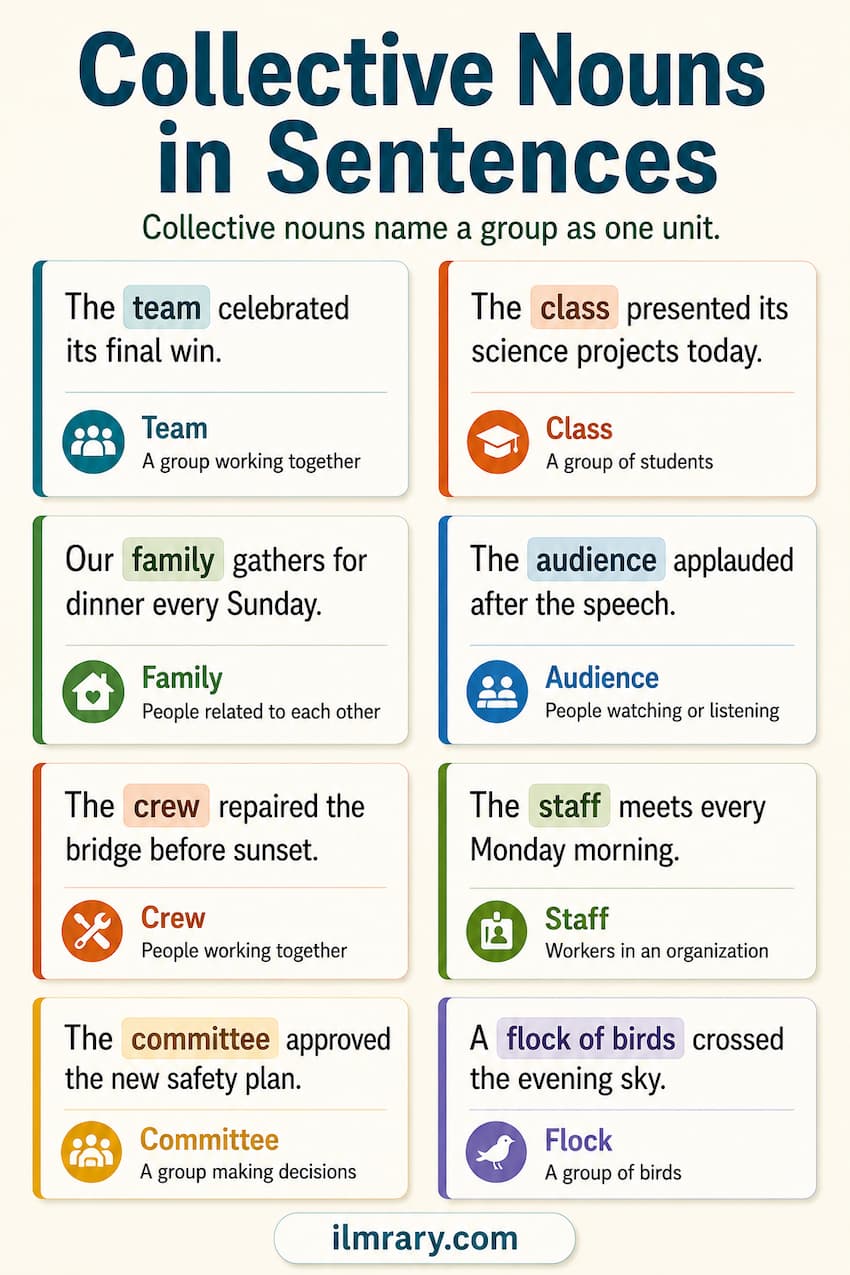
A collective noun names a group of people, animals, or objects gathered as one whole.
A collective noun names one group, so a team, a family, or a crowd counts as a single unit.
| Collective noun | Group it names | Example sentence |
|---|---|---|
| Team | A group of players | The team won the match. |
| Family | A group of relatives | The family ate dinner together. |
| Herd | A group of large animals | A herd of cows grazed nearby. |
| Bunch | A group of objects | She held a bunch of keys. |
- The team practices every morning.
- A family shares meals together.
- The class finished the project early.
- A crowd gathered outside the stadium.
- The committee meets on Fridays.
- A flock of birds flew over the lake.
- The herd moved toward the river.
- A crew loaded the boxes quickly.
- The choir sang a beautiful song.
- A jury reached its decision.
- The staff welcomed the new manager.
- A pack of wolves crossed the field.
- The audience clapped after the show.
- A band played in the park.
- The group worked on the report.
- A swarm of bees passed the window.
Collective Nouns for People in Sentences
These collective nouns name groups of people acting as one unit.
- The team trains after school.
- A family lives next door.
- The class listened to the teacher.
- A crowd filled the square.
- The committee approved the plan.
- A jury weighed the evidence.
- The staff prepared the report.
- A choir rehearsed for the concert.
- The crew repaired the engine.
- A board of directors met today.
- The audience waited for the band.
- A panel of experts answered questions.
- The government announced new rules.
- A troupe of dancers took the stage.
- The orchestra finished the symphony.
- A gang of workers cleared the road.
Collective Nouns for Animals in Sentences
These collective nouns name groups of animals in the wild or on a farm.
- A herd of elephants crossed the plain.
- The flock of sheep moved up the hill.
- A pack of wolves hunted at night.
- The school of fish darted away.
- A pride of lions rested in the shade.
- The swarm of bees circled the hive.
- A colony of ants built a nest.
- The litter of puppies slept together.
- A gaggle of geese crossed the road.
- The murder of crows settled on the roof.
- A shoal of fish filled the net.
- The troop of monkeys swung through the trees.
- A flock of birds landed on the wire.
- The herd of cattle returned at dusk.
Collective Nouns for Things in Sentences
These collective nouns name groups of objects gathered together.
- She held a bunch of flowers.
- A stack of books sat on the desk.
- The fleet of ships left the harbor.
- A set of tools lay on the bench.
- The pile of laundry grew taller.
- A collection of stamps filled the album.
- The series of lessons ended today.
- A bundle of letters arrived in the post.
- The range of products impressed buyers.
- A chain of islands stretched across the sea.
- The cluster of grapes hung from the vine.
- A string of lights brightened the hall.
- The batch of cookies cooled on the tray.
- A deck of cards lay on the table.
Collective Nouns With a Singular Verb
When the group acts as one, the verb is singular: the team wins.
- The team is ready for the final.
- The committee has made its decision.
- A family eats dinner at seven.
- The class starts at nine each day.
- The crowd moves toward the exit.
- The jury agrees on the verdict.
- The staff meets every Monday.
- The choir sings at the festival.
- A herd of cows grazes in the field.
- The board votes on the budget tonight.
- The audience claps at the end.
- The company plans to expand next year.
- The group works well together.
- A flock of birds flies south in winter.
Collective Nouns With a Plural Verb
Use a plural verb when the members act as separate individuals.
- The team are arguing among themselves.
- The family are going their separate ways.
- The staff are taking their holidays.
- The committee are divided on the issue.
- The crew are wearing their own uniforms.
- The jury are unable to agree.
- The class are finishing their tests.
- The band are tuning their instruments.
- The audience are returning to their seats.
- The group are sharing their ideas.
- The orchestra are packing up their gear.
- The team are eating with their families tonight.

Collective Nouns in British and American English
The verb after a collective noun shifts with the dialect you write in.
American English leans singular, while British English allows the team are as well as the team is.
Singular Verbs in American English
American English treats a collective noun as one unit and uses a singular verb.
- The team is winning the series.
- The government is passing a new law.
- The family is moving to a new city.
- The committee is meeting this week.
- The company is hiring more workers.
- The staff is working overtime.
- The band is releasing an album.
- The jury is still out.
Plural Verbs in British English
British English often treats the same noun as individuals and uses a plural verb.
- The team are winning the series.
- The government are passing a new law.
- The family are moving to a new city.
- The committee are meeting this week.
- The company are hiring more workers.
- The staff are working overtime.
- The band are releasing an album.
- Leeds United are signing a new player.
Collective Nouns With the Of Phrase
Many collective nouns join a second noun with of, as in a flock of birds.
- A flock of birds settled on the field.
- A herd of cattle blocked the road.
- A pack of wolves followed the trail.
- A bunch of keys hung by the door.
- A school of fish circled the reef.
- A pile of leaves covered the path.
- A set of dishes filled the cupboard.
- A fleet of trucks delivered the goods.
- A pride of lions guarded the cubs.
- A stack of plates wobbled on the shelf.
- A swarm of insects rose from the grass.
- A bundle of newspapers sat on the step.
- A colony of ants marched across the floor.
- A chain of mountains framed the valley.
- A bouquet of roses brightened the table.
- A panel of judges scored the contest.
Collective Nouns in Negative Sentences
Form the negative with doesn’t, isn’t, or hasn’t before the verb.
- The team doesn’t practice on Sundays.
- The family isn’t ready to leave.
- The class hasn’t finished the test.
- The committee doesn’t agree on the date.
- The crowd isn’t moving any faster.
- The staff hasn’t received the memo.
- The choir doesn’t perform in summer.
- The jury hasn’t reached a verdict.
- The board doesn’t meet in August.
- The crew isn’t on the ship yet.
- The audience doesn’t seem interested.
- The herd hasn’t returned to the barn.
Collective Nouns in Questions
Form a question with does, is, or has before the collective noun.
- Does the team play this weekend?
- Is the family coming to dinner?
- Has the committee made a decision?
- Does the class start at eight?
- Is the crowd getting bigger?
- Has the staff been told?
- Does the choir rehearse on Tuesdays?
- Is the jury ready to return?
- Does the company offer training?
- Has the crew finished loading?
- Is the audience allowed to record?
- Does the herd move at dawn?
Pronouns With Collective Nouns in Sentences
Use it for the group as one unit and they for the members as individuals.
- The team lost its first match of the season.
- The committee published its report.
- The family sold its old house.
- The company changed its logo this year.
- The jury gave its verdict to the judge.
- The band released its new single.
- The team collected their medals one by one.
- The staff brought their own lunches.
- The crew wore their safety gear.
- The class handed in their essays.
- The choir practiced their parts at home.
- The group shared their results with us.
How Do You Use a Collective Noun in a Sentence
Place the collective noun as the subject, then match the verb to its meaning.
- Put the collective noun first as the subject: The crowd cheered loudly.
- Use a singular verb when the group acts as one: The team plays tonight.
- Use a plural verb for individual actions: The team are changing into their kits.
- Add an of-phrase to name the members: A herd of deer crossed the road.
- Match the pronoun to the meaning: The company raised its prices.
- Keep the agreement consistent in one sentence: The board meets and gives its opinion.
- Choose singular in American English: The staff is on a break.
- Choose plural in British English when natural: The staff are on a break.
- Form the negative with doesn’t or isn’t: The choir doesn’t sing today.
- Form a question with does or is: Does the jury agree?
Frequently Asked Questions
What Is a Collective Noun?
A collective noun is a word that names a group of people, animals, or things treated as one unit. Example: The team won the match.
Are Collective Nouns Singular or Plural?
Collective nouns are treated as singular when the group acts as one unit and as plural when the members act individually. Example: The committee has decided. The committee are divided.
Is It The Team Is or The Team Are?
Both can be correct. American English prefers the team is, while British English allows the team are, especially when the players act as individuals.
What Is the Difference Between a Collective Noun and a Plural Noun?
A collective noun names a group as one unit, like team or flock. A plural noun shows more than one separate item, like players or birds.
Do Collective Nouns Use Singular or Plural Verbs in British and American English?
American English uses a singular verb with collective nouns, while British English uses a singular or plural verb. Example: The staff is meeting (US). The staff are meeting (UK).
What Are Some Examples of Collective Nouns?
Common collective nouns include team, family, class, crowd, committee, jury, herd, flock, pack, and bunch. Example: A flock of birds flew past.
What Is the Collective Noun for a Group of Birds?
The general collective noun for birds is a flock. Some birds have their own terms, such as a murder of crows and a parliament of owls.
Can a Collective Noun Be Plural?
Yes, a collective noun can be made plural like most nouns when you mean more than one group. Example: Three teams entered the tournament.
Which Pronoun Do You Use With a Collective Noun?
Use it for the group acting as one unit and they for the members acting individually. Example: The band released its album. The band packed their bags.
What Collective Nouns Are Always Plural?
A few collective nouns always take a plural verb, including police, people, and cattle. Example: The police are searching the area.
How Do You Use a Collective Noun in a Sentence?
Place the collective noun as the subject and match the verb to its meaning. Use a singular verb for the group as one unit. Example: The class studies grammar on Mondays.
Why Do The Team Is and The Team Are Both Sound Correct?
Both sound correct because English allows agreement by meaning, not just form. When the group feels like one unit, use is. When it feels like separate people, use are.