
Nobody gets credit for hearing something, only for what followed, and another word for listening has to show that. The result is the part that survives.
Listening claims a virtue and reports no result. A recruiter reads it as a soft line unless a change follows in the next clause.
The act itself is a claim about attention. What you did with it is a claim about outcome, and a panel will only test the second.
Listening Synonyms for the Attention and for What Followed
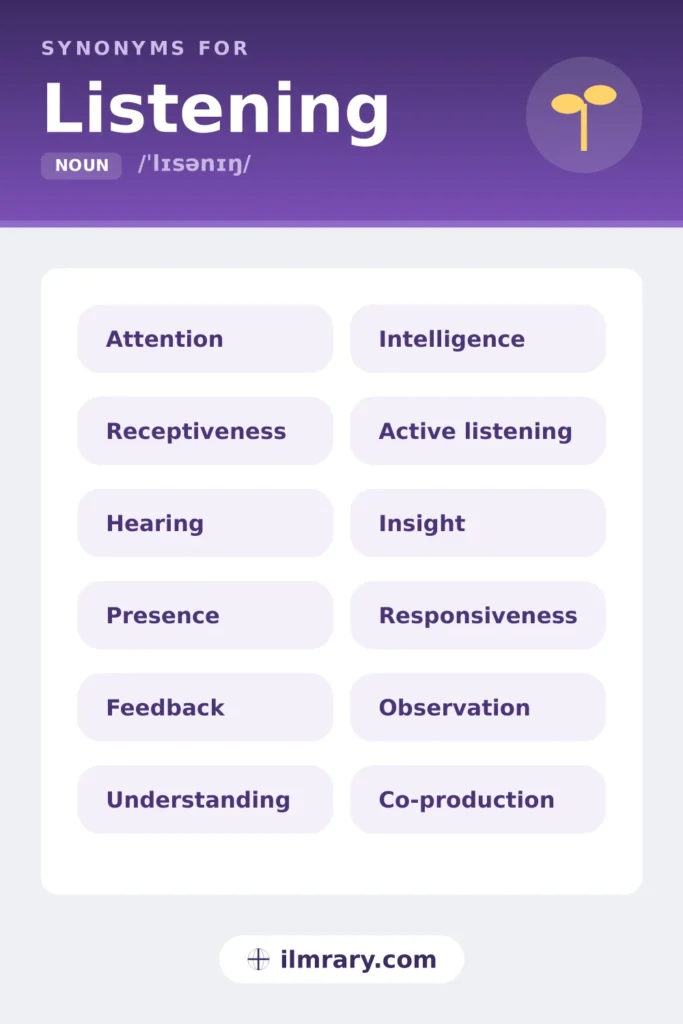
Words for the Attention Itself
Attention words describe the act. Observable behaviours are what evidence them, since attention is visible to the person speaking even when nothing follows.
Attention
Cover letter
Meaning
Concentrated notice given to somebody.
When to use it
It is the plainest word and the scarcest resource, since attention cannot be divided and everybody knows when it has been. Undivided is the qualifier that carries it.
- Attention rather than expertise was what the families said had been missing.
- Undivided attention for twenty minutes did what four appointments had not.
Active listening
Resume bullet
Meaning
A technique of reflecting back and checking understanding.
When to use it
It names specific behaviours that can be taught and observed, which makes it a skill claim rather than a personality one. Counselling and mediation training fix the method.
- Active listening training changed how the intake calls ran within a month.
- Active listening is a method rather than a manner, which the training made obvious.
Receptiveness
Cover letter
Meaning
Willingness to take in something you might not want to hear.
When to use it
It claims openness to the unwelcome, which is the only part of listening that is hard. People report on it accurately about others and inaccurately about themselves.
- Receptiveness to the criticism was what made the second draft work.
- Receptiveness was assumed and the staff survey measured otherwise.
Hearing
Cover letter
Meaning
Registering what was said.
When to use it
Shared with the meeting family in a formal sense. Here it is deliberately weaker than listening, since being heard and being listened to are what complaints distinguish between.
- They were heard and not listened to, which the complaint said in those words.
- Hearing the objection was not the same as answering it.
Presence
Cover letter
Meaning
Being fully there rather than partly elsewhere.
When to use it
Clinical and pastoral settings use it for the quality patients notice most, and it resists measurement entirely. Its value is that people can tell.
- Presence at the bedside was what the family remembered a year afterwards.
- Presence cannot be scheduled in six-minute appointments.
Observation
Resume bullet
Meaning
Noticing what is not being said.
When to use it
Shared with the observation family, where structured noticing is the technical sense. In conversation it names attention to the unspoken, which is where most of the information is.
- Observation of who did not speak in the meeting shaped the whole redesign.
- Observed the process for four shifts before proposing a single change.
Consultation
Resume bullet
Meaning
Asking for views before deciding.
When to use it
Shared with the communicate family, where the timing claim is testable. It is listening with a procedural obligation attached.
- Consulted two hundred residents and changed the route twice as a result.
- Consultation closed a week before the decision was published.
Words for What the Listening Produced
Outcome words are the only real evidence. Listening that changed nothing is indistinguishable from not listening, and readers apply that test instinctively.
Intelligence
Resume bullet
Meaning
Information gathered that informs a decision.
When to use it
It claims the listening had a purpose and produced something usable. Commercial and security usage is precise and the word travels well into service settings.
- Intelligence from the front line predicted the surge six weeks before the modelling did.
- Intelligence was collected and never reached anybody who could act on it.
Insight
Cover letter
Meaning
Understanding that reaches past what was said.
When to use it
Shared with the insight family, where market research has thinned the word. It claims you understood something the speaker had not articulated.
- The insight from the complaints data reframed the whole redesign.
- Insight was the word on the slide and the finding was a percentage.
Feedback
Resume bullet
Meaning
Views given back about something already experienced.
When to use it
Shared with the feedback family, where saying what changed is what stops it reading as a survey nobody read. It is listening that was solicited.
- Feedback from the pilot changed two questions before the rollout.
- Feedback was collected for three years and analysed in the fourth.
Understanding
Cover letter
Meaning
Grasp of what somebody actually meant.
When to use it
Shared with the knowledge family, where mechanism rather than recall is the claim. Demonstrating it means restating the other person's position in terms they accept.
- Understanding was demonstrated by restating the objection until they agreed it was theirs.
- Understanding of what the ward needed came from three nights rather than four meetings.
Responsiveness
Resume bullet
Meaning
Acting on what was heard, visibly and soon.
When to use it
It closes the loop, which is the part that decides whether anybody speaks up again. Speed matters less than visibility, since people need to see the connection.
- Responsiveness to the first three suggestions produced forty more.
- Responsiveness was measured by how long between raising something and hearing back.
Co-production
Cover letter
Meaning
Building something together with those who will use it.
When to use it
Shared with the engagement family, where shared authorship rather than shared opinion is claimed. It is the strongest possible evidence that listening happened.
- Co-produced the referral form with four service users and two clinicians.
- Co-production changed what the service measured, not only how it looked.
How to Choose the Right Synonym for Listening
Prove the listening with what followed. Attention words describe the act, and the observable ones are the evidence, since active listening names behaviours that can be taught and watched while presence names a quality people notice and nobody can measure. Receptiveness is the only hard part, because it claims willingness to take in something unwelcome. Outcome words are the real proof, and readers apply that test instinctively, so intelligence claims the listening produced something usable, responsiveness closes the loop that decides whether anybody speaks again, and co-production is the strongest evidence available because the people who talked helped build the result. Being a good listener claims a personality and evidences nothing.
What you heard and what moved are the two halves: active listening or receptiveness for the act, responsiveness or co-production for the proof that it counted.
Opposite Words for Listening
- Talking over
- Dismissing
- Tokenism
- Selective hearing
- Ignoring
Test Your Word Choice
Question 1: Which is the only genuinely hard part of listening?
Receptiveness means taking in something you would rather not hear, which is where listening actually fails. Attention is scarce and hearing is passive registration.
Question 2: Which decides whether anybody speaks up again?
Visibly acting on what was raised closes the loop, and people who see no connection stop raising things. Presence and observation are qualities of the listening itself.
Question 3: What distinguishes being heard from being listened to?
Complaints use exactly this distinction, since registering what was said and acting on it are different. Volume and audience are beside the point.
Listening Synonyms: Questions Recruiters Ask
What can I write instead of a good listener on a resume?
Replace a good listener with what you heard and what changed because of it. Feedback from the pilot rewrote two questions before rollout, or co-produced the referral form with four service users, both evidence the listening in a way the phrase never does.
Is active listening a real skill?
Active listening is a real skill because it names behaviours that can be taught, watched and corrected: reflecting back what was said, checking understanding before responding, holding the question open. Being a good listener names a personality trait instead, which nobody can teach and no reader can verify.
Why do people say they were heard but not listened to?
Saying you were heard but not listened to means somebody took the words in and changed nothing afterwards. The phrase appears in complaint files constantly, and it almost always describes a process that was followed to the letter while the outcome had been fixed beforehand.
What is the strongest evidence of listening on a resume?
Co-production is the strongest evidence of listening, because the contribution of the people who spoke is visible in the thing that was built. Reporting a consultation shows only that the meetings happened. Building the form with four service users shows whose words survived into it.