
Taking a problem up is not the same as passing it sideways, and resume synonyms for escalation say which. Recruiters read the two in opposite ways.
Escalated does not say which. It reads as trouble to some readers and as good judgement to others, and neither reading is safe.
Going up the line puts a name and a date on record. Going across to another team keeps the level and changes the owner, and a panel reads them differently.
Escalation Synonyms for Going Up and for Handing Across
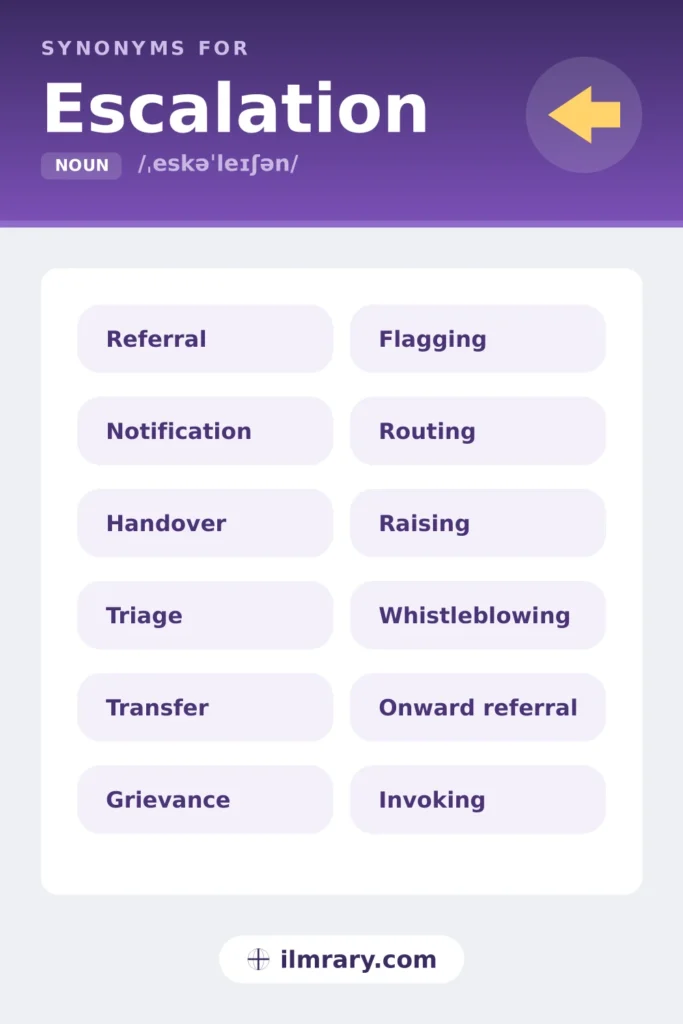
Escalation Words for Moving a Problem Upward
Upward movement asks somebody with more authority to act. The judgement is when to do it, and both hesitancy and reflex are recognised failures.
Referral
Resume bullet
Meaning
Sending a case to somebody better placed to handle it.
When to use it
It moves sideways to expertise rather than upward to authority, which is the distinction clinical and social care settings keep sharp. Volume and appropriateness are both measured.
- Referrals to the specialist team rose a third and the rejection rate halved.
- Referral routes had been unchanged for a decade and two of them led nowhere.
Notification
Resume bullet
Meaning
Formally telling a body that something has happened.
When to use it
A duty usually sits behind it and a clock usually starts with it, so timing is the checkable part. Regulators publish notification requirements and count breaches.
- Notified the regulator within the statutory window and led the response.
- Notification took four hours and the internal investigation took four months.
Flagging
Resume bullet
Meaning
Marking something so that somebody looks at it.
When to use it
Shared with the highlight family, where the matter stays unresolved by implication. It is the lightest form of raising something and leaves the responsibility ambiguous.
- Flagged the inconsistency in draft and the final version kept it.
- Flagged three risks and one of them arrived exactly as described.
Raising
Cover letter
Meaning
Bringing a concern formally to somebody's attention.
When to use it
It claims you spoke rather than that anybody acted, which is honest and often the whole of what you controlled. Records of when a concern was raised matter after the event.
- Raised the staffing concern at three consecutive governance meetings.
- Raised it early enough that the minutes settled the later argument.
Whistleblowing
Cover letter
Meaning
Reporting wrongdoing through a protected route.
When to use it
Legal protections attach to it, which makes it a specific act rather than a strong word for complaining. Using it loosely on a resume misdescribes both you and the situation.
- The whistleblowing policy was rewritten after the case and the volume rose.
- Whistleblowing protections applied and the investigation still took eighteen months.
Invoking
Cover letter
Meaning
Triggering a formal procedure that then takes over.
When to use it
It claims the process began rather than that you argued for it, which is a cleaner and more checkable statement. Contract clauses and emergency plans are what get invoked.
- Invoked the dispute resolution clause after two failed meetings.
- Invoked the business continuity plan for the first time in eleven years.
Grievance
Everyday
Meaning
A formal complaint raised by an employee.
When to use it
Employment procedure fixes it, and it names a specific route with defined stages. Describing an informal disagreement as a grievance misstates what happened.
- The grievance was upheld in part and the procedure was rewritten afterwards.
- Two grievances in a year prompted the review that found the rota fault.
Words for Handing Something On
Lateral movement passes work to somebody else without implying anything went wrong. Doing it cleanly is an underrated skill and an easy one to evidence.
Handover
Resume bullet
Meaning
Transferring work or responsibility to whoever takes it next.
When to use it
Shared with the deliver family, where the receiver accepting it is the real claim. Poor handovers cause more incidents than poor work does.
- Handed over the service with documentation the receiving team accepted unchanged.
- Handover ran across three shifts and nothing was dropped.
Triage
Resume bullet
Meaning
Sorting incoming work by urgency and routing it.
When to use it
Clinical origin and now used across service work, and it claims a decision under time pressure rather than an administrative sort. The criteria are what make it defensible.
- Triage moved the queue from three days to the same afternoon.
- Triage criteria were written down after the second complaint and never before.
Routing
Cover letter
Meaning
Directing work to the right place first time.
When to use it
It measures accuracy rather than speed, and misrouting is the hidden cost in most service operations. Wrongly routed cases are countable, which makes the improvement provable.
- Routing accuracy rose once the intake questions changed and rework halved.
- Routing sent a third of cases to a team that could not act on them.
Transfer
Resume bullet
Meaning
Moving a case or responsibility to another party entirely.
When to use it
It claims a complete move rather than shared handling, so the original holder is done. Records and consent both matter, which is why the word is formal.
- Transferred four hundred cases across the boundary change without a single loss.
- Transfer took a fortnight and the file audit took three months.
Onward referral
Cover letter
Meaning
Passing a case on again after already receiving it.
When to use it
It admits the case has moved more than once, which is usually a sign the routing is wrong. Counting them is how services find the fault.
- Onward referrals fell by half once the assessment happened at first contact.
- Onward referral was the norm and nobody had counted how often.
Stepping down
Everyday
Meaning
Moving something to a lower level of intervention.
When to use it
Health and social care use it for reducing the intensity of care, which is the opposite direction from escalation. It claims a judgement that less is now enough.
- Stepped down the intensive support after eleven weeks rather than at the review date.
- Stepping down was harder to justify than stepping up and better for the person.
Matching an Escalation Synonym to the Evidence
Say how far it went and who had to act. Upward movement carries a duty or a cost, so notification starts a regulatory clock, invoking triggers a procedure that then runs itself, and whistleblowing is a protected legal act rather than a strong word for complaining. Raising and flagging are the lightest forms and claim only that you spoke, which is often exactly what you controlled and worth recording. Lateral movement claims routing skill instead, so triage decides urgency under time pressure, handover claims the receiver accepted the work, and transfer claims a complete move rather than shared handling. Stepping down runs the other way entirely. Escalation covers the whole map and names no destination.
The destination and the duty are what a panel reads for. Notification or invoking where a clock started, triage or handover where the work moved sideways and nothing had gone wrong.
Opposite Words for Escalation
- Containment
- Resolution
- De-escalation
- Absorption
- Closure
Test Your Word Choice
Question 1: Which act starts a regulatory clock?
Notification formally tells a body something has happened, and a statutory window usually runs from it. Flagging marks something for attention and triage sorts incoming work by urgency.
Question 2: Which word is a protected legal act rather than a strong word for complaining?
Whistleblowing carries statutory protections and describes reporting wrongdoing through a defined route. A grievance is an employment complaint and raising claims only that you spoke.
Question 3: What does a high onward referral count usually indicate?
Cases moving more than once normally mean the first routing decision was wrong. High demand raises volume everywhere and good triage reduces onward movement rather than causing it.
Escalation Synonyms: What Panels Ask Next
What can I write instead of managed escalations?
Instead of managed escalations, name the destination and who had to act. Notified the regulator within the statutory window, invoked the dispute clause after two failed meetings, or cut onward referrals by half each say where the problem went. Escalation covers the whole map and names no point on it.
What is the difference between escalation and referral?
Escalation moves a problem upward to somebody with more authority, and referral moves it sideways to somebody with more expertise. Confusing the two makes a routine specialist handover read as a crisis, which a panel will notice. Onward referral is the version worth counting, since cutting it is a measurable claim.
Should I describe something as whistleblowing on a resume?
Whistleblowing belongs on a resume only where the act met the legislation that protects it. The word describes a protected legal act, not a strong term for complaining, and applying it to an internal disagreement misstates the situation and your position in it. Raised or flagged covers that case accurately.
Why is stepping down a case worth mentioning?
Stepping a case down is worth mentioning because reducing intervention is harder to justify than increasing it, and better for the person. Doing it on evidence rather than at a scheduled review is a judgement claim few applications ever make. Escalation runs one way; stepping down runs the other.