
How you came by what you know is the harder half of the claim, and other ways to say knowledge answer it.
Knowledge says a head holds something and stops. A course you sat and fifteen years on the job both produce it, and a panel wants the route.
How deep it goes is one question, and a test would settle it. Where it came from is the other, and a certificate or a job title settles that route.
Knowledge Synonyms for Depth of Knowing and for How It Was Got
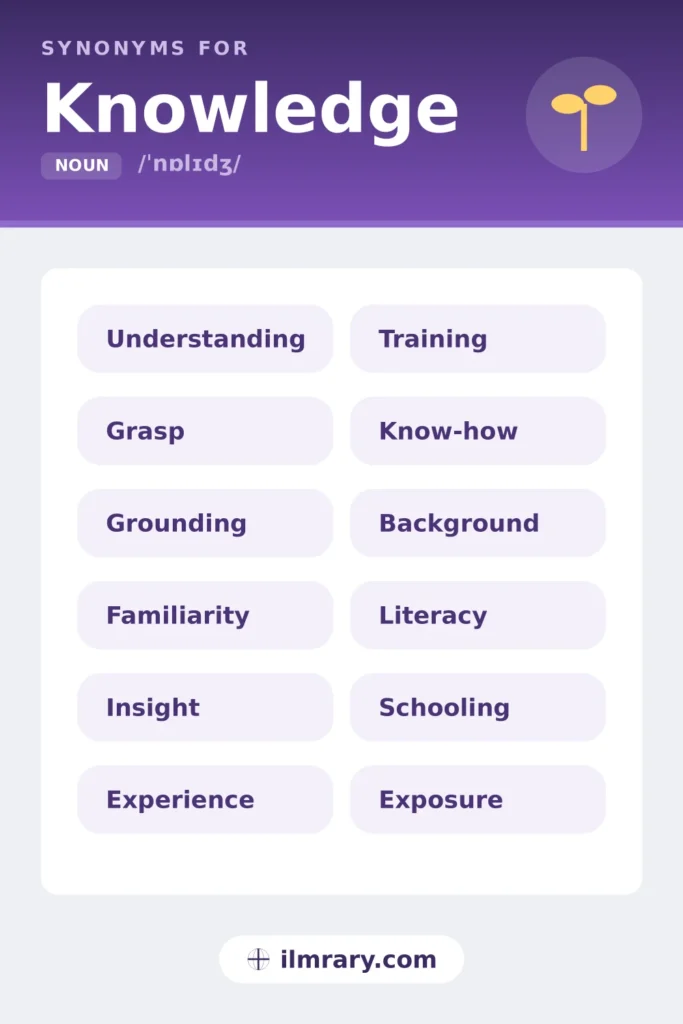
Knowledge Words for Depth of Knowing
Depth words grade how securely somebody holds a subject. Interviews test them within minutes, so overclaiming here is more visible than anywhere else on a resume.
Understanding
Cover letter
Meaning
Grasp of how and why something works.
When to use it
Mechanism rather than fact is the claim, which is why it survives questioning better than knowledge does. It promises you can reason about the subject rather than recall it.
- Understanding of how the funding formula responds to population change.
- Understanding rather than recall is what the assessment tested.
Grasp
Cover letter
Meaning
Firm hold on a subject, including its awkward parts.
When to use it
Slightly informal and confident, and it implies you can handle the exceptions rather than the general case. A firm grasp is the fixed phrase.
- A firm grasp of the exemptions is what made the advice usable.
- She had a grasp of the politics that the technical team lacked entirely.
Grounding
Cover letter
Meaning
Solid foundations in a subject, usually formally acquired.
When to use it
Training or education is implied, so it points at where the knowledge came from. British academic and professional writing use it more than American.
- A grounding in statistics that the rest of the policy team did not share.
- Grounding came from the first two years and everything since built on it.
Familiarity
Resume bullet
Meaning
Acquaintance with something through exposure.
When to use it
It concedes acquaintance rather than command, which is the honest word for tools you have used without mastering. Its modesty makes it credible.
- Familiarity with all four case systems and specialism in one.
- Familiarity was enough for the pilot and not for the rollout.
Literacy
Cover letter
Meaning
Enough working knowledge to read and use a field competently.
When to use it
Data literacy and financial literacy are the fixed phrases, and both mean a threshold rather than a level. It claims you can follow the argument rather than lead it.
- Data literacy across the whole management team was the point of the programme.
- Financial literacy was assumed and the accounts proved otherwise.
Insight
Cover letter
Meaning
Understanding that reaches past what is visible.
When to use it
It claims you saw something others did not, which needs the something to be nameable. Market research thinned it by attaching it to every finding.
- Insight from the complaints data reframed the whole redesign.
- Insight was the word on the slide and the finding was a percentage.
Command
Cover letter
Meaning
Confident control of a body of knowledge in use.
When to use it
Shared with the expertise family, where it suggests fluency under pressure. It is a performance claim rather than a storage claim.
- Her command of the regulations survived four hours of cross-examination.
- Command of the source material showed in every unprepared answer.
Words for How the Knowing Was Acquired
Provenance words say where the knowledge came from, which readers use to predict how it will behave under pressure. Learned on the job and learned in a classroom fail in different places.
Experience
Resume bullet
Meaning
Knowledge gathered by having done the work.
When to use it
Shared with the experienced family, and years attach to it, which makes it the most quantifiable noun here. Time proves exposure rather than quality.
- Nine years of experience across three regulatory regimes.
- Experience of two failed migrations shaped how she planned the third.
Training
Resume bullet
Meaning
Knowledge acquired through structured instruction.
When to use it
Formal, dated and usually certificated, so it is the most checkable provenance available. It says nothing about whether the training was ever used.
- Training in the statutory framework before the role required it.
- Training was thorough and the first real case bore no resemblance to it.
Know-how
Everyday
Meaning
Practical knowledge of how to make something work.
When to use it
Shared with the expertise family, where the workshop rather than the library is the source. It names the part that never got written down.
- Know-how from the old line kept the new one running through commissioning.
- Twenty years of know-how retired with him and the manual did not cover it.
Background
Cover letter
Meaning
The field somebody came from before this work.
When to use it
It explains rather than claims, which makes it right for career changes and unusual routes. Naming the transferable part is what stops it reading as a digression.
- A background in archaeology explained the patience with the records.
- Background in clinical work made the procurement arguments much shorter.
Schooling
Everyday
Meaning
Formal education taken in a subject.
When to use it
It points at institutions and years rather than capability, so it dates a person as much as it describes them. Slightly old-fashioned outside education itself.
- Schooling in the older conventions made the transition harder rather than easier.
- His schooling was in physics and his career was in policy.
Exposure
Resume bullet
Meaning
Contact with something without responsibility for it.
When to use it
The most modest provenance word available and the most honest for adjacent experience. It claims you were nearby rather than in charge.
- Exposure to board-level reporting through two years of committee work.
- Exposure was genuine and the accountability was somebody else's.
Choosing a Knowledge Synonym That Holds Up
Say how deep and say where from. Depth runs from familiarity, which concedes acquaintance, through literacy, which names a working threshold, to understanding and grasp, which claim you can reason about the subject and handle its exceptions. Command is the performance end, since it claims fluency under pressure rather than storage. Provenance runs from exposure, which admits you were nearby rather than responsible, through training, which is dated and checkable, to experience, which attaches years, and know-how, which names the part nobody wrote down. Background explains an unusual route and needs the transferable part named. Knowledge covers all of it and answers neither question, which is why the phrase about good knowledge of survives no interview.
Answer both questions in one word, familiarity or literacy where the claim is modest, understanding or command where it is not, and name the source beside it.
Opposite Words for Knowledge
- Ignorance
- Inexperience
- Unfamiliarity
- Misconception
- Guesswork
Test Your Word Choice
Question 1: You have used all four systems and mastered one. Which noun is honest for the other three?
Familiarity concedes acquaintance through exposure rather than command. Command claims fluency under pressure and insight claims you saw something others missed.
Question 2: Which noun names knowledge that was never written down?
Know-how is practical knowledge of making something work, learned on the floor. Training is structured instruction and grounding implies formal foundations.
Question 3: Which noun admits you were nearby rather than responsible?
Exposure claims contact without responsibility. Experience claims you did the work and background names the field you came from.
Knowledge Synonyms: Questions Applicants Ask
What can I write instead of good knowledge of on a resume?
Replace good knowledge of with the depth you can defend: understanding where you can explain the mechanism, familiarity where you have used it without mastering it, grounding where formal training stands behind it. Each survives the follow-up question the original phrase invites.
What is the difference between knowledge and understanding?
Knowledge is what you can recall, and understanding is what you can reason from. Understanding survives an unexpected question about an edge case while recall usually does not, which is why interviewers design questions that separate the two within the first ten minutes.
Is exposure too weak a word to claim?
Exposure is honest rather than weak, and honesty about adjacent experience reads better than an inflated claim that collapses on the second question. Two years of committee exposure to board reporting is a real statement somebody can check with one phone call.
When should I mention a background in another field?
Mention a background in another field whenever the transferable part can be named. A background in archaeology means nothing on its own and a great deal beside the patience with incomplete records that came out of it.