
A skills list proves nothing on its own, and resume synonyms for skill decide how much it claims. The level is where applications overreach.
Skill sets no level. Somebody who has used a tool twice and somebody who teaches it both write the same line on a resume.
Top-end wording claims a level a test would settle. Grounding wording claims a start, and a panel matches the word against the years beside it.
Skill Synonyms for Top-End Command and for Grounding
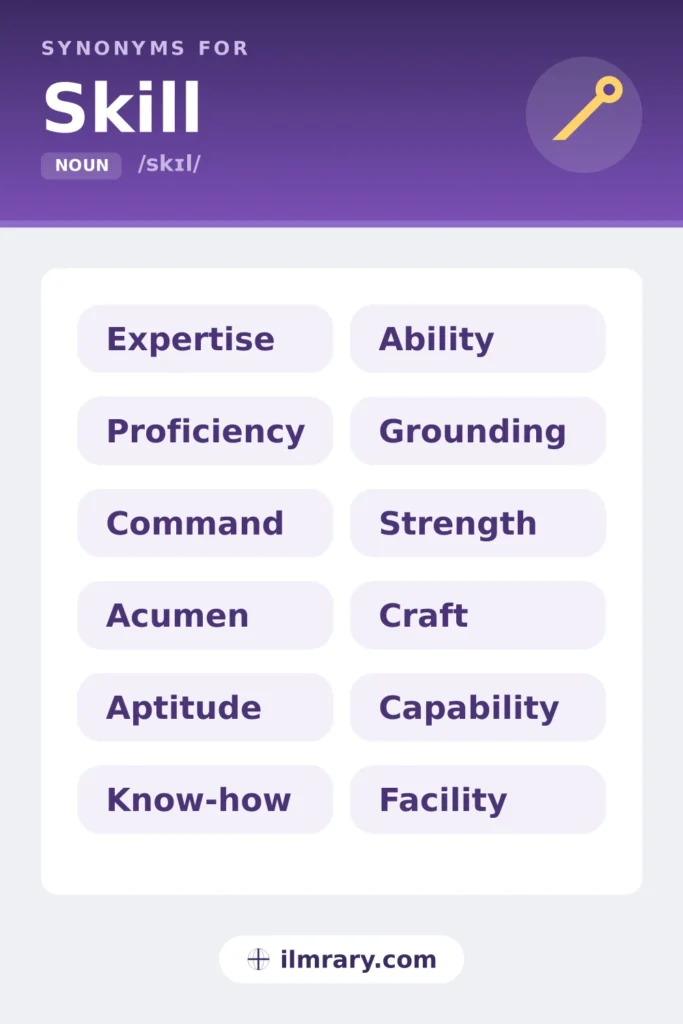
Stronger Words for Skill on a Resume
Recruiters scan this section for level, not for words. Every word here answers how good, and answers it without the word strong.
Expertise
Resume bullet
Meaning
Deep knowledge and ability built through long experience in one area.
When to use it
It claims years rather than training, so it needs a specialism attached. Expertise in nothing in particular reads as expertise in nothing.
- Twelve years of expertise in payments fraud across three regulated markets.
- Brought in for her expertise in migrating legacy pension systems.
Proficiency
Resume bullet
Meaning
A measured level of ability, high enough to work without supervision.
When to use it
The word language tests and certifications use, which is why it reads as verifiable rather than boastful.
- Proficiency in Python, SQL and dbt, verified through the internal assessment.
- Reached working proficiency in Spanish within the first year abroad.
Command
Resume bullet
Meaning
Confident control of a subject or a language.
When to use it
It suggests the subject does what you want rather than the other way round. Languages and technical stacks take it most naturally.
- A strong command of German gained across four years in Hamburg.
- Her command of the tax code shortened every review by a week.
Capability
Resume bullet
Meaning
What a person or an organisation is able to do.
When to use it
It describes capacity at a system level, so it suits bullets about what you built for others rather than what you personally know.
- Built the analytics capability from two contractors to a team of nine.
- The platform gave regional offices a reporting capability they had never had.
Acumen
Resume bullet
Meaning
Sharp judgement within a particular field.
When to use it
It claims decisions rather than knowledge, which is why business, commercial and financial are almost the only words that precede it.
- Commercial acumen that turned a loss-making line into a 14% margin.
- Her political acumen kept the programme funded through two reorganisations.
Fluency
Resume bullet
Meaning
Ease and speed in using a language or a system.
When to use it
Beyond languages it signals that a tool has stopped slowing you down, which is a real claim about pace rather than knowledge.
- Fluency in Mandarin, used daily with the Shanghai engineering team.
- Fluency across the Adobe suite, from first concept to print-ready file.
Technique
Resume bullet
Meaning
A specific method of doing something well.
When to use it
It names a repeatable procedure rather than general ability, so it belongs to crafts, sports, surgery and laboratory work.
- Refined the interview technique the whole research team now follows.
- Trained six juniors in the sampling technique before the audit.
Literacy
Resume bullet
Meaning
Working knowledge of a subject, enough to use it confidently.
When to use it
It sets a lower bar than proficiency and is honest about it, which makes it the right word for a working knowledge you do not want to overstate.
- Data literacy across the marketing team rose from 20% to 80% after the programme.
- Financial literacy sufficient to challenge the forecast rather than accept it.
It needs a qualifying word in front. Literacy alone means reading and writing. ❌
Competence
Resume bullet
Meaning
The ability to do something to an accepted standard.
When to use it
It sets the bar at adequate, and readers hear that. Regulated professions use it precisely, everyone else hears faint praise.
- Assessed against the nursing competence framework at band six.
- The audit confirmed competence across all four control areas.
Outside regulated fields it damns with faint praise. Say proficiency. ❌
Mastery
Resume bullet
Meaning
Complete control of a subject after long practice.
When to use it
The strongest claim on the page, and the hardest to evidence. It survives where the work itself proves it and collapses where it does not.
- Mastery of counterpoint evident across three published arrangements.
- Twenty years brought a mastery of the process that no manual holds.
A claim nobody can check reads as a boast. Show the evidence or drop it. ❌
Formal Words for Skill in a Cover Letter
Cover letters explain how you got good at something, which changes the word. All four describe origin rather than level.
Aptitude
Cover letter
Meaning
A natural tendency to learn something quickly.
When to use it
It points at how fast you improve rather than where you stand now, which suits early-career letters where the ceiling matters more than the current level.
- An aptitude for statistics that took me from novice to lead analyst in two years.
- The tests identified an aptitude for spatial reasoning.
Grounding
Cover letter
Meaning
Basic training that supports everything built on top of it.
When to use it
It credits the foundation rather than the finish, which explains a career change better than any level word can.
- A grounding in classics that made the legal drafting quick to learn.
- Her grounding in mechanical engineering shows in how she debugs software.
Strength
Cover letter
Meaning
A quality someone is reliably good at.
When to use it
The plainest way to name what you bring without ranking yourself, which is why it survives in appraisals and interviews alike.
- My strength is turning a stalled project back into a shipping one.
- Listening was the strength every reference letter mentioned.
Facility
Cover letter
Meaning
Natural ease in doing something.
When to use it
Formal and slightly old-fashioned, and it implies the thing costs you no effort, which is a different claim from being good at it.
- A facility with numbers that colleagues relied on more than the spreadsheet.
- He had a facility for calming a room that could not be taught.
Everyday Words for Skill
Conversation and interviews take all six. Two of them credit nature over work, which is the opposite of what a resume should do.
Ability
Everyday
Meaning
The power or capacity to do something.
When to use it
The most neutral word available, which is its whole use. It makes no claim about level, source or evidence.
- The ability to read a room is worth more here than the qualification.
- She has the ability, she just has not had the chance yet.
Know-how
Everyday
Meaning
Practical knowledge of how to get something done.
When to use it
It values the doing over the theory, which is why trades and engineering use it and academic writing does not.
- The know-how sat with two engineers who had been there since the start.
- Plenty of theory in the room and very little know-how.
Craft
Everyday
Meaning
A skill built by long practice, usually one that produces something.
When to use it
It implies the work has a tradition and standards behind it, so writing, carpentry and film take it and spreadsheets do not.
- He learned the craft by rebuilding other people's furniture for a decade.
- Editing is a craft and nobody arrives good at it.
Talent
Everyday
Meaning
A natural ability that stands out without training.
When to use it
It credits birth rather than effort, which is generous about someone else and quietly self-defeating about yourself.
- The talent was obvious at fourteen; the discipline took another ten years.
- There is real talent in that intake.
On a resume it hands your work back to luck. Say expertise or proficiency. ❌
Flair
Everyday
Meaning
A natural and stylish ability at something.
When to use it
It adds style to talent, which is why design, cooking and writing take it and audit does not.
- A flair for headlines that the whole desk borrowed from.
- She had a flair for making difficult news land gently.
Too vague to evidence, and it reads as self-praise on paper. ❌
Dexterity
Everyday
Meaning
Skill in using the hands, or in handling something tricky.
When to use it
Literally about hands, and figuratively about handling awkward situations, which is why political dexterity is a phrase and political flair is not.
- The dexterity needed for the repair took months to build.
- He handled the committee with a dexterity nobody expected.
Telling the Skill Synonyms Apart
Decide first whether you are naming a level or an origin. Proficiency, competence and mastery all rank you, and they rank you low, adequate and highest, so pick honestly. Expertise and command claim years behind the level. Aptitude, grounding and facility explain where the ability came from, which is a cover-letter question rather than a resume one. Talent and flair credit nature over work, and on paper that quietly gives your own effort away.
A level you could be asked to prove is the one to name: proficiency, expertise, command. Talent and flair are for describing somebody else.
Opposite Words for Skill
- Inexperience
- Incompetence
- Weakness
- Shortcoming
- Ineptitude
Test Your Word Choice
Question 1: Your resume needs a word for a language you use daily at work. Which fits?
Proficiency states a level that can be assessed. Talent credits nature, and flair describes style rather than working ability.
Question 2: Which word sets the bar at merely adequate outside regulated professions?
Competence means meeting an accepted standard, and general readers hear faint praise. Expertise and command both claim more.
Question 3: You are explaining a career change from physics to finance. Which word carries it?
Grounding credits the foundation the new field is built on. Mastery overclaims, and dexterity is about hands or tricky handling.
Questions That Follow a Skill Claim
What is a professional word for skill on a resume?
Expertise and proficiency are the professional words for skill that rank highest on a resume, because both point at a level somebody could verify. Capability suits an ability you built into a team rather than one you hold yourself.
How do I describe skills on a resume without saying strong?
Describe skills on a resume by replacing the adjective with a noun that already holds the level. Proficiency in SQL says more than strong SQL skills, and expertise in payments fraud says more than either, because the level arrives without you asserting it.
What is the difference between skill and competence?
Skill describes an ability without setting a level, and competence sets the level at the accepted standard. Outside regulated professions that standard reads as adequate rather than good, which is why competence can quietly undersell work that mastery or expertise would describe accurately.
Is talent a good word to use on a resume?
Talent works when you are describing other people and works against you on your own resume, because the word credits natural ability rather than the training and practice behind it. Flair does the same thing, and a recruiter reads both as effort you never had to make.