
Writers hear two rules about said that contradict each other. What to say instead of said turns on which rule fits the line in front of you.
A tag like said stays invisible, and invisibility is its job. The reader follows who spoke without noticing the verb, which is exactly what a long conversation needs.
Noise is what the alternatives add, and a reader hears every bit of it. Whispered puts a volume on the line, snapped adds temper, and conceded records a point given up.
Said Synonyms From a Whisper to a Verdict
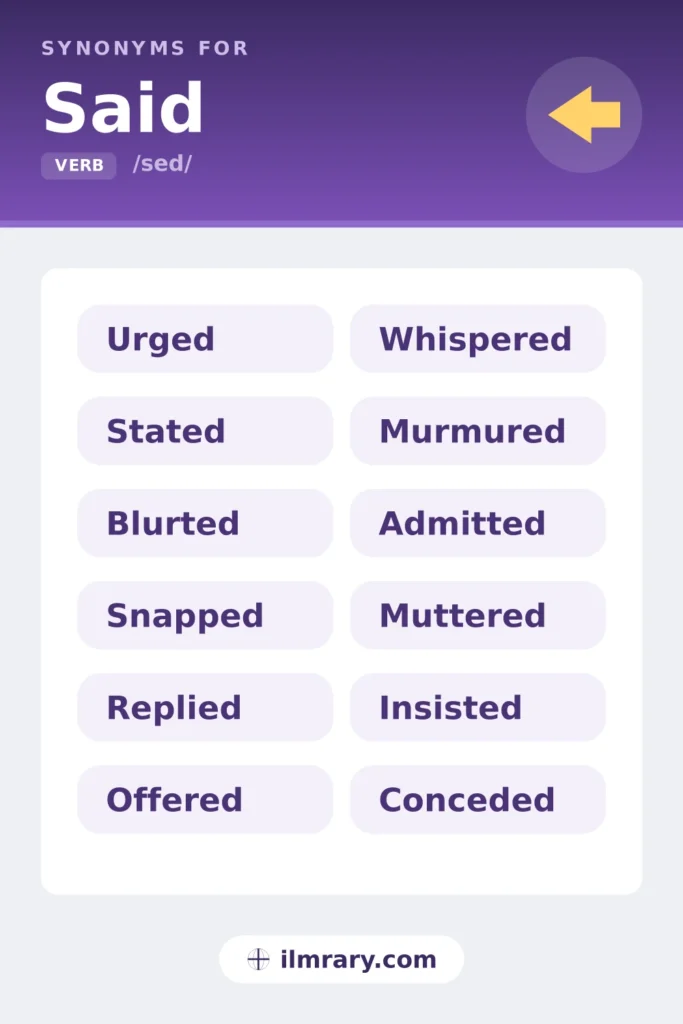
Said Synonyms That Set the Volume of a Line
Volume is the first quality a speech verb can add. From a whisper to a shout, each of these tells the reader how the words left the mouth.
Whispered
Everyday
Meaning
Spoke below the breath so only the nearest ear could catch it.
When to use it
Secrecy or tenderness, and the scene decides which. A whispered line pulls the reader closer to the page in either case.
- She whispered the name so the ward would not hear.
- He whispered that the buyers were already inside.
Murmured
Formal writing
Meaning
Spoke softly and evenly, more sound than sentence.
When to use it
Murmuring is softness without secrecy. Crowds murmur and so do lovers, which makes it the gentlest verb on the page. It is also the least exact about the words spoken, so it belongs where the sound counts for more than the sentence.
- The gallery murmured when the verdict was read.
- She murmured something kind and left.
Muttered
Everyday
Meaning
Spoke low and half to yourself, meaning to be heard anyway.
When to use it
Resentment is the load it hauls. A character who mutters is complaining without the courage of a complaint, and readers grasp that in one word.
- He muttered that nobody had asked him.
- She muttered her way through the washing-up.
Blurted
Spoken
Meaning
Let the words out before judgement could stop them.
When to use it
Timing gone wrong, in one verb. Blurted tells the reader the speaker regretted the sentence while still finishing it.
- He blurted the price before the seller could name hers.
- She blurted out the surprise a week early.
Snapped
Everyday
Meaning
Spoke short and sharp out of temper.
When to use it
One verb of temper outperforms a paragraph of description. Snapped is best rationed to the moment patience actually breaks, or every page reads angry.
- Fine, she snapped, and the room went quiet.
- He snapped at the intern and apologised within the minute.
Announced
Formal writing
Meaning
Spoke for the whole room to hear, claiming the moment.
When to use it
Scale is the claim. People announce engagements and resignations, so the verb hands one line ceremony, and lending it to small news plays as comedy.
- She announced the closure to a silent floor.
- He announced that dinner was, at last, served.
Urged
Formal writing
Meaning
Pressed somebody toward an action with force behind the words.
When to use it
Urging is pressure with warmth still in it. The verb reports effort, so it suits speeches and appeals, where what was said was meant to move someone.
- Doctors urged the council to fund the clinic another year.
- She urged him to take the train instead.
Words for What the Speaker Was Trying to Do
Stance verbs report the move a speaker made. Admitting, insisting and conceding are turns in an argument, and the verb keeps the score.
Replied
Everyday
Meaning
Spoke in answer to what had just been said.
When to use it
Direction is all it adds, and often that is enough.
- Not today, she replied, and shut the hatch.
- He replied by return of post.
Admitted
Spoken
Meaning
Said a thing that cost the speaker something to say.
When to use it
Reluctance is priced in. Admitted tells the reader the sentence went against the speaker's interest, which is why courtrooms and confessions turn on it.
- He admitted the figures had been rounded up.
- She admitted, at last, that the letter was hers.
Insisted
Everyday
Meaning
Held a claim in the face of doubt or refusal.
When to use it
Repetition against resistance. Insisted only makes sense when somebody has pushed back, so the verb quietly tells the reader the exchange is a contest.
- She insisted the door had been locked at nine.
- He insisted on paying for both.
Conceded
Formal writing
Meaning
Gave up a point the other side had won.
When to use it
Scorekeeping made visible. Conceded records that an argument moved, which is why essays and match reports both need it, and it dignifies the speaker rather than shaming them.
- The minister conceded that the target would be missed.
- Fair point, he conceded, and moved on.
Stated
Formal writing
Meaning
Put something on the record in level, deliberate words.
When to use it
Flat by design. Stated strips feeling out, which is its work in reports and witness accounts, and exactly why dialogue written with it goes cold.
- The witness stated that the van was white.
- The policy states the refund window twice.
Also used for Claim
Offered
Spoken
Meaning
Put words forward gently, leaving room for them to be declined.
When to use it
Tentative and kind. Offered suits condolences and suggestions, where the speaker hands the listener something they are free to set down.
- It gets easier, she offered, though she doubted it.
- He offered that the dates might be wrong.
Repeated
Everyday
Meaning
Said the same words again, and made the second time count.
When to use it
The second saying is never neutral. Repeated signals patience wearing thin, or grief circling back, or a witness holding a line, and the scene decides which.
- She repeated the question until he looked up.
- He repeated the address slowly for the operator.
Choosing a Said Synonym Without Overwriting the Line
Said is the control against which every replacement gets measured. The volume verbs change what a reader hears: whispered and murmured pull the scene close, snapped and announced push it loud. The stance verbs change what the exchange means, since admitted, insisted and conceded track who is winning an argument, and offered and urged track who is giving ground kindly. That is also the danger. A speech verb interprets the line for the reader, and a page where every line arrives interpreted reads like a stage direction. Fiction editors defend said because it disappears, and dialogue works best when the words, not the verbs, do the talking.
Said can carry the traffic of a conversation, and the stronger verbs belong where something changes. One snapped after forty saids reads like a slap, which is the arithmetic you want.
Opposite Words for Said
- Kept quiet
- Left unsaid
- Withheld
- Bit back
- Swallowed
Test Your Word Choice
Question 1: Which verb tells the reader the speaker regretted the line at once?
Blurting means the words escaped before judgement caught them. Stated is deliberate by definition and replied only marks whose turn it was.
Question 2: Which verb keeps score in an argument?
Conceding records that a point changed hands. Murmured sets a volume and announced sets a scale, and neither says who was winning.
Question 3: Which verb should carry most of an ordinary conversation?
Said disappears, so the reader stays on the words themselves. Urged and snapped interpret the line, and interpretation is spent sparingly or not felt at all.
Said Synonyms: Questions Writers Ask
What can I write instead of said in dialogue?
Instead of said, a volume verb such as whispered or snapped tells the reader how the line sounded. A stance verb such as admitted or insisted tells them what the line was doing. What to say instead of said depends on which of those the scene is missing.
Is it wrong to use said all the time?
Said all the time is closer to right than wrong, and most editors defend it. The verb vanishes, so the dialogue reads at speaking pace. Trouble only starts when every line also drags an adverb behind it doing work a better line would do.
Why do teachers say said is dead?
Teachers push variety through the said is dead poster because it builds vocabulary, and the exercise has value in a classroom. In finished writing the rule reverses. Editors restore said as the default, and the strong verbs stand out only because said surrounds them.
How often should a speech verb replace said?
A speech verb other than said belongs at the turning points, roughly a handful per scene. Volume or stance changes, somebody concedes or snaps, and the verb marks it. Between those moments said keeps the exchange moving at reading speed.
Which words instead of said work in formal writing?
Formal writing leans on stated, noted, confirmed and conceded, because minutes and reports need the record more than the sound. Whispered and snapped belong to scenes, and a report that reaches for them has started writing fiction.