
Grief and a grey Tuesday deserve different words, and synonyms for sad run the whole distance between them.
Sad covers a mood and a bereavement in one syllable. A condolence card and a rainy text both reach for it, and only one of them can afford the shrug.
Affording the right weight is the skill. Glum keeps a mood small and almost fond, mournful dresses sorrow formally, and devastated should be saved for the losses that earn it.
Sad Synonyms From a Rough Week to Real Grief
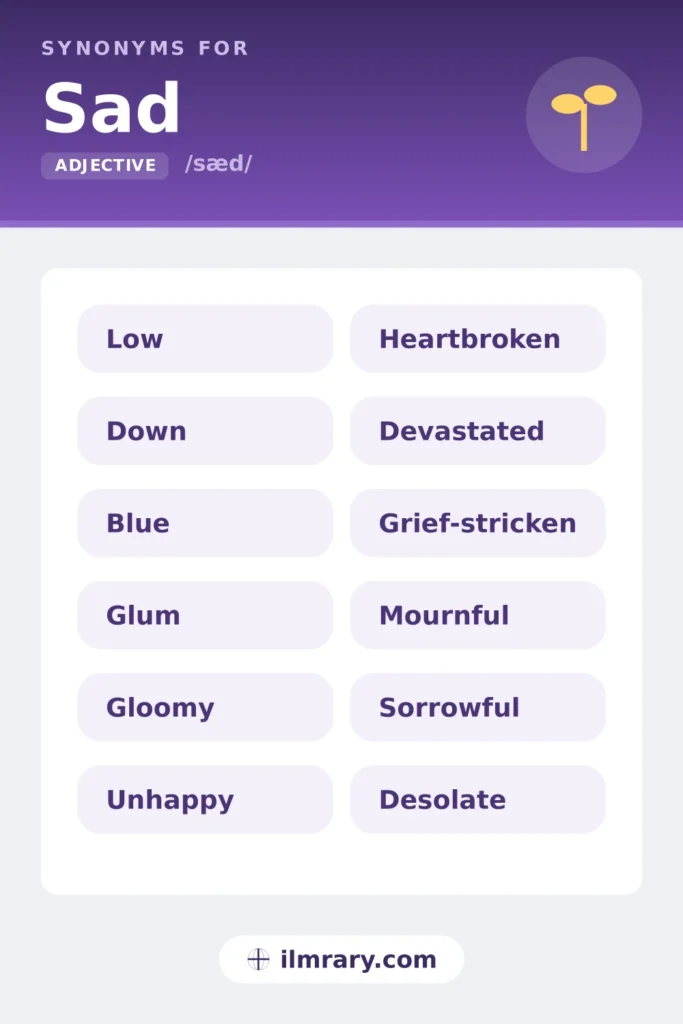
Sad Synonyms for Everyday Low Days
Low days need sayable words. Each of these keeps the sadness at a size a conversation can hold.
Unhappy
Everyday
Meaning
Not at ease with how life stands.
When to use it
The plain opposite of happy, and the most durable. Unhappy at work names a lasting state rather than a bad afternoon. Surveys use it because it measures without drama.
- She was unhappy in the new branch from week one.
- An unhappy compromise that suited nobody.
Also used for Happy
Down
Spoken
Meaning
Low in spirits for now.
When to use it
Casual and kind, the word friends reach for first.
- He has been down since the season ended.
- You sound down; come over.
Low
Everyday
Meaning
Quietly lacking energy and hope.
When to use it
Understatement with real range. Feeling low can name a rough week or shade toward something a doctor should hear, and listeners know to ask.
- She admitted she had been low all winter.
- A low mood settled over the camp after the news.
Blue
Spoken
Meaning
Touched with mild, almost musical sadness.
When to use it
Song vocabulary in daily speech. Feeling blue keeps sadness light and a little stylish, and greetings cards have loved it for a century.
- A blue mood followed the last box packed.
- He gets blue around the anniversary.
Gloomy
Everyday
Meaning
Dark in outlook, expecting worse.
When to use it
Weather for the mind. A gloomy forecast and a gloomy mood share the darkness, and the word points outward at the future.
- The meeting turned gloomy after the figures.
- A gloomy November suited the book he was writing.
Glum
Everyday
Meaning
Silently down in the mouth, visibly so.
When to use it
Small and visible. Glum shows on a face across a room, sadness at the scale of a cancelled match rather than a loss.
- The subs sat glum under one umbrella.
- A glum silence met the new rota.
Downcast
Formal writing
Meaning
Visibly dejected, eyes literally lowered.
When to use it
The posture is in the word. Downcast describes grief you can sketch, which is why reporters and novelists keep it.
- The team trooped off downcast but unbeaten.
- She looked downcast at the mention of the farm.
Words for Grief and Real Loss
Grief asks for words that respect its weight. These are spent rarely, like the days they name.
Heartbroken
Everyday
Meaning
Broken open by loss or love.
When to use it
The strongest everyday grief word. Heartbroken belongs to endings that reorganise a life, and small uses cheapen a word people need.
- Heartbroken letters filled the club's postbag.
- She was heartbroken and back at work by Thursday.
Devastated
Everyday
Meaning
Flattened by news or loss.
When to use it
Disaster vocabulary lent to feeling. Devastated claims total collapse for a time, and its overuse in speech has not yet dulled it on the page.
- The village was devastated by the closure.
- Devastated, he still gave the eulogy.
Grief-stricken
Formal writing
Meaning
Struck down by mourning.
When to use it
Grief as a blow. Grief-stricken describes the early days when loss still arrives physically, the obituary's exact word.
- The grief-stricken family asked for privacy.
- A grief-stricken city queued past the gates.
Mournful
Formal writing
Meaning
Expressing sorrow in sound, look or manner.
When to use it
Sorrow made audible. A mournful whistle and a mournful hymn perform the feeling, which is why music and processions own the word.
- A mournful horn sounded off the point.
- The final line of the log is brief and mournful.
Sorrowful
Formal writing
Meaning
Full of sorrow, in an older key.
When to use it
Scripture's cadence survives in it. Sorrowful suits elegy and liturgy, and everyday prose finds it a size too large.
- A sorrowful procession passed the shut mills.
- The statue's sorrowful face draws the visitors.
Desolate
Formal writing
Meaning
Emptied of comfort, person or place alike.
When to use it
Landscape and feeling in one word. A desolate platform and a desolate widow share the emptiness, and the doubling is the power.
- The house felt desolate with the clocks stopped.
- Desolate weeks followed the diagnosis.
Choosing a Sad Synonym That Matches the Loss
Weight is the whole question with sadness. The everyday set stays sayable. Down and blue keep it casual, low understates with real range, and glum and downcast make it visible at two formalities. Gloomy points the darkness at the future. Unhappy names the lasting state beneath a mood. The grief set should be spent rarely, like the days it names. Heartbroken and devastated claim collapse, and grief-stricken marks the early physical days. Mournful and sorrowful perform sorrow in sound and scripture, and desolate empties person and place with one word. Sad covers a cancelled match and a funeral, which is exactly the problem. A condolence deserves a word the weather could never take.
The weight of the loss picks the word. Sad can keep the middle of the scale, while glum and heartbroken hold the two ends honestly.
Opposite Words for Sad
- Happy
- Cheerful
- Content
- Joyful
- Lighthearted
Test Your Word Choice
Question 1: Which word points the darkness at the future?
Gloomy expects worse, in forecasts and moods alike. Glum shows on a face now and blue keeps the sadness light and musical.
Question 2: Which claim belongs to the early physical days of loss?
Grief-stricken describes mourning that still arrives as a blow. Down and low name passing and quiet lows, not bereavement.
Question 3: Which word empties places and people alike?
Desolate carries its landscape sense into feeling, emptiness in both. Mournful performs sorrow and unhappy names a lasting state.
Sad Synonyms: Questions People Actually Ask
What can I say instead of sad in a message?
Instead of sad, weigh the loss: down or low for a rough patch, gloomy for dark expectations, heartbroken or devastated only where life actually reorganised. The synonyms for sad divide by weight, and the reader feels a mismatch instantly.
Is sad too childish a word for serious writing?
Sad is not childish, and plain prose uses it to real effect exactly because it refuses drama. The word fails only at the extremes, where a cancelled match and a bereavement need different vocabulary, and the extremes are what this set supplies.
What should I write in a condolence message?
A condolence message works best plain and specific: name the person, one memory, one offer of practical help. Heartbroken and devastated belong to the bereaved rather than the messenger, so plain words dressed with a memory remain the honest choice.
How do I describe sadness in creative writing?
Sadness arrives through behaviour rather than labels: the unwashed cup, the coat kept on indoors, the reply two days late. One observed detail outworks any adjective on the scale, and readers trust what they see over what they are told.