
Saying sorry in public is a legal question as much as a human one, and apology synonyms are where the two meet.
Apology is the strongest word here. It admits fault outright, which is why lawyers spent years telling their clients to reach for anything else.
Expressing feeling concedes nothing. Accepting responsibility concedes a great deal, and a few words go further and offer to put the harm right. A panel hears the difference at once.
Another Word for Apology and What a Lawyer Would Allow
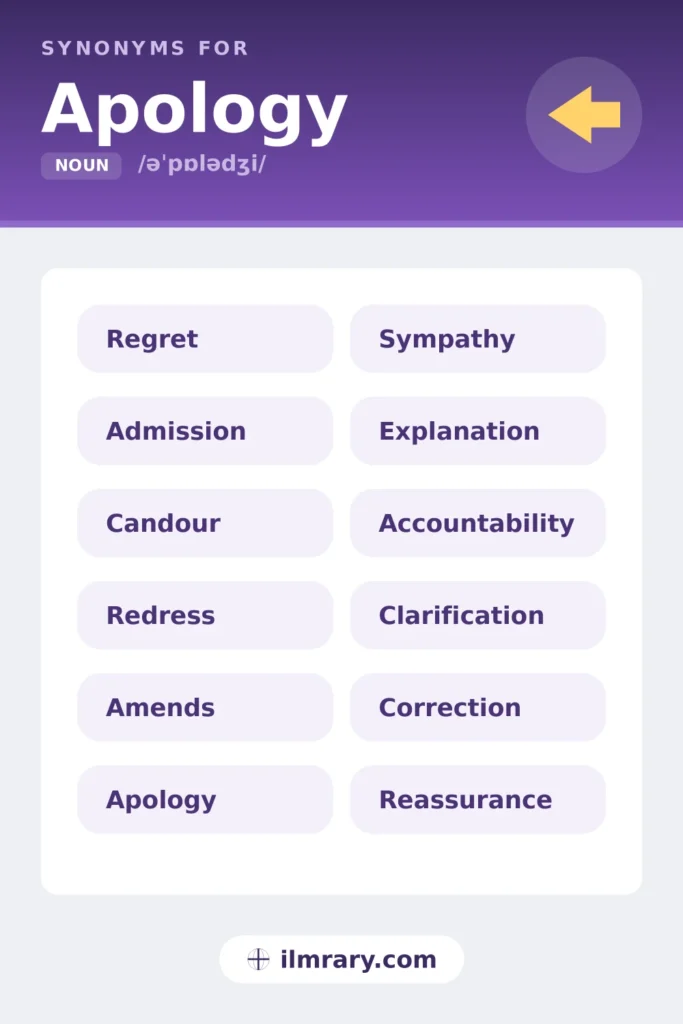
Apology Words That Stop Short of Fault
Partial forms acknowledge an experience without accepting responsibility for causing it. They are frequently what the situation warrants and frequently used where more was owed.
Regret
Cover letter
Meaning
Sorrow that something happened.
When to use it
It concedes feeling rather than fault, which is why the phrase we regret that has become a signal of exactly that. Genuine regret and defensive regret read identically on paper.
- The letter expressed regret and named no decision anybody had taken.
- Regret was expressed within a week and the apology took two years.
Acknowledgement
Resume bullet
Meaning
Accepting that something happened.
When to use it
It concedes the facts without conceding responsibility, which is often the honest first step while an investigation runs. Refusing even this is what turns complaints into claims.
- Acknowledgement within twenty-four hours changed how the whole complaint proceeded.
- Acknowledgement of the delay came before anybody knew whose fault it was.
Sympathy
Everyday
Meaning
Feeling for somebody in a difficult situation.
When to use it
It positions the speaker outside the events entirely, which is appropriate for misfortune and insulting for something you caused. The distinction is what recipients react to.
- Sympathy was offered for a situation the organisation had created.
- Sympathy where an apology was owed is what the ombudsman criticised.
Explanation
Resume bullet
Meaning
An account of how something came to happen.
When to use it
It is what most complainants actually want and what organisations most often withhold. An explanation without an apology reads as a defence and with one reads as candour.
- The explanation was the only thing the family had asked for and it took two years.
- Explanation and apology together closed a complaint that either alone had not.
Clarification
Cover letter
Meaning
Correcting a misunderstanding about what happened.
When to use it
It claims the problem was in the understanding rather than the events, which is sometimes true and usually heard as a refusal. Use it only where the facts genuinely support it.
- Clarification was issued and read by everybody as a refusal to apologise.
- A clarification that actually clarified, which is rarer than the word suggests.
Correction
Resume bullet
Meaning
Putting right something that was stated wrongly.
When to use it
It addresses the record rather than the harm, which makes it necessary and never sufficient. Publishing one with the same prominence as the error is the test.
- The correction ran in the same position as the original, which is the standard nobody meets.
- Corrections were issued quietly and the original figure kept circulating.
Reassurance
Resume bullet
Meaning
Telling somebody the problem will not recur.
When to use it
Shared with the persuade family, where it removes a fear rather than supplying a reason. Without a described change it is the least believed statement in any response.
- Reassurance came with the specific change that had been made, which is why it was believed.
- Reassurance without a change reads as the same letter everybody else received.
Words That Accept Responsibility
Full forms concede fault and usually cost something. Legislation in several places protects them from being treated as liability, which was the objection that held them back.
Apology
Resume bullet
Meaning
Saying sorry for something you were responsible for.
When to use it
The word itself now has statutory protection in several jurisdictions, which removed the legal argument against giving one. What remains is institutional reluctance.
- The apology named the decision and the person who made it.
- An apology in the first fortnight would have prevented a two-year complaint.
Admission
Cover letter
Meaning
Accepting that you were responsible.
When to use it
It concedes fault explicitly, which is why insurers historically resisted it. An admission and an apology are separable and are usually confused with each other.
- The admission was made in the report and the apology was made in person.
- Admission of the error preceded any finding about whose it was.
Candour
Cover letter
Meaning
Telling somebody plainly when something has gone wrong.
When to use it
Shared with the trust family, where healthcare made a duty of candour statutory. It requires you to tell people before they ask, which is what makes it demanding.
- The duty of candour was discharged before the family had raised anything.
- Candour about the delay preserved a relationship that concealment would have ended.
Accountability
Resume bullet
Meaning
Answering personally for an outcome.
When to use it
Shared with the accountability family, where it attaches to a named person. An apology from an organisation and accountability from an individual are different acts.
- Accountability sat with one director rather than a committee, which changed the pace.
- Accountability was collective, which meant nobody had it.
Redress
Cover letter
Meaning
Putting right a wrong somebody suffered.
When to use it
Shared with the accountability family, where it looks at the person harmed rather than the person at fault. Apology, explanation and remedy are its three usual components.
- Redress included a rewritten policy as well as a payment.
- Redress took two years and the family had asked only for an explanation.
Amends
Everyday
Meaning
Action taken to compensate for a wrong.
When to use it
It claims doing rather than saying, which is why making amends is the phrase. Slightly old-fashioned and it names the practical half that an apology alone leaves out.
- Amends were made quietly and mattered more than the statement did.
- Making amends took a year and the apology took a paragraph.
Which Apology Synonym Fits What You Did
Say how much is being conceded. Partial forms stop short of fault, so regret concedes feeling and has become the signal of a defensive statement, acknowledgement concedes the facts and is the honest first step while an investigation runs, and sympathy positions the speaker outside events entirely, which is appropriate for misfortune and insulting for something you caused. Explanation is what most complainants actually want and what organisations most often withhold. Full forms concede fault, and statutory protection in several jurisdictions removed the legal argument against apologising, leaving only institutional reluctance. Candour goes further by requiring you to tell people before they ask, and amends names the practical half that words alone leave out.
Concede what the situation warrants, acknowledgement or explanation while facts are unclear, apology and amends once responsibility is known.
Opposite Words for Apology
- Denial
- Deflection
- Silence
- Cover-up
- Blame-shifting
Test Your Word Choice
Question 1: What removed the legal argument against apologising?
Several jurisdictions legislated that an apology is not an admission of liability, which ended the objection. What remains is institutional reluctance rather than legal risk.
Question 2: Which positions the speaker outside events entirely?
Sympathy is what you offer somebody experiencing misfortune you had no part in, which is why it reads as insulting for something you caused. Regret concedes feeling and acknowledgement concedes facts.
Question 3: What do most complainants actually want?
Understanding how something came to happen is the most commonly stated request and the one organisations most often withhold. Compensation and resignations follow when explanation is refused.
Common Questions About Apology Synonyms
Does apologising admit liability?
Apologising does not admit liability in several jurisdictions, where legislation says so directly and removed the argument organisations leaned on for years. What remains is institutional reluctance rather than legal exposure, so an acknowledgement withheld on legal advice is now mostly withheld out of habit.
What is the difference between regret and an apology?
Regret concedes a feeling and an apology concedes fault, which is the entire distance between them. We regret that you feel upset has become the recognisable shape of the first, and recipients read it exactly as it was drafted, as a statement engineered to admit nothing.
What is the duty of candour?
The duty of candour is a statutory requirement in healthcare to tell people when something has gone wrong, before they ask. Telling somebody unprompted is the demanding part and also the part that works, because a family who learn of harm from a lawyer never trust the account afterwards.
Why does reassurance so often fail?
Reassurance fails because it promises without describing. Saying it will not happen again convinces nobody who has just been harmed, while naming the specific change, a second signature on every discharge, turns the same sentence into something the reader can check.